

Last updated September 28, 2026
What a clinic actually screens for
A transplant moves your own hair from a donor zone, usually the back and sides, into the thinning areas up top. It never adds hair, it only relocates what you already have. That single fact drives every candidacy decision a surgeon makes, and it is why a good clinic turns some men away instead of taking the booking. The screen is about supply, not desire.
Below is the short list of factors a consultation weighs, the rough numbers clinics work from, and where each one leaves a hair system. Read the first column as the factor, then follow it across. A hair system sits outside this math entirely because it never borrows from your donor.
| Candidacy factor | What a clinic looks for | What flags a not a candidate call | Hair system |
|---|---|---|---|
| Loss stage (Norwood) | Stable, patterned loss, often around stage 3 to 5 | Stage 6 to 7 with a thin donor, or fast unpredictable loss | Covers any stage, from a small area to the full scalp |
| Donor density | Roughly 65 to 85 follicular units per square centimeter | Below about 40 units per square centimeter leaves too little to harvest | Density is built to order, fully independent of your donor |
| Donor pattern | A firm permanent horseshoe band front to back | Diffuse unpatterned thinning that reaches into the donor zone | No donor zone is touched or needed |
| Supply vs demand | Lifetime graft supply, often cited near 5,000 to 8,000, covers the area | A large bald area that outstrips the grafts available to fill it | Coverage is limited only by base size, up to a full head |
| Scarring in the recipient area | Healthy skin that will hold and feed transplanted grafts | Scar tissue with poor blood supply that grafts struggle in | The base rests over scarring and covers it cosmetically |
The men clinics turn away most
Three groups hear no far more often than the rest, and they are the men we see most in our chairs in Peoria and Eighty Four. The first is diffuse thinning, where the loss is spread evenly rather than falling in the classic receding pattern. When the thinning reaches into the donor band itself, a pattern clinicians call diffuse unpatterned, there is no safe zone to harvest from, because the hair you would move is on its way out too.
The second is a limited or weak donor. Even with a normal pattern, some men simply carry a lower native density, closer to or under 40 follicular units per square centimeter in the donor, and a surgeon cannot pull grafts from a bank that thin without leaving the back visibly see through. The third is advanced stage loss, Norwood 6 or 7, where the bald area is so large that even a full lifetime graft supply cannot fill it convincingly. This is the point men describe as too far gone, and it is the same conversation as not a candidate, just from the other end.
The graft math nobody explains up front
A transplant is a fixed budget you can only spend once. Most donor zones yield somewhere in the range of 5,000 to 8,000 grafts across a lifetime of sessions, and every graft moved forward is gone from the back for good. A hairline and mid scalp rebuild on a stage 5 or 6 head can ask for more grafts than the budget holds, which is how a man with a genuinely healthy donor still ends up outside the candidate line.
Density is the other half. Native scalp hair grows at roughly 80 to 100 follicular units per square centimeter. A transplant almost never restores that. A strong result lands closer to 30 to 50 units per square centimeter in the rebuilt area, which reads as fuller but not as the density of your teens. A hair system is knotted or injected to whatever density suits your age and face, and it delivers that across the whole covered area at once, with no ceiling set by a donor.
Why a hair system sits outside all of it
Every factor in the table above is a supply question, and a hair system answers none of them because it brings its own supply. The hair is tied into a base made of lace, thin skin, or poly, and that base bonds to your scalp with tape or adhesive. It does not ask what your donor looks like, how advanced your loss is, or whether there is scar tissue underneath. It covers what is there today and it adjusts the next time your own hair shifts.
That flexibility is the real difference. A transplant is a permanent, one direction commitment fixed to the donor you have now. A hair system is reversible and re fittable, so a man at stage 4 today and stage 6 in five years wears a unit built for each stage rather than chasing a surgical result that was budgeted for the head he used to have. For a fuller side by side on the permanent trade offs, see our hair system vs hair transplant page and the long term comparison.
Covering, not treating
We want to be precise about what a hair system does and does not do, because honesty is the whole point of this page. A hair system is cosmetic. It covers thinning and bald areas with real or synthetic hair on a base. It does not treat, cure, or regrow anything underneath, and it makes no claim to. If your loss comes from alopecia, scarring, or a condition your doctor is managing, the unit sits over it and restores the look of a full head while your medical care stays with your physician.
That framing matters for the men clinics turn away, because a no from a surgeon is often heard as no options left. It is not. It only means the surgical route does not fit your supply. A cosmetic system that never needed that supply is a separate path, and for many of these men it is the more predictable one.
How we classify, and where we stop
In a consultation with Nico Rigano, Ivette Rigano, or Denisse Diaz, we look at the same things a clinic looks at, but we use them to classify, never to diagnose. We can tell you that your thinning looks diffuse rather than patterned, or that your loss looks advanced enough that a transplant would be fighting the graft math. We cannot and do not diagnose the cause of your hair loss or tell you a surgeon is wrong. That is a medical judgment for a physician.
What we can do is build you a hair system that fits the head you have now. A custom unit carries a few cost drivers we rank openly, longer lengths over six inches, European hair, and a fully custom template among them, with the figure itself deferred to your consultation. From there the build is measured to your scalp, your climate, and how you actually live. If you were told you are not a candidate, that is the exact conversation we are set up to have.
Real work
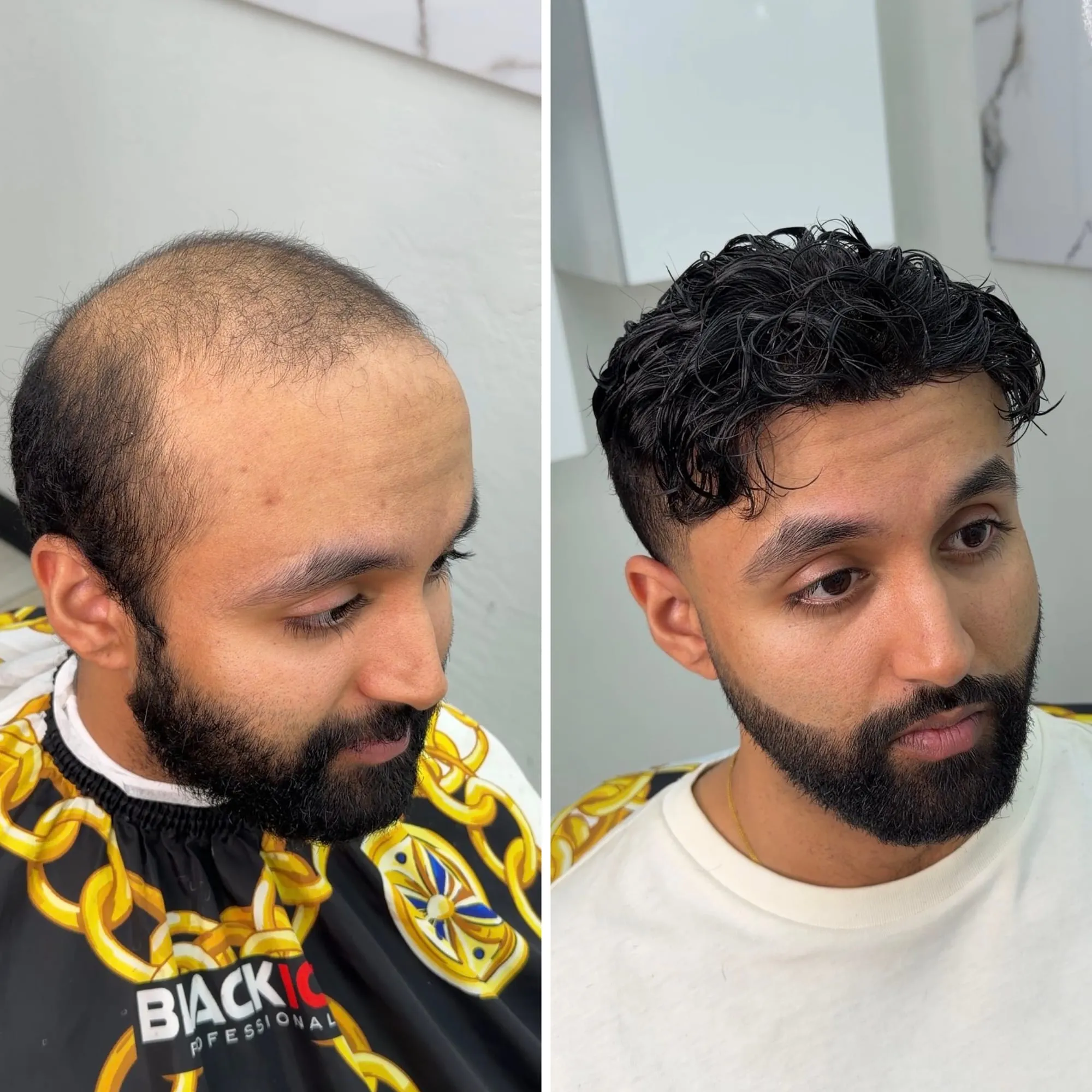
This is what it looks like.
A real client from our chair, photographed before and after his hair system was installed and cut in.
Questions, answered.
Why would a clinic say I am not a transplant candidate?
Usually one of three reasons: diffuse thinning that reaches into the donor zone, a donor density too low to harvest safely (often near or under 40 follicular units per square centimeter), or advanced loss where the bald area is larger than your lifetime graft supply can fill. A hair system depends on none of these.
Is diffuse thinning really a dealbreaker for a transplant?
Often, yes. When the thinning is diffuse and unpatterned, it reaches into the back and sides a surgeon would harvest from, so the moved hair is thinning too. There is no stable donor bank to draw from. A hair system needs no donor, so diffuse thinning does not limit it.
What does too far gone actually mean?
It usually means Norwood stage 6 or 7, where the bald area is so large that even a full lifetime graft supply, often cited near 5,000 to 8,000 grafts, cannot cover it at a convincing density. It is the same call as not a candidate, described from the advanced end. A hair system covers a full scalp regardless.
Can I get a hair system if I have transplant scarring?
Yes. The base rests over scar tissue and covers it cosmetically. A hair system does not depend on healthy skin or blood supply underneath the way transplanted grafts do, which is one reason men come to us after a transplant that did not take.
Does a hair system treat my hair loss?
No. A hair system is cosmetic. It covers thinning and bald areas with hair on a thin base that bonds to your scalp. It does not treat, cure, or regrow hair, and any underlying condition stays under the care of your doctor while the unit restores the full look.
Can you tell me if I am a transplant candidate?
We classify, we do not diagnose. We can point out whether your loss looks diffuse or advanced enough that surgery would fight the graft math, but only a physician can diagnose the cause or clear you for a procedure. What we can do is fit a hair system to the head you have now.
Keep reading
Related guides.
Options Compared
Hair systems, transplants, SMP, medication, shaving, or nothing. An honest side by side of coverage, reversibility, commitment, and upkeep.
Hair System vs Hair Transplant
A side by side look at hair systems and hair transplants: results, timeline, upkeep, and who each one suits. Non surgical vs surgical, honestly.
Transplant vs System, Long Term
A transplant relocates follicles for good but does not stop future loss. How a transplant and a hair system compare over the long term, honestly.
After a Failed Transplant
Yes, you can wear a hair system after a failed hair transplant. How we choose scar-aware attachment, base, and hairline to cover old graft work.