

Last updated September 28, 2026
Two products, but really one decision
People shop fibers and concealers as if they were two different answers, but in practice they solve the same problem from the same angle. Both are topical cover-ups. They sit on the surface, they wash off, and they lean on the hair or the scalp that is already there. Neither one builds anything. So the honest way to think about the whole category is a single question: do you need to cover up thinning that is still visible, or do you need coverage where the hair itself is gone?
That is the real fork in this decision. Cover-up makes existing thin hair read as fuller for a day. Coverage puts a new head of hair and a defined hairline where you want one, every day, regardless of what is growing underneath. Fibers and concealers live entirely on the cover-up side of that line. A hair system lives on the coverage side. Once you see the category that way, choosing between them stops being about brand names and starts being about how much hair you actually have left in the area you care about.
What hair fibers actually do, and where they stop
Hair building fibers are tiny keratin strands, roughly a third of a millimeter to half a millimeter long, that carry a static charge so they cling to the sides of your existing hair. Shake them onto a thinning crown, press them in, lock them with a fixing spray, and the strands you still have suddenly look two or three times thicker. For diffuse thinning where you keep real density, that effect is genuinely convincing from conversational distance and it takes only a minute or two to apply.
The ceiling is built into how they work. Fibers have nothing to grab where there is no hair, so a smooth bald area stays a smooth bald area no matter how much product goes on. They cannot draw a hairline, because a hairline is defined by individual hairs and their direction, and static-charged dust cannot create that edge. They also live and die with your wash cycle: a normal application lasts about a day, up to two or three days if you barely disturb it and use a locking spray, and heavy sweat or rain can streak or shed it before then. Fibers thicken what you have. They do not give you more hair.
What scalp concealers actually do, and where they stop
Scalp concealers, whether powder compacts, spray cans, or tinted creams, work on contrast rather than volume. A pale scalp glowing through dark hair is what makes thinning obvious, so concealers dye the skin a shade close to your hair and that gap in tone shrinks. Under normal light and from a step back, a well-matched concealer can make a thinning zone look meaningfully denser, and root sprays are a quick fix for regrowth between color appointments.
But a concealer is paint, not hair. It adds zero volume and it cannot build a hairline, so up close it reads as tinted skin, and against a crisp edge or in bright, raking light the flatness shows. It transfers to pillowcases, collars, and fingertips, it can run with sweat or rain, and it reapplies daily. On a fully bald area it can cut the shine and soften the contrast, but it will never look like hair, because there is no hair there to imitate. Concealers reduce the contrast of thinning. They do not reverse it.
Fibers, concealers, and a hair system side by side
Here is the same set of criteria applied to all three, so the ceilings are visible in one place. The figures are typical for how these products behave in daily use and they move with your climate, your activity, and how carefully you apply them. No amounts appear, because a hair system is quoted to your specification at consultation. What is definitive is what each product can and cannot do.
| Criteria | Hair building fibers | Scalp concealer (powder, spray, cream) | Hair system |
|---|---|---|---|
| What it does | Clings to existing strands to make them look thicker | Tints the scalp to reduce contrast with your hair | Adds real hair and a defined hairline on top of the scalp |
| Needs existing hair in the area | Yes, it has nothing to grab without visible strands | No, but with no hair it only dulls shine | No, it covers regardless of what grows underneath |
| Fiber or particle size | Keratin strands about 0.3 to 0.5 mm long | Fine pigment, no length, tints skin only | Full-length hair cut to your style, from about 1 inch upward |
| Works on a fully smooth or bald zone | No | Partial, reduces shine and contrast only | Yes |
| Can create a hairline | No | No | Yes, a knotted lace or skin front reads as your own edge |
| Typical hold per application | About 1 day, up to 2 to 3 days with a locking spray | About 1 day, reapply daily | Continuous, reattach roughly every 2 to 4 weeks |
| Sweat, rain, and swimming | Can shed or streak without a locking spray | Can transfer or run | Stays attached, water tolerance set by attachment method |
| Detectable up close | Convincing at a distance, shows on the scalp up close | Reads as tinted skin up close | Front reads as scalp up close when fitted well |
| Daily time cost | About 1 to 3 minutes to apply | About 1 to 2 minutes to apply | None once attached, styled like your own hair |
| Wear-life horizon | Per application, gone at the next wash | Per application, gone at the next wash | Roughly 1 to 12 months per unit by base type |
When fibers or concealers are genuinely the right call
None of this makes fibers or concealers bad products. They are the right tool in specific situations, and we will tell you so honestly rather than sell past them. If you still have real density and you are dressing up early, diffuse thinning for a photo, an event, or a normal workday, fibers do that job cheaply and in under three minutes. If your only tell is a pale scalp peeking through otherwise decent hair, a concealer that matches your tone can quietly close that gap. And if you color your hair, a root spray between appointments is a sensible touch-up, not a compromise.
- You keep visible density and only want early thinning to look fuller: fibers fit
- Your main tell is scalp shine through decent hair: a matched concealer helps
- You need a same-day, wash-out fix for one occasion: either one works
- You want zero commitment and no attachment routine: cover-ups stay simple
When a hair system is the honest answer
The moment your need crosses from covering up to actual coverage, cover-ups run out of room and a hair system becomes the honest answer. If the area you care about has gone smooth, if you want a real, defined hairline instead of a softened silhouette, or if you are tired of a product that resets every time you wash, sweat, or swim, no amount of fiber or concealer closes that gap. Those products depend on the hair you have lost, which is exactly the thing that is no longer there.
A hair system does not treat, cure, or regrow anything, and we are careful to say so. What it does is cosmetic and complete: it puts a full head of real hair and a hairline where you want them, styled like your own, holding through sweat and water for weeks per attachment rather than resetting every wash. For men past early thinning, that is usually the difference between managing an appearance daily and simply having hair again. If you are somewhere in between, our practitioners at our Peoria, AZ and Eighty Four, PA studios will look at what you still have and tell you honestly whether a cover-up still serves you or whether coverage is the better call.
What is set at consultation
A cover-up is priced on a shelf because it is a consumable. A hair system is not, because it is built to you, which is why we quote it against your actual specification rather than publishing a blanket figure. Ranked by how much they move the number, the big drivers are base construction, hair type and origin, and any custom template, followed by add-ons such as hair length over about six inches, a silk top, or a larger base. European hair and fully custom work sit at the higher end, stock and standard builds at the lower end. Two men can order what sounds like the same unit and need very different builds, so the real number belongs at the consultation.
What we can tell you before you sit down is the logic on this page. Fibers and concealers are cover-ups that dress up the hair you still have, and they are honestly good at that within their ceiling. A hair system is coverage that replaces the hair that is gone, hairline included. Bring the area you actually want solved to the consultation with Nico Rigano, Ivette Rigano, or Denisse Diaz, and we will tell you which side of the line you are on before anyone talks about a build.
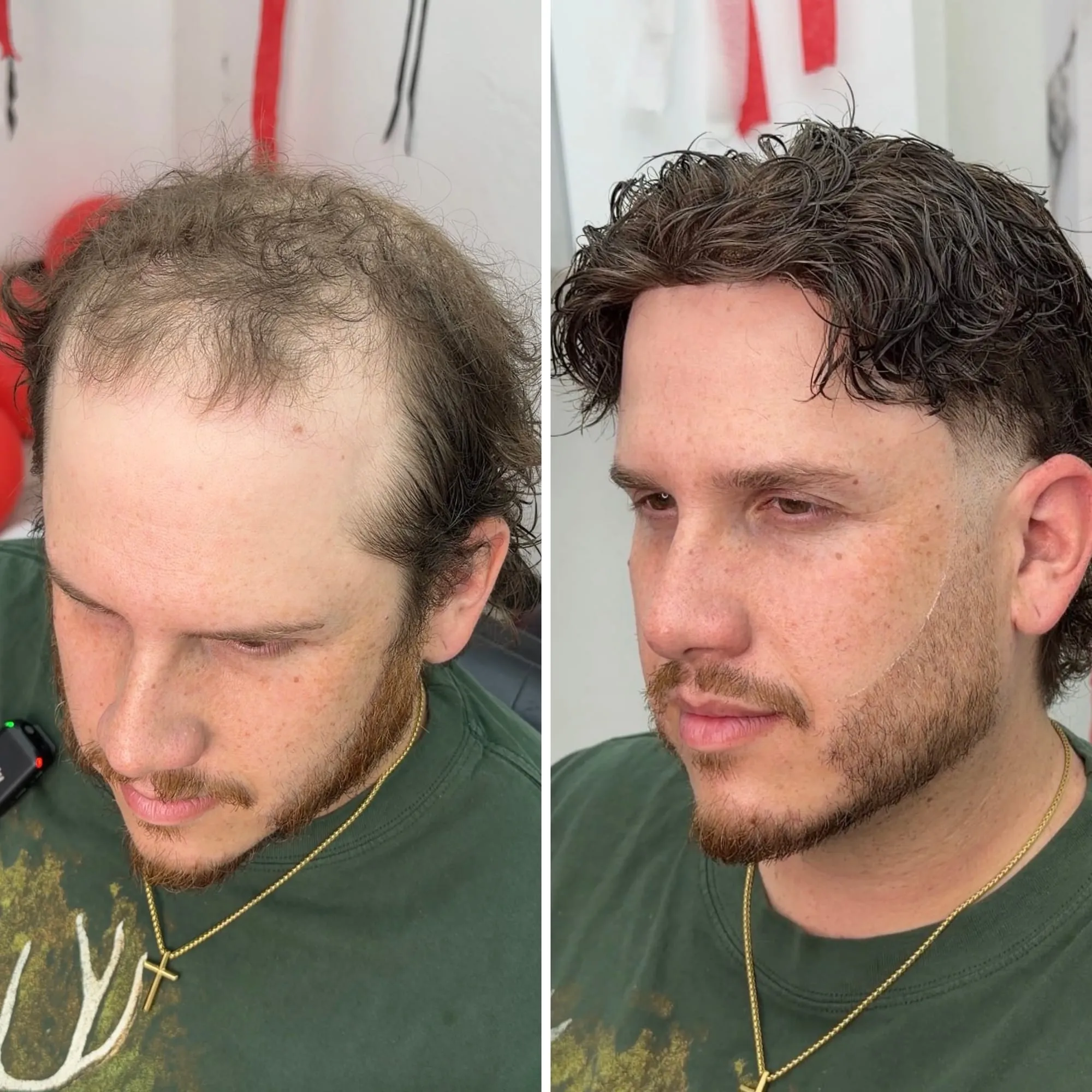
Real work
This is what it looks like.
A real client from our chair, photographed before and after his hair system was installed and cut in.
Questions, answered.
What is the difference between hair fibers and a hair system?
Hair fibers are a cover-up. They are tiny keratin strands that cling to the hair you still have to make it look thicker, and they wash out at the next shampoo. A hair system is coverage. It adds real hair and a real hairline on top of the scalp and works even where nothing grows, holding for weeks per attachment rather than a day.
Do hair fibers work on a bald spot?
No. Fibers cling to existing strands using a static charge, so a smooth bald area gives them nothing to grab and it stays visible. They thicken thinning hair, they do not create hair. For a bald zone you need coverage, which is what a hair system provides.
Can a concealer give me a hairline?
No. A concealer tints the scalp to reduce the contrast that makes thinning obvious, so it can soften the look and dull the shine, but it adds no volume and cannot draw an edge. A hairline is defined by individual hairs and their direction, which only real hair, such as a knotted lace or skin front on a hair system, can build.
Should I use fibers or a hair system?
It depends on how much hair you have in the area you care about. If you still keep real density and want early thinning to look fuller for a day, fibers do that cheaply and fast. If the area has gone smooth, or you want a defined hairline that holds through sweat and water, a hair system is the honest choice, because cover-ups depend on the hair you have already lost.
Why are there no prices on this page?
Cover-ups are consumables with a shelf price. A hair system is built to your specification, so the figure depends on base, hair type, template, and any add-ons, and two men ordering what sounds like the same unit can need different builds. We quote against your actual specification at consultation, with no obligation.
Keep reading
Related guides.
Options Compared
Hair systems, transplants, SMP, medication, shaving, or nothing. An honest side by side of coverage, reversibility, commitment, and upkeep.
Hair System vs SMP
A hair system adds real hair you can style. SMP tattoos the look of stubble onto your scalp. Here is who each one actually suits, honestly.
What Is a Hair System
A hair system is a custom hair unit fitted and blended into your own hair for a full, natural look. Here is how non surgical hair replacement works.
How Long Hair Systems Last
How long a hair system lasts depends on the base, your routine, and maintenance. Here is what to expect and how to make yours last longer.