

Last updated September 28, 2026
Why these are not the same tool
The distinction is simple once you see it. Extensions are an addition. They take strands you already grow and hang more hair off them, which is fantastic for a woman with a full head of fine hair who wants more length or body. A hair system is a replacement layer. It creates coverage that does not depend on your remaining hair at all, because it bonds to skin rather than to strands.
That difference matters most for the pattern almost every man loses hair in. Thinning tends to hit the hairline, the temples, and the crown first, and it leaves the sides and back strongest. Extensions need dense donor hair exactly where men have the least of it, and they do nothing for a scalp that is already showing through at the front. A hair system is built for that map, not against it.
| Consideration | Hair extensions for men | Hair system |
|---|---|---|
| What it attaches to | Sections of your own growing hair | The scalp surface itself |
| Typical hardware | Micro or nano rings 2mm to 5mm, or tape wefts near 4cm wide | None, a base film 0.03mm to 0.12mm thick |
| Donor hair needed | Yes, dense strands at every anchor point | No, works over bare or sparse scalp |
| What it can build | More length and volume on hair you still have | Full coverage, including a receded or bald front |
| Front hairline | Cannot build a hairline where hair is gone | Builds a new hairline in lace or thin skin |
| Weight load | Pulls on individual anchor strands all day | Spread across a bonded base, not single hairs |
| Move up or reset | Every 6 to 10 weeks as your hair grows out | Reset on a 2 to 4 week adhesive cycle |
| Best candidate | Thick hair wanting extra length or body | Pattern loss at the crown, temples, or hairline |
The load problem: micro links on hair that is already thinning
Micro link and nano ring extensions work by clamping a small metal ring, usually 2mm to 5mm across, around a section of your own hair, then locking the added strand in with it. Every ring carries weight, and that weight hangs on the anchor strands every hour you wear it. On a full, coarse head of hair the load is shared across thousands of healthy anchors and the strain on any one is small.
On a man who is thinning, the math turns against you. There are fewer anchor points, each one is finer, and the same added weight now pulls harder on strands that already have less to give. Constant tension on fine hair is a known downside of any bead or ring method, and it tends to show up worst at the temples and hairline, which is exactly where a man is trying to hold onto the hair he has left. Loading weight onto the weakest strands to hide thinning is working against your own goal.
The visibility problem: beads and rows show through a sparse scalp
The second issue is what you can see. Extensions are designed to be hidden under a curtain of your own hair growing over the top of them. The rings, the tape tabs, and the weft seams all sit close to the scalp and rely on dense coverage above to stay out of sight. Women part their hair to check that the rows are buried.
A thinning scalp cannot bury anything. When the hair above an anchor is sparse, the hardware and the seam line read straight through, especially in hard overhead light or when the hair is wet. Beads glint, tape tabs shine, and rows of attachment points become visible tracks across the scalp. The very condition that sends a man looking for more hair is the condition that makes extensions hardest to hide.
What a hair system does differently
A hair system starts from the scalp, not from your strands. The hair is tied or injected into a sheer base, and that base bonds to the skin with tape or adhesive across a broad, continuous area. Nothing clamps onto a single strand, so there is no point load pulling on fine hair and no metal hardware to catch the light.
Because the coverage is built into the base rather than borrowed from your remaining hair, a system can put a clean, full front where the hairline has receded to bare skin. Lace and thin skin fronts let your scalp color read through so the edge disappears, and density is dialed in on purpose, commonly in the 80 percent to 130 percent range, to match your age and face rather than whatever your thinning hair happens to be doing. That is the coverage extensions physically cannot create, because they have nothing to attach to at the front.
When extensions actually make sense for a man
We will be straight with you, because that is how we work. If you have a genuinely full, thick head of hair and you simply want it longer or fuller for a while, extensions can do that job and a hair system would be the wrong tool. Some men with dense hair use them for length ahead of a role, a shoot, or a season, and that is a fair use.
But that is a small group, and it is not why most men reach out to us. If your reason for looking is thinning, a receding hairline, a visible crown, or a scalp that shows in photos, extensions are the wrong fit twice over. They need the donor hair you are short on, and they get more visible as the hair around them thins. A hair system is the tool built for that situation.
How we decide in our chair
We do not lead with a product. We look at where your hair is strong, where it is thinning, and what you actually want to walk out looking like. If your own hair could carry length on its own, we will tell you so and you will not need us to build a unit. If the loss is at the front, the temples, or the crown, we design a hair system to the shape of your face and the way you live.
That decision happens in person with Nico Rigano, Ivette Rigano, or Denisse Diaz at our Peoria, Arizona and Eighty Four, Pennsylvania studios, once we have seen your scalp, your hair, and your routine. Any cost driver, such as European hair or a fully custom base, is walked through at that consultation so there are no surprises. To place this next to the other paths men weigh, start with our full comparison of hair replacement options.
Real work
This is what it looks like.
A real client from our chair, photographed before and after his hair system was installed and cut in.
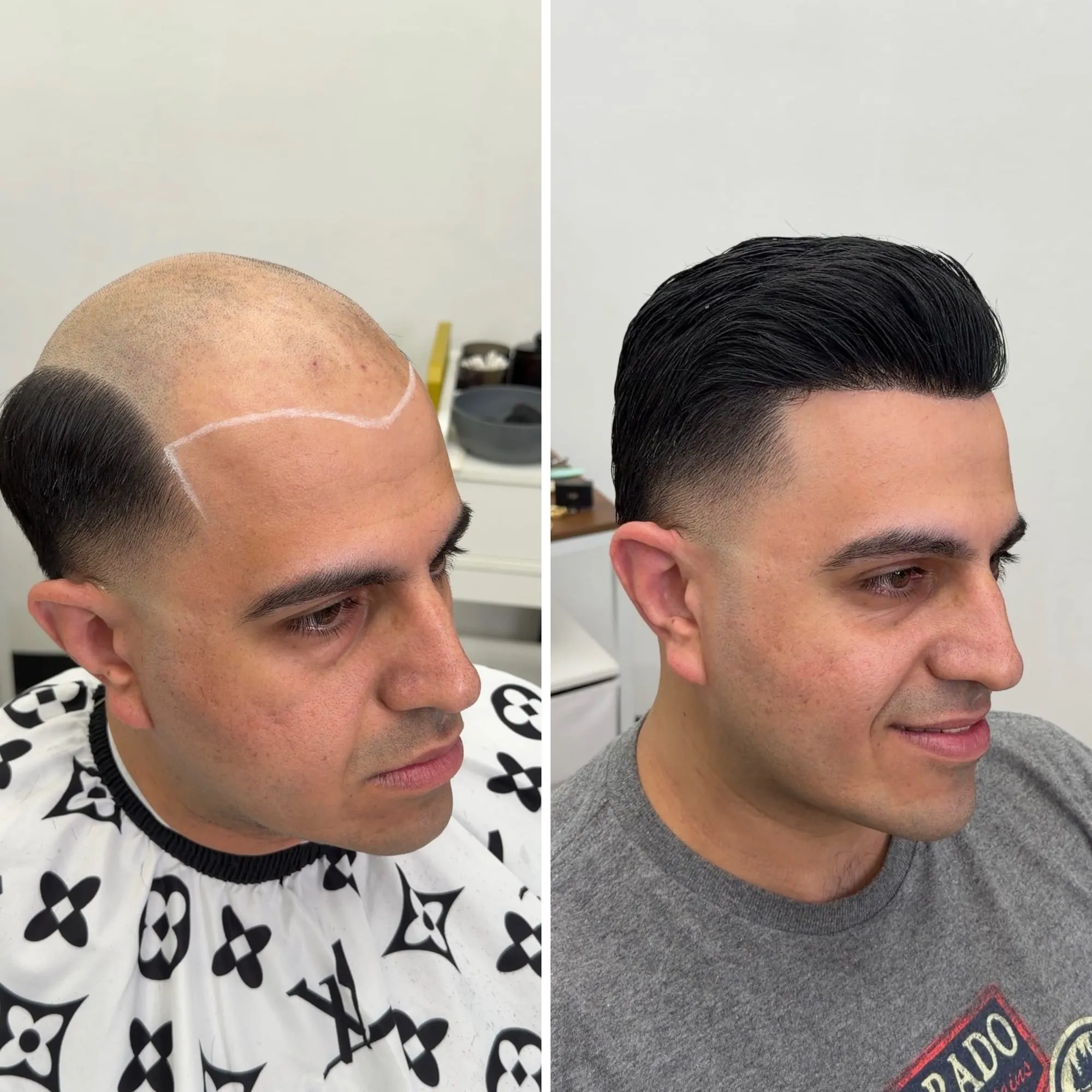
Questions, answered.
Can hair extensions cover a receding hairline?
No. Extensions anchor to hair you already grow, so they cannot build a hairline where the hair is gone. There is nothing at a bare front for a bead, ring, or tape weft to attach to. A hair system builds a new front in lace or thin skin that bonds to the scalp instead.
Do micro link extensions damage thinning hair?
The load is the concern. Each ring carries weight on the strands it clamps, and on fine or thinning hair that constant tension strains the anchors, worst at the temples and hairline. A hair system spreads the load across a bonded base rather than pulling on single strands.
Why do extensions show through on a man losing hair?
Extensions are meant to hide under dense hair growing over them. A thinning scalp cannot cover the rings, tape tabs, or row seams, so they read through in hard light or when wet. A hair system has no hardware and its base is built to disappear against the scalp.
Are extensions ever the right choice for a man?
Yes, in one case. A man with a genuinely full, thick head of hair who just wants more length or body can use extensions well. If the reason you are looking is thinning or a receding front, extensions are the wrong tool and a hair system is the honest fit.
How is a hair system attached if not to my hair?
It bonds to the scalp surface with tape or adhesive across a broad, continuous area, not to individual strands. That is why it works over bare or sparse scalp and why there is no point load pulling on fine hairs the way a bead or ring does.
Keep reading
Related guides.
Options Compared
Hair systems, transplants, SMP, medication, shaving, or nothing. An honest side by side of coverage, reversibility, commitment, and upkeep.
What Is a Hair System
A hair system is a custom hair unit fitted and blended into your own hair for a full, natural look. Here is how non surgical hair replacement works.
Types of Hair Systems
Lace, skin, and poly hair systems compared by look, feel, durability, and upkeep, so you can choose the right base for your hair and lifestyle.
The Hairline
A natural hair system hairline is built from irregularity, a soft density gradient, and careful placement. Here is how we design one that reads as yours.