

Last updated October 27, 2026
The short version
Integration adds density. Extensions add length. That is the cleanest way to hold them apart. Integration spreads a mesh over a thinned area and blends added hair into it so the top reads fuller; extensions hang extra strands off the hair you already grow so a section reads longer or thicker.
Both only work while you still have usable hair to build on, so both suit early to moderate thinning and neither suits a bald front. If you are weighing either one against a full unit, our hair system versus extensions and hair system versus integration guides cover that; this page stays on integration versus extensions.
Why men mix these two up
The confusion is fair. Both take hair you did not grow and attach it to hair you did, so they look like the same idea. What differs is what they attach to and what they are for.
Extensions are a strand tool: a bead, ring, or tape tab grabs a small section of your own hair and locks added strands to it to add length or thickness there. A hair integration system is an area tool: a mesh is anchored around the edge of the thinned zone, your own hair is drawn up through it, and added hair is tied into the mesh so fullness fills in evenly across the area, not off single strands.
Integration and extensions, side by side
Here is how the two compare on the factors that decide the outcome for a man thinning on top. Read the first column as the question.
| Factor | Hair integration (mesh) | Hair extensions |
|---|---|---|
| Main job | Adds density across a thinned area | Adds length or thickness to strands |
| What it attaches to | A mesh anchored at the perimeter of the zone | Individual sections of your own hair |
| Typical hardware | A fine net, threaded or beaded at the edges | Micro or nano rings 2mm to 5mm, or tape wefts |
| Coverage pattern | Fills the whole thinned area evenly, edge to edge | Sits only where strands can anchor it |
| Load on your hair | Spread around a perimeter, carried by the mesh | Point load on each clamped strand all day |
| Best candidate | Diffuse thinning on top with real coverage left | A full, thick head wanting extra length |
| Front hairline | Leans on your existing hairline, cannot rebuild it | Cannot build a hairline where the hair is gone |
| Maintenance cadence | Tightened every 6 to 10 weeks as hair grows out | Moved up every 6 to 10 weeks as hair grows out |
Density or length: the question that decides it
Strip away the hardware and you are choosing between two wants. If what bothers you is scalp showing through the hair on top, that is a density problem, and extensions do little for it: adding length around a thinned area does not fill it, it just makes the sparse scalp more obvious.
If what you miss is length, extensions give you that on the hair that is still strong, but they build down from the strands you have, not out over the scalp between them. Integration is the opposite: it sits over the thinned zone and gives even fullness there. Naming your real want, density or length, usually settles the choice.
Where each one starts to fail
Both borrow from hair you still have, so both hit a ceiling, and it is largely the same one. Extensions need dense, strong anchor strands, which thinning men have least of at the temples and crown, and the clamped strands pull on fine hair that is already struggling. Integration needs enough surrounding hair to blend with and to hide the mesh, so once roughly a third of your coverage is gone the net starts to show.
Neither can put a clean edge where your hairline has receded to bare skin, because both lean on your own front to look real. If your loss is advanced, still moving, or concentrated at the hairline, a unit that bonds to the scalp is the dependable answer, and the two guides linked here show how a hair system handles what they cannot.
How we decide in our chair
We do not lead with a product. We look at how much hair you have on top, where it is thinning, whether your hairline is intact, and whether the loss is settled or still moving. If you have real coverage and a hairline you like and only want more fullness, integration is worth a serious look because it keeps your own hair. If your hair is strong and you only want length for a season, extensions can do that without us building anything.
That call happens in person with Nico Rigano, Ivette Rigano, or Denisse Diaz at our Peoria, Arizona and Eighty Four, Pennsylvania studios, because it rests on things a page cannot see: your density, your growth rate, and how you want to live. Any cost driver, such as European hair or a fully custom mesh, is walked through there rather than guessed at online.
Real work
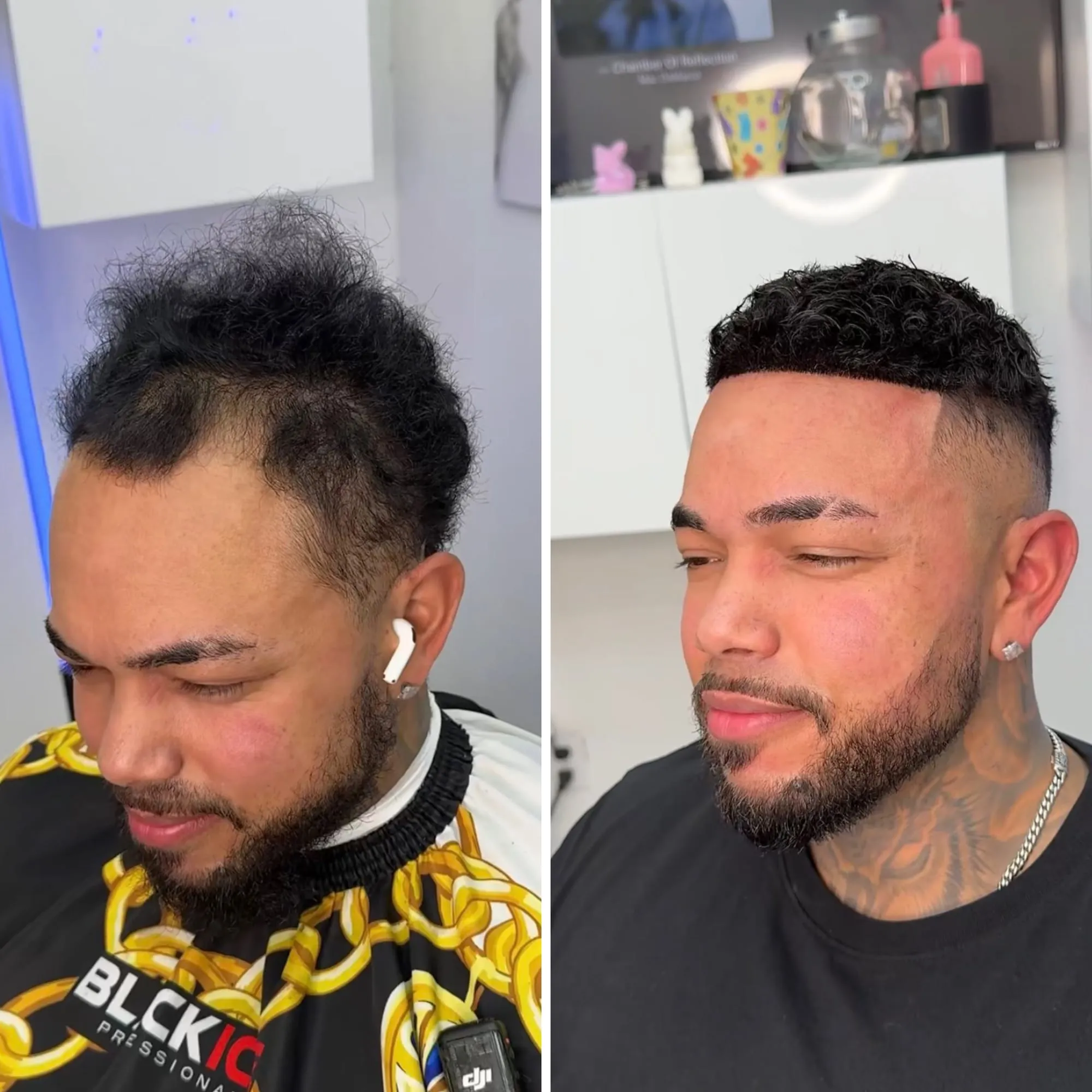
This is what it looks like.
A real client from our chair, photographed before and after his hair system was installed and cut in.
Questions, answered.
Is a hair integration system the same as hair extensions?
No. Integration anchors a mesh over a thinned area and pulls your own hair through it to add density across the zone. Extensions clamp or tape added strands onto sections of your hair to add length. Both lean on the hair you still have, but one fills an area and the other lengthens strands.
Can hair extensions fix thinning on top of my head?
Not really. Extensions add length to the strands they anchor to, so around a thinned area they make the sparse scalp more obvious rather than filling it. Thinning on top is a density problem, which is what integration is built for, and what a full hair system handles once the loss is advanced.
Which is better for a man losing hair, integration or extensions?
For most men whose complaint is thinning on top, integration fits better, because it adds fullness across the area while keeping your own hair. Extensions suit a man whose hair is still full and who only wants length. It comes down to whether your real problem is density or length.
Do integration or extensions work if I am mostly bald?
No. Both borrow from the hair you still have, so once roughly a third or less of your natural coverage remains there is not enough to pull through a mesh or to anchor extensions to. At that stage a hair system that bonds to the scalp is the reliable option.
Keep reading
Related guides.
System vs Extensions
Extensions add length to hair you still have. A hair system bonds full coverage to the scalp. Why systems, not micro links, fit male pattern loss.
System vs Integration
Integration pulls your existing hair through a mesh; a hair system covers the area for full density. How we pick, and who each one actually fits.
Integration System
A hair integration system pulls your own hair through a fine mesh and blends added hair around it, for men who still have hair. How the method works.