

Last updated October 27, 2026
The short version
An integration is a breathable mesh fitted over the thinned area, held at the perimeter by your own hair rather than bonded to bare scalp. Your existing hair is brought up through the mesh to sit on top, and extra hair is tied in beneath it, so you add fullness without covering or removing anything you still have. The result tracks the hair you keep, so it reads as a denser version of your own head and suits thinning hair, not advanced loss.
Why the method leans on the hair you still have
This is what separates integration from a covering unit. With a hair system the base carries all of the hair you see, so what is underneath barely matters. With an integration your own hair is the top layer. The added hair is ventilated into the mesh below to pad out density, but it is your existing hair, pulled through and lying over the top, that the eye actually lands on.
That changes what good work looks like. The parting falls where your hair naturally parts, and colour and texture match at the surface, because all of it is your hair. The density underneath only has to support the hair on top, not impersonate it, which is why a well set integration reads so quietly.
- Your own hair stays on top as the visible layer
- Added hair sits in the mesh beneath it to build density
- The parting and surface colour are yours already, so they match by default
- Nothing of your own is cut away or bonded over to make room
How much of your own hair the method needs
Because the mesh hides under your hair and the blend rides on it, integration needs a real amount of coverage left to work with. As a rough guide, once thinning passes the point where roughly a third of your natural density remains, there is not enough on top to cover the mesh or carry the fill. It is also the wrong tool for a receded or bare front, since an integration leans on your existing hairline and cannot build a new one.
So the honest candidacy test is about what is still there. When we look, we read a few specific things first.
- How much density is left across the top, and whether that loss is even or concentrated in spots
- Whether your hairline is intact enough to frame the blend
- How the hair is holding at the edges, since that is where the mesh anchors
- Whether the thinning has settled or is still moving quickly
Protecting thinning hair while it is anchored
Thinning hair is more fragile than a full head, and any method that attaches to your own hair has to respect that. An integration holds at the perimeter, threaded or beaded onto your hair around the edge of the mesh rather than glued to skin. Done carelessly, that attachment can pull on already-vulnerable hair, so the anchoring is where the real care goes.
We hold the tension without dragging, spread the anchor points so no section takes the strain, and move them at maintenance so the same hairs are not loaded every time. If your edges are too fine to anchor to safely, we will say so, because protecting the hair you have matters more than adding to it.
- Anchored at the perimeter to your own hair, not bonded to the scalp
- Tension set to hold without dragging on fragile hair
- Anchor points spread and rotated at each visit to avoid strain
- Handled gently when washing and styling around the edges
Your own hair keeps growing underneath
One reason men with thinning hair lean toward integration is that it leaves your own hair alone. The centre of the mesh is open, so your scalp still breathes and your hair keeps growing through it much as before. Nothing is trimmed close to seat a base, the trade a bonded hair system usually asks for, so you keep the length and movement you already have. For a man not ready to shorten or cover the hair he still has, that is often the deciding point.
How it behaves as your hair grows and changes
An integration is tied to your growth, so it rides up as your hair gets longer. Maintenance is less about re-bonding than re-anchoring the mesh to fresh growth and recutting the blend, which lands on a longer rhythm than a bonded unit, in the region of every six to ten weeks. The honest caveat is that thinning is rarely finished, and if the hair carrying the integration keeps thinning, a covering hair system eventually becomes the more reliable answer.
We are upfront about that from the start, and cost flexes on the usual drivers: the type of added hair, the size and build of the mesh, and how often you come in. Nico, Ivette, and Denisse make the call with you in person at our Peoria, Arizona and Eighty Four, Pennsylvania studios, because candidacy depends on things a page cannot see: your density, your edges, and how you want to live. If the hair is there to carry it, it is a good way to add fullness while keeping what you have.
Real work
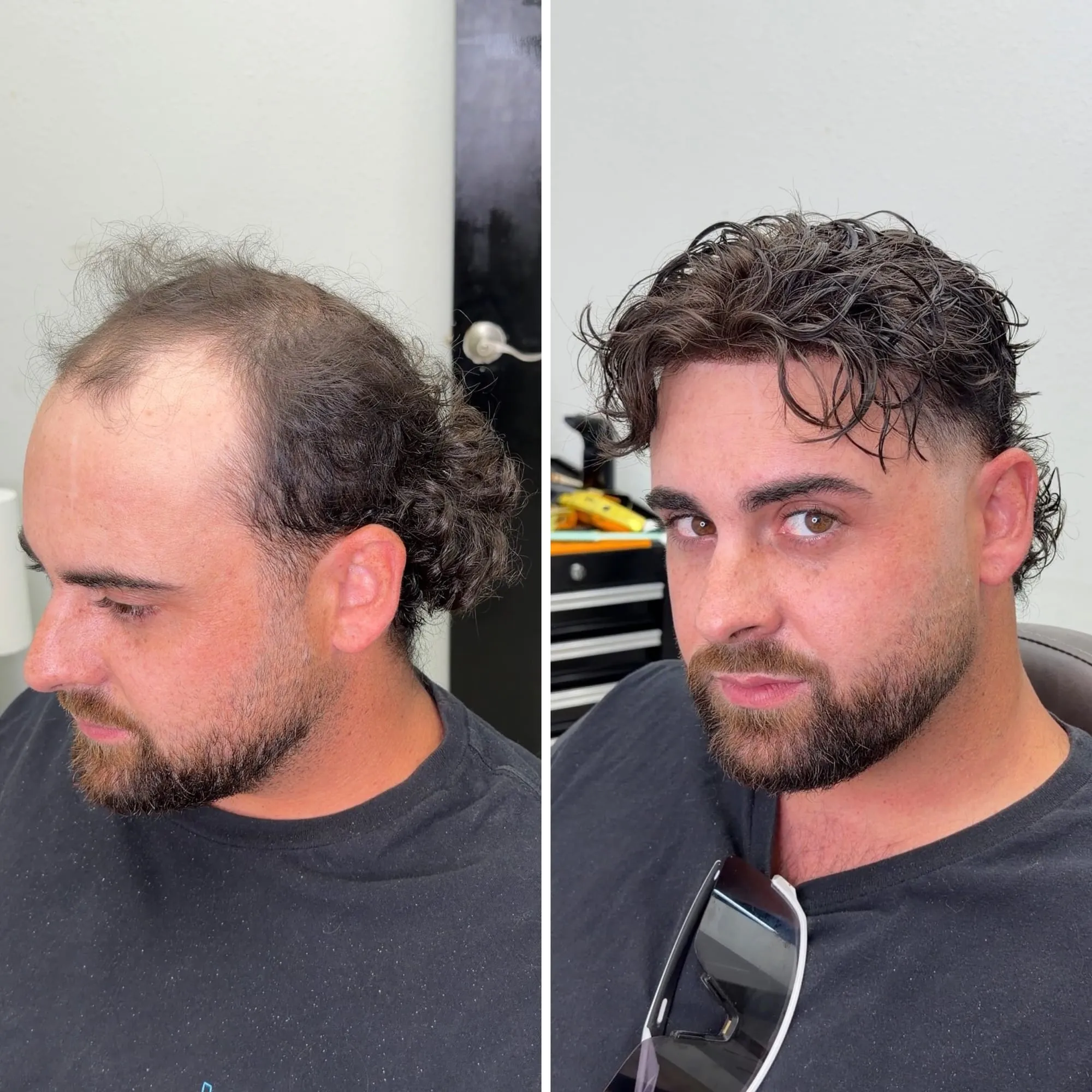
This is what it looks like.
A real client from our chair, photographed before and after his hair system was installed and cut in.
Questions, answered.
How does hair integration work for thinning hair?
A fine mesh is anchored over the thinned area, your own remaining hair is pulled up through the openings to sit on top, and added hair is tied into the mesh underneath for density. Your hair stays the visible layer, so the result reads as a fuller version of your own head, not a piece laid over it.
Is my hair too thin for an integration?
It depends on how much is left. As a rough guide, once thinning passes the point where about a third of your natural density remains, there is not enough on top to cover the mesh and carry the blend, and a covering hair system becomes the better answer. We check your density and edges in person first.
Does hair integration damage thinning hair?
It should not when it is anchored and maintained correctly. The risk with any method that attaches to your own hair is tension on already-fragile strands, so we set the hold gently, spread and rotate the anchor points, and will tell you honestly if your edges are too fine to anchor to safely.
Can I still grow my own hair with an integration?
Yes. The centre of the mesh is open, so your scalp breathes and your hair keeps growing through it. Nothing is trimmed close or bonded over, a main reason men who still have hair prefer integration to a covering unit.
How often does an integration need tightening?
Because it is anchored to your own hair, the mesh rides up as you grow, so it is re-anchored and re-blended on a schedule that usually lands around every six to ten weeks. Faster growth means more frequent visits. We set the exact rhythm to your hair at the start.
Keep reading
Related guides.
Integration System
A hair integration system pulls your own hair through a fine mesh and blends added hair around it, for men who still have hair. How the method works.
How Integration Works
Hair integration anchors a fine mesh to your own hair and blends added hair through it. Here is the full process, from consult to maintenance.