

Last updated September 28, 2026
Why swimming is its own question
Men who swim often already know a system can handle sweat, and they assume the pool is just more of the same. It is not. Sweat is warm and salty and it works on the bond from underneath. Swimming adds three things sweat never does: prolonged soaking, moving water dragging at the edges, and pool or ocean chemistry that acts on the adhesive and the hair itself.
This is the audience version of the swimming question. If you want the step by step routine for a specific swim, our care guide on swimming with a hair system walks through the protocol. Here we are answering the bigger one: does an active swimmer life fit a system in the first place, and what should you know going in.
Chlorine, salt water, and submersion are three different problems
A chlorinated pool is chemistry. Chlorine is an oxidizer, so over repeated swims it can dull the hair, shift lighter tones, and work at the edges of the bond faster than plain water would. Rinsing the unit with fresh water soon after you get out is the single habit that protects it most, because it stops the chlorine from sitting and drying into the hair.
Salt water is more about drag and grit than chemistry. The ocean pulls at the perimeter with every wave and leaves salt behind as it dries, which can stiffen the hair and creep under a lifting edge. A freshwater rinse matters here too, along with drying the edges so salt does not sit at the bond line.
Full submersion is the mechanical test. Diving in, pushing off a wall, or duck diving a wave puts direct pressure on the front hairline, which is exactly where a bond is thinnest and most visible. This is why a swimmer usually wants a stronger, more water tolerant attachment than someone who only sweats at the gym.
The bond question for swimmers
For a regular swimmer we lean toward adhesives and tapes built to tolerate water and a longer, more secure bond overall, then we make the front hairline the priority since that is what submersion tests first. The trade off is honest: a stronger, more waterproof hold usually means a longer stretch between reattachments and a more deliberate removal, rather than a quick daily on and off.
How your scalp reacts to being wet for long stretches matters as much as the adhesive. Skin that stays damp under a bond can get irritated, so we test your routine and adjust before it becomes a problem, and if any irritation lingers we will point you to a physician rather than guess at it. If you already run oily or sweat heavily on top of swimming, that changes the plan again, and we would rather build for your real week than a tidy version of it.
- Rinse with fresh water soon after every swim, pool or ocean
- Dry the perimeter and hairline so chemistry does not sit at the bond
- Favor a water tolerant adhesive matched to how often you swim
- Protect the front hairline, the part submersion tests first
- Watch how your scalp handles staying wet, not just how the hold lasts
Living the Phoenix pool life
In the Valley a pool is not a vacation, it is a Tuesday. Backyard swims, long stretches of open water season, and sun on top of chlorine all add up, and the sun is its own factor because ultraviolet light fades hair over time the same way it fades anything left outside. A cap helps when you are doing laps, and a rinse plus a little shade for the unit between swims goes a long way.
None of this means a swimmer should settle for a unit that looks tired by August. It means the maintenance rhythm is built around how much water and sun it actually meets. We would rather set that cadence honestly at the start than have you wondering why summer hair does not last like winter hair.
What drives cost and upkeep for a swimmer
The cost drivers are the same ones anyone weighs, read through a swimmer's week: the base material, the type of hair, and how often you come in for maintenance. Water and sun exposure tend to shorten how long the hair looks its best, so a heavy swimmer often plans a slightly tighter maintenance cadence, and that cadence is the real lever, not any single number.
Base choice is a genuine trade off here. A finer, more skin like base can feel and look more natural but may ask for more careful handling around constant water, while a sturdier base takes the pool in stride with less fuss. There is no universal right answer, only the one that fits how much you swim and how you want it to feel.
Deciding if this fits your swim life
If swimming is a real part of your life and you have been holding off because you assumed a system and the water do not mix, that assumption is worth testing. Plenty of active swimmers wear systems every day. It comes down to the right attachment and an aftercare habit you will actually keep.
The honest way to know is a consultation. At our studios in Peoria, Arizona and Eighty Four, Pennsylvania we look at your scalp and your routine, talk through how much and where you swim, and tell you plainly what attachment and cadence make sense. If your particular swim life makes a system a poor fit, we will say so.
Real work
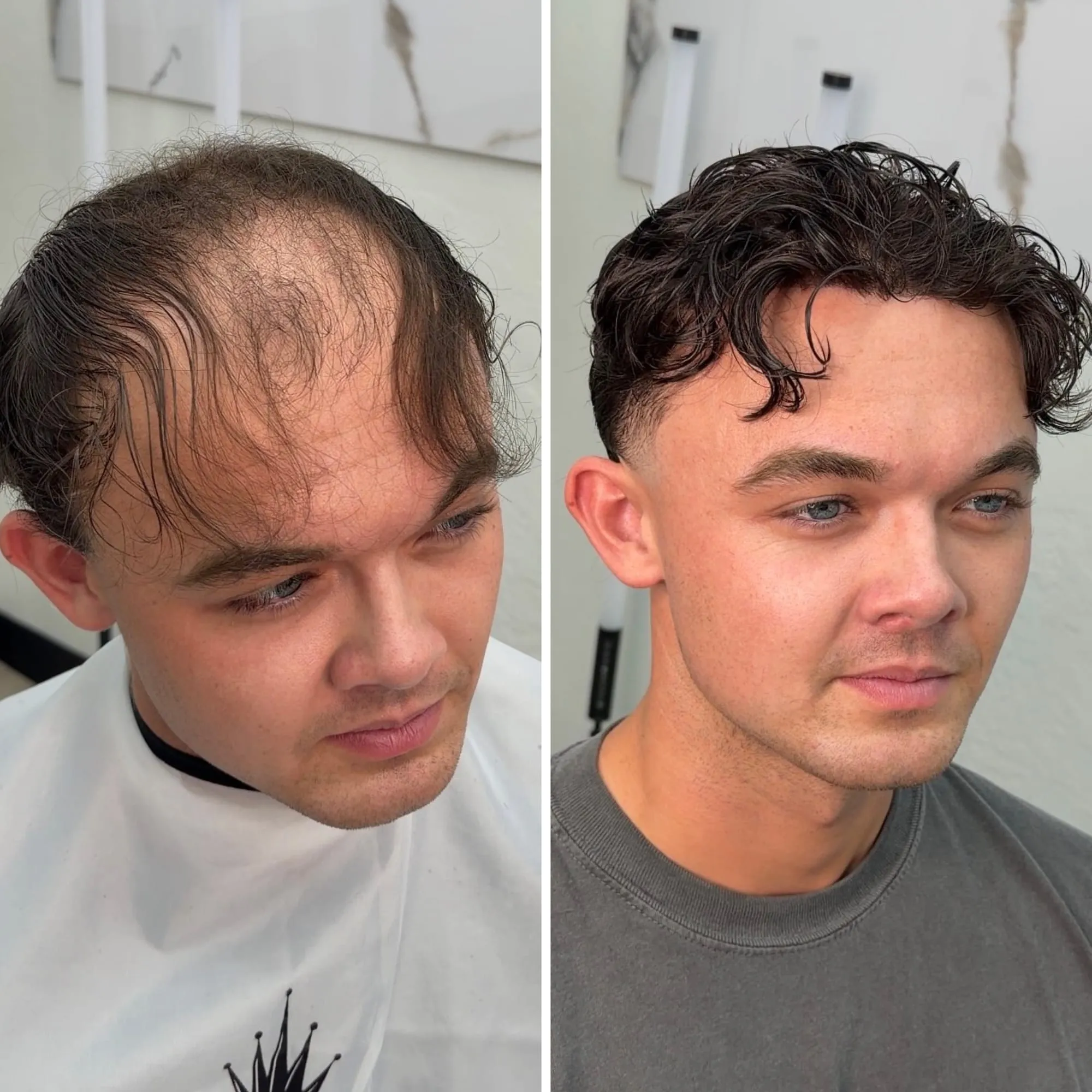
This is what it looks like.
A real client from our chair, photographed before and after his hair system was installed and cut in.
Questions, answered.
Can you swim in a hair system?
Yes. Regular swimmers wear systems every day. The key is a water tolerant attachment and a habit of rinsing with fresh water and drying the edges soon after each swim, because pool and salt water work at the bond and the hair over time.
Is chlorine bad for a hair system?
Chlorine is an oxidizer, so over repeated swims it can dull the hair, shift lighter tones, and work at the bond edges. It is not a dealbreaker. Rinsing the unit with fresh water soon after you get out is the single habit that protects it most.
Does salt water affect a hair system differently than a pool?
Yes. Salt water is more about drag and grit than chemistry. Waves pull at the perimeter and salt stiffens the hair as it dries and can creep under a lifting edge, so a freshwater rinse and drying the bond line matter just as much as they do after a pool.
Do I need a different attachment because I swim?
Usually, yes. Submersion tests the front hairline first, so a swimmer typically wants a stronger, more water tolerant bond than someone who only sweats. We match the adhesive to how often you swim and check how your scalp handles staying wet.
Keep reading
Related.
Oily and sweaty scalps
If your hair system keeps coming off on an oily scalp, the fix is adhesive choice, scalp prep, and a shorter reattachment cycle. Here is how.
Sensitive skin and adhesive allergies
How a hair system can work when adhesive irritates your skin: acrylate and latex sensitivity, skin testing, and tape-free clip alternatives.
For Professionals
How a hair system fits a working professional's schedule: discreet, low-maintenance, and undetectable on camera and across a desk.
For Young Men
Why a hair system fits men in their 20s and 30s. Full hair now, no surgery, built for an active life and natural at close range.