

Last updated September 28, 2026
Why oil and sweat break a bond early
Adhesive holds a unit to your skin, and it holds best on a surface that is clean, dry, and stable. Your scalp produces sebum, the natural oil that keeps skin supple, and it produces sweat to cool you down. Both sit exactly where the adhesive needs to grip, and both keep coming all day, so on an oily or high sweat scalp the bond is fighting a moving target rather than gripping a fixed one.
Sebum works like a slow release oil that softens the adhesive and lets the edges creep and lift. Sweat adds water and salt that thin the bond and break the seal, usually at the hairline and the perimeter first, which is why lifting tends to start at the front where you notice it most. None of this is a flaw in you or in the unit. It is physiology, and it is the single most common reason a bond that should last does not.
This is a different problem from a bond loosened by a hard workout, a hot day, or a tight hat, even though the symptoms overlap. Those are situational and pass. An oily, sweaty scalp is a baseline your fit has to be built around every day, so the answer lives in adhesive choice, prep, and cadence rather than in avoiding activity.
Choosing an adhesive that survives oily skin
Adhesives fall into two broad families. Soft bond tapes and water based liquids are gentle and easy to remove, and they typically hold a few days to around two weeks in ideal conditions. Hard bond acrylic adhesives grip harder and are built for humidity and moisture, and they can hold up to several weeks. On an oily, sweaty scalp the honest expectation is the shorter end of whatever range you are in, because the oil is always working against the hold.
For most men who run oily we lean toward a waterproof, humidity resistant adhesive, and we match the exact product to how your skin actually behaves rather than to a label. The right pick is the one your scalp tolerates comfortably while still holding, so we would rather test a couple of options on you than promise that one product is the answer for everyone.
- Favor waterproof, humidity resistant adhesives over gentle water based ones
- Consider a scalp protecting base coat under the adhesive to buffer sebum
- Match the product to how your skin reacts, not to marketing on the tube
- Expect the shorter end of any published hold range when you run oily
Scalp prep that actually holds
Most early lifting on an oily scalp is a prep problem, not an adhesive problem. If any film of oil is left on the skin when the adhesive goes down, the bond starts compromised before you leave the chair. Getting the surface genuinely clean and dry is the highest leverage step, and it is one you can control at home once we show you the routine.
- Clean the scalp with a residue free clarifying step so no oil film remains
- Let the skin dry fully before any adhesive touches it
- Use a scalp prep or astringent product to cut surface oil right before attaching
- Some men benefit from an antiperspirant style scalp product to slow sweat at the perimeter
- Press the perimeter and hairline down firmly and give the bond time to set before sweating
How often to reattach when you run oily
Reattachment cadence is where oily and sweaty scalps differ most from the average. Where a drier scalp might comfortably stretch a bond to three or four weeks between reattachments, an oily, high sweat scalp often does better on a shorter cycle of roughly one to two weeks, because that is when the bond is still doing its job rather than quietly failing at the edges.
Shorter is not worse. A clean bond every week or two looks better, feels more secure, and is easier on your skin than nursing a lifting one for the sake of stretching the calendar. The right interval is the one where your unit still feels locked down on the last day, and we set that with you rather than guessing. Reattaching at home versus in studio is a real choice here, and we are happy to teach the routine so a shorter cycle does not mean living in our chair.
What we do differently in the chair
When a client tells Nico Rigano, Ivette Rigano, or Denisse Diaz that a system keeps coming off, the first thing we do is treat oil and sweat as the likely cause rather than blaming the unit. We look at how your scalp behaves, test how it reacts to adhesive, and build the fit around that reality from the start at our Peoria, AZ and Eighty Four, PA studios.
That usually means a moisture ready adhesive, a prep routine you can repeat at home, and a reattachment cadence set to your skin rather than to a generic schedule. Base choice matters too, since some bases breathe and shed moisture better than others, and we weigh that against the look you want. The goal is a bond you stop thinking about, because it holds through a normal sweaty day without creeping.
When it is your skin, not your routine
Sometimes an oily scalp is more than ordinary oil. Flaking, persistent itch, redness, or a scalp that stays greasy no matter how you clean it can point to a skin condition, and that is a matter for your physician or dermatologist, not for us. We fit units, we do not diagnose skin, and we will never tell you a system treats a scalp condition.
What we can do is work alongside whatever your doctor advises, and adjust the cosmetic side so a unit still fits comfortably and holds. A system covers the appearance of loss while you handle the health of your scalp separately, and the two goals do not have to compete.
Real work
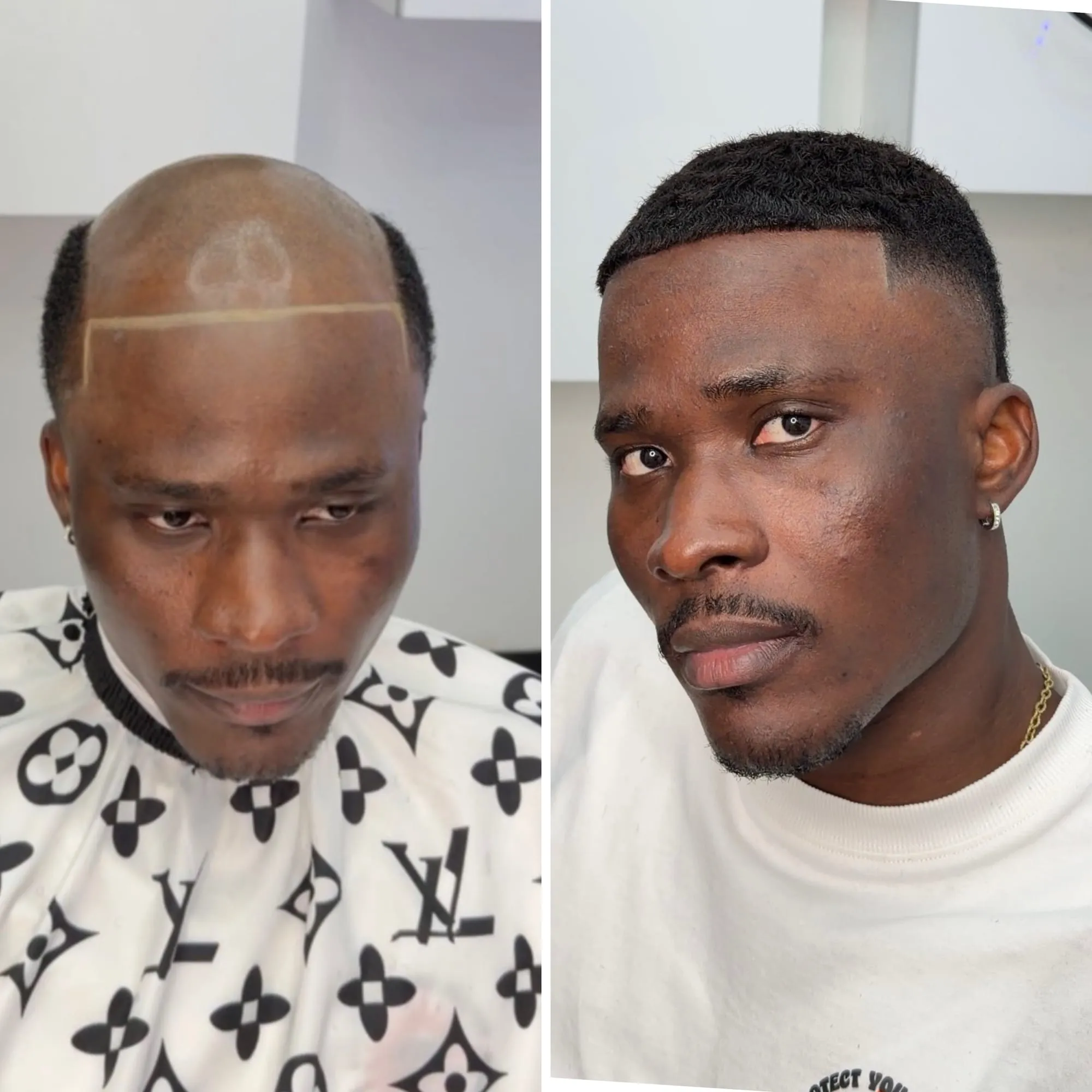
This is what it looks like.
A real client from our chair, photographed before and after his hair system was installed and cut in.
Questions, answered.
Why does my hair system keep coming off when my scalp is oily?
Sebum and sweat sit exactly where the adhesive needs to grip, softening the bond and thinning the seal so the edges lift, usually at the hairline first. It is physiology, not a defect. The fix is a humidity resistant adhesive, cleaner scalp prep, and a shorter reattachment cycle.
What adhesive is best for an oily, sweaty scalp?
A waterproof, humidity resistant adhesive usually beats a gentle water based one for oily skin, often paired with a scalp protecting base coat. There is no single best product for everyone, so we test a couple on your skin and pick the one that holds while staying comfortable.
How often should I reattach if I sweat a lot?
Oily, high sweat scalps often do best on a roughly one to two week cycle, where a drier scalp might stretch to three or four weeks. A fresh bond every week or two looks and feels better than nursing a lifting one, and we set your interval to your skin rather than a generic schedule.
Is my oily scalp a medical problem?
It can be. Persistent flaking, itch, redness, or grease that will not clean off can point to a skin condition, and that is for your physician or dermatologist to assess. We handle the cosmetic fit only and work alongside their advice, and a system covers the appearance of loss without treating your scalp.
Keep reading
Related.
Swimmers
Can you swim in a hair system? Yes. How chlorine, salt water, and full submersion change the bond and the aftercare, from a Phoenix studio.
Sensitive skin and adhesive allergies
How a hair system can work when adhesive irritates your skin: acrylate and latex sensitivity, skin testing, and tape-free clip alternatives.
For Professionals
How a hair system fits a working professional's schedule: discreet, low-maintenance, and undetectable on camera and across a desk.
Thinning Hair
Thinning but not bald? A hair system can add density and blend into the hair you still have. How early-stage hair systems work, from our chair.