

Last updated September 28, 2026
Why the beard drives the design
Most conversations about a hair system start at the scalp. When you wear a beard, we start with the whole face. The beard sits directly under the hairline, so the eye compares the two the moment it lands on you, and any gap in color or texture between them reads as off before anyone can say why.
This is barber thinking as much as hair replacement thinking. A good barber already balances a beard against the hair on top, and a unit is no different. We treat the beard as a fixed reference and build the unit to sit with it, rather than choosing hair in isolation and hoping it lands.
Matching a grey beard
Grey is where most mismatches happen. A beard often greys earlier and more heavily than the hair up top, so a man can carry a salt and pepper beard while the scalp hair reads darker. Put a solid, non-greying unit above that beard and the two stop looking like they belong to the same head.
The fix is to build grey into the unit on purpose. Hair systems can be ordered with a grey percentage blended through them, so the top can carry the same scattered grey your beard already shows. We look at how much grey your beard holds and where it sits, then match the unit to that rather than to a flat color chip.
- Read the beard first: how much grey, and how it is distributed
- Order a grey percentage into the unit instead of a flat shade
- Blend grey through the hairline, not just the back, so the front agrees with the beard
- Recheck the match in daylight, where grey shifts most
Hairline design when a beard is in the frame
A beard adds structure to the lower face, which changes what hairline suits you up top. A strong, defined beard can carry a slightly stronger hairline without looking heavy, while a softer beard usually pairs with a softer, more graduated front. The two lines are a set, and we design them to belong together.
Age reads in the pairing too. A crisp, dense hairline over a heavily greyed beard is one of the combinations that looks built rather than grown. Where your beard tells an honest age, we let the hairline tell the same one, so the whole picture holds up instead of fighting itself.
Where the giveaways hide
The tells with a beard are specific. Color is the big one, but density and temple design matter just as much. If the hair at your temples does not flow toward the beard the way growing hair would, the connection between face and hairline looks interrupted, even when the color is right.
Texture is the quieter tell. A beard that is coarse or wavy next to a unit that is straight and fine can read as two different heads of hair. We match texture and the direction the hair travels at the sides so the eye follows one continuous line from temple to jaw.
What drives cost and upkeep
For a beard match, the drivers are the same ones behind any unit plus one more. Base material, hair type, and the size of the area set the baseline, and a specific grey blend or texture match adds a bit of ordering detail because the unit is being built to a reference rather than a stock spec.
Upkeep runs on a cadence, not a one time fix. Grey can fade or warm as a unit ages while your beard keeps its own grey, so a system built to match a beard is worth rechecking at maintenance to keep the two in step. We are upfront about that rhythm before you commit so the color match stays honest over time.
Deciding if this is right for you
If you wear a beard and you want the hair up top to look like it belongs to the same face, that is exactly the problem a well matched unit solves. The beard gives us a clear reference, which often makes the match more precise, not less.
The honest way to know is a consultation. We look at your beard and your face together, talk through the grey and the texture, and tell you plainly what a match would take. If a system is not the right call for you, we will say so.
Real work
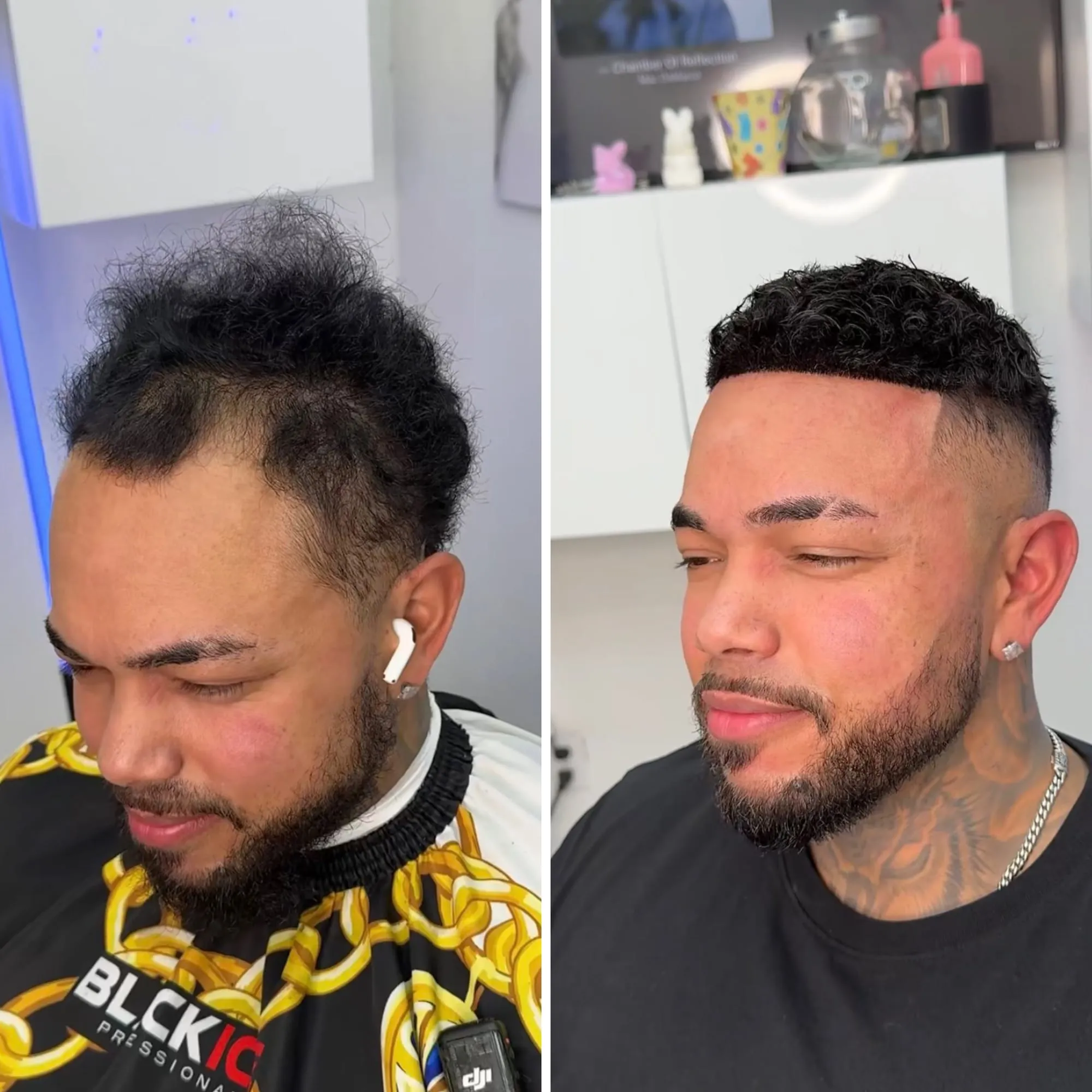
This is what it looks like.
A real client from our chair, photographed before and after his hair system was installed and cut in.
Questions, answered.
My beard is grey but my hair is not. Can a system still match?
Yes, and it is one of the more common things we design for. Hair systems can be ordered with a grey percentage blended through them, so the top carries the same scattered grey your beard shows instead of reading as a flat, darker shade above it.
Does wearing a beard change the hairline I should get?
It does. A beard adds structure to the lower face, so a defined beard can carry a slightly stronger hairline while a softer beard pairs with a softer front. We design the two lines as a set so they belong together.
What usually gives a system away when you have a beard?
Color mismatch is the biggest tell, followed by temple design and texture. If the sides do not flow toward the beard the way growing hair would, or the texture differs from your beard, the connection between face and hairline looks interrupted.
Will the beard match stay accurate over time?
Grey can fade or warm as a unit ages while your beard keeps its own grey, so we recheck the match at maintenance. Keeping the two in step is part of the upkeep rhythm we walk through before you commit.
Keep reading
Related.
For Men Over 50
How a hair system is built for a man in his fifties or sixties: age-appropriate density, grey blending, and a mature hairline that reads as your own.
Receding Hairline
How a hair system rebuilds a receding hairline without surgery: a front built where your hairline used to sit and blended into your own hair.
For Professionals
How a hair system fits a working professional's schedule: discreet, low-maintenance, and undetectable on camera and across a desk.
For Black Men
How a hair system is matched to coil and curl pattern, density, and skin tone for Black men, so the result reads as your own textured hair.