

Last updated September 28, 2026
The real question is who applies it, not where the unit came from
People often collapse two different decisions into one. Where a unit is bought and who attaches it are separate choices. You can order a fully custom unit and still install it yourself, or buy a stock unit and have a professional cut it in. This page is only about the second axis, who does the applying, because that is what decides how the finished result looks on your head on day one.
An install is not one action. It is a short sequence: prep the scalp and the unit, place the unit so the hairline lands in the right spot, bond it down, trim the lace front, then cut and blend the hair into your own so nothing reads as a hard edge. Reattaching a unit you already own and have already had cut in is a much shorter routine. The first full install is the hard one, and it is the one where a trained pair of hands earns its place.
The install, by the numbers
Here are the definitive specs behind a first install, the figures that make the skill gap concrete. The ranges below are typical for how these steps behave in real use, and they move with your hair, your climate, and the base you chose. No money appears here on purpose, because the figure for a professional install is set to your unit and your head at consultation. What is definitive is the technique and the tolerances.
| Install factor | Definitive spec or range | Self-install reality | Professional install |
|---|---|---|---|
| Full install time | First attempts run about 60 to 120 minutes; a practiced routine drops to about 25 to 45 minutes | Slow and error-prone early, because every step is new at once | About 45 to 90 minutes including the cut-in and blend |
| Hairline placement | Set roughly 4 finger-widths, about 7 to 10 cm, above the top brow line, following a soft arch rather than a straight line | Easy to set too low or too straight, which is the single most common giveaway | Placed to your face shape and age, measured against your old hairline photos |
| Lace front trim | Cut between the knots leaving about 1 to 2 mm of clear lace so no hard border shows against the skin | The riskiest cut for a beginner; too tight frays the knots, too wide leaves a visible edge | Trimmed knot line by hand, often with bleached knots at the front for an invisible base |
| Scalp prep and bond | Degrease skin with 70 to 99% isopropyl; let tape or glue tack about 5 to 15 minutes before pressing down | Under-prep or rushing the tack time is why a first bond lifts early | Full degrease, spot test for sensitive skin, even pressure across the whole perimeter |
| Adhesive hold window | Soft-bond tape holds roughly 3 to 14 days; hard-bond glue holds roughly 2 to 4 weeks per cycle | Choosing the wrong adhesive for your sweat and activity level shortens every hold | Adhesive matched to your scalp, climate, and how often you want to reset |
| Cut-in and blend | Point-cut to remove bulk and taper the perimeter into your own hair; done only after the unit is bonded | Almost never attempted well on a first solo unit; this is the step that reads as a haircut, not a unit | The core of the professional service and the hardest skill to self-teach |
The skill curve, cycle by cycle
Self-install is a learnable skill, not a talent, but it is a curve, not a switch. The bond gets reliable quickly. The hairline judgment and the blend take longer, because they depend on reading your own head in a mirror, which is genuinely harder than working on someone else. Here is roughly how the curve runs for most men who commit to learning it.
| Stage | Typical cycle range | Time per install | Where it stands |
|---|---|---|---|
| First installs | Cycle 1 to 2 | 60 to 120 minutes | Best done watched or coached; hairline and lace trim are the weak points |
| Building the routine | Cycle 3 to 6 | 40 to 60 minutes | Bond gets consistent; hairline placement is still the hardest call |
| Competent solo | Cycle 7 to 10 and up | 25 to 45 minutes | Clean and repeatable; periodic cut-in refreshes still benefit from a pro |
What a professional catches that a first-timer misses
The value of a pro install is not mystique, it is a set of specific errors caught before they show. These are the ones we fix most often when someone comes in after a rough self-install, ranked by how badly each one reads in daylight.
- Hairline set too low or too flat, the number-one tell, because a real hairline sits higher and arches than most people expect
- A visible lace edge, where the front was trimmed too far back from the knots and leaves a hard line on the skin
- Density too heavy at the very front, when a natural hairline should start soft and irregular, not full
- A blend that stops at the unit's edge instead of tapering the perimeter hair into your own
- The wrong adhesive for your scalp, so the bond lifts at the temples or the front within days
- Knots left dark and unbleached at the front, which catch light and read as dots against the skin
When self-install genuinely makes sense
None of this means self-install is a trap. For the right person it is the honest, economical long-term answer, and we teach it on purpose through the install-your-own service. It fits best once the hard, one-time decisions have already been made by a pro: your hairline position is set, your unit is already cut in to your face, and you are essentially repeating a known routine rather than inventing it in the mirror.
The men it suits are the ones who are comfortable with their hands, who wear a base that is forgiving to handle such as a thicker skin or a mono body, and who value the control of resetting their own bond on their own schedule. The men it does not suit yet are first-timers, anyone chasing an on-show lace hairline for the first time, and anyone who would rather spend the time living than learning. There is no shame in either lane, and plenty of men move from one to the other over a year.
This is not the same as at-home vs studio reattachment
It is worth drawing a clean line here, because these two decisions get confused constantly. A full install includes placement, the lace trim, and the cut-in, all the one-time shaping that defines how the unit looks. A reattachment is the recurring step of cleaning off old adhesive and re-bonding a unit that has already been shaped, which is a much shorter and lower-stakes routine.
That is why plenty of men have a professional handle the first install and the periodic cut-in refresh, then reattach at home in between. Deciding who applies the unit the first time is a different question from deciding where you reset the bond every couple of weeks. If your question is really about the recurring reset rather than the first shaping, the at-home vs studio reattachment breakdown is the page you want.
What is set at consultation
For a professional install, the drivers that move the effort, and therefore what is quoted, are ranked roughly like this: whether it is a first install with a fresh hairline and full cut-in versus a straightforward reset, the base type and how delicate the front lace is to trim, whether the front knots need bleaching, and the hair length, since anything much over about six inches takes longer to cut in and blend. A first install with a custom cut-in sits at the higher end of effort, a repeat reset at the lower end.
For self-install, the cost driver is not a service figure at all, it is your time and your tolerance for a learning curve, plus the tools and adhesives you will keep on hand. Every actual figure is quoted at your consultation against your real unit and your real head, not published as a blanket price, because a first install and a routine reset are genuinely different amounts of work. Bring your unit, or your plan for one, and we will tell you honestly which lane fits you now and when it makes sense to switch.
Real work
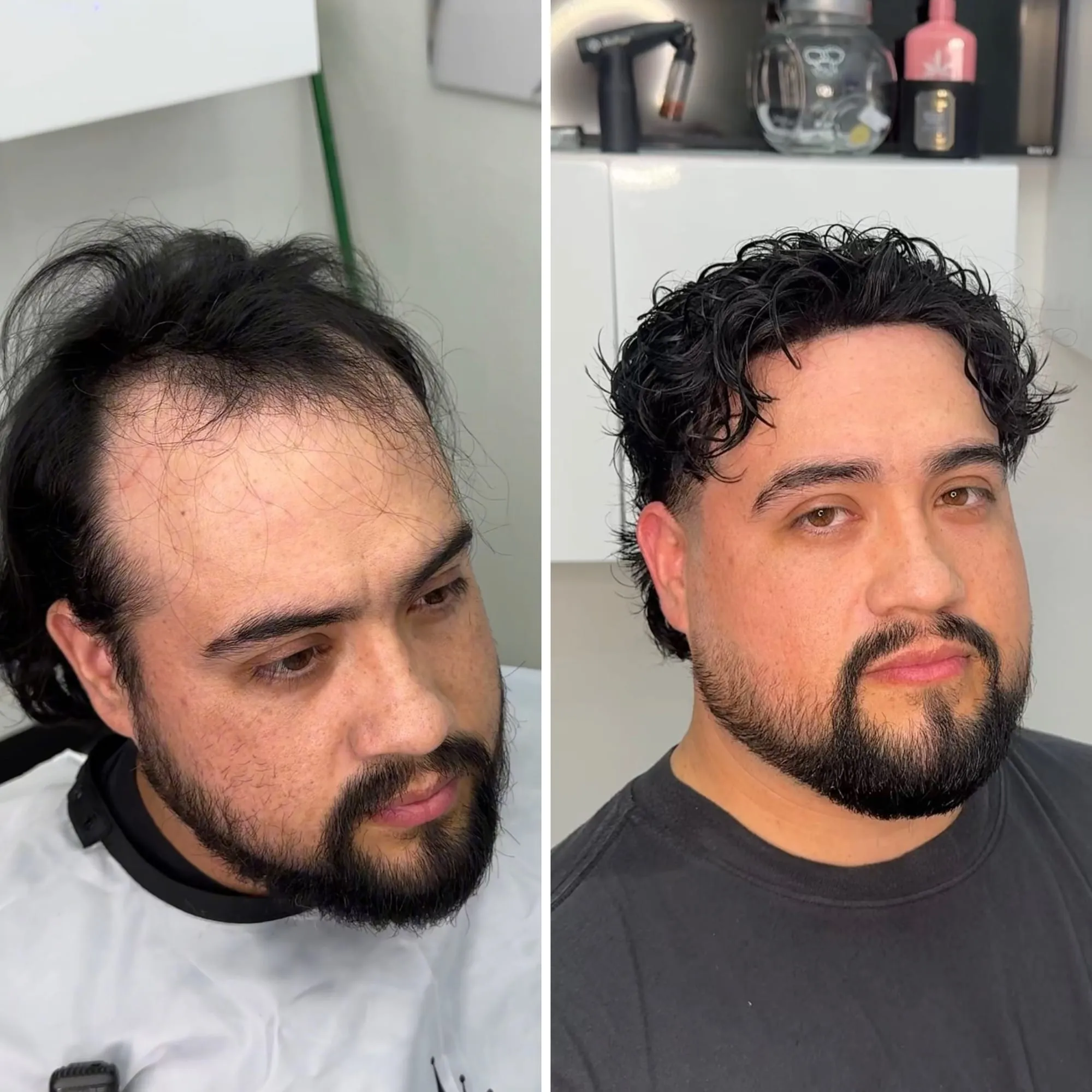
This is what it looks like.
A real client from our chair, photographed before and after his hair system was installed and cut in.
Questions, answered.
Can I install a hair system myself the first time?
You can, but the first install is the hardest one, because placing the hairline, trimming the lace front, and cutting the unit in all happen at once. Most men get a far cleaner result having a pro do the first install and the cut-in, then learn to reattach and reset the bond themselves after that.
How long does it take to get good at self-install?
The bond gets reliable within the first few cycles. Hairline judgment and a clean blend usually take somewhere around the third to tenth full cycle, dropping install time from an hour or two down to about 25 to 45 minutes once the routine is yours.
What is the most common self-install mistake?
Setting the hairline too low and too straight. A natural hairline sits higher than most people expect, roughly 4 finger-widths above the brows, and follows a soft arch. A visible lace edge from trimming too far back from the knots is a close second.
Is this the same as deciding to reattach at home or in the studio?
No. An install includes the one-time placement, lace trim, and cut-in that shape the unit. A reattachment is the recurring reset of an already-shaped unit. Many men have a pro do the first install and periodic cut-in, then reattach at home in between.
Why are there no prices on this page?
Because a first install with a fresh hairline and full cut-in is a different amount of work than a routine reset, and the figure also depends on your base, front lace, and hair length. We quote against your actual unit and head at consultation, with no obligation.
Keep reading
Related guides.
Options Compared
Hair systems, transplants, SMP, medication, shaving, or nothing. An honest side by side of coverage, reversibility, commitment, and upkeep.
Attachment Methods
Tape, bonding, and clip attachment for hair systems compared by hold, comfort, and how they suit your routine. How to attach a hair system.
Reattach at Home or Studio
Should you reapply your hair system yourself or come in? How the reattachment cycle, skill curve, time, and failure modes compare at home vs the studio.
The Hairline
A natural hair system hairline is built from irregularity, a soft density gradient, and careful placement. Here is how we design one that reads as yours.