

Last updated September 28, 2026
The one tradeoff that decides it
Mono and lace sit at opposite ends of the same axis. Monofilament is a fine but resilient mesh, so it survives daily handling, holds knots under tension, and tolerates being re-ventilated when it thins. Lace is the thinnest material used in hair replacement, which is exactly why a lace hairline can vanish against your skin, and also why it tears sooner. Durability and undetectability pull against each other, and the base you pick is really a decision about which one you are willing to trade for the other.
Breathability follows the same split. The open weave of lace lets your scalp breathe and dumps heat quickly, which matters in an Arizona summer or under a hard workout. Monofilament breathes too, but its tighter mesh and the poly or skin perimeter most mono units carry for attachment cut airflow compared with full lace. So lace is cooler and more invisible, mono is tougher and more forgiving, and the table below puts real numbers to every point of that comparison.
Mono base vs lace, spec by spec
Here is the definitive comparison across the specifications that actually differ between the two bases. The wear-life ranges are typical for daily use and shift with your climate, activity, and how carefully the unit is maintained. Density figures are the ranges each base carries comfortably without stressing the weave. No amounts appear because the price of any build is set to your specification at consultation; what is fixed is how these two materials behave.
| Criteria | Monofilament base | Lace base (Swiss / French) |
|---|---|---|
| Base material | Fine hand-tied polyester or nylon monofilament mesh, usually with a poly or skin perimeter | Swiss or French lace mesh, the finest material used in hair replacement |
| Breathability | Moderate, the mesh breathes but sealed edges and the perimeter reduce airflow | High, the open weave lets the scalp breathe and sheds heat fast |
| Typical wear life | Roughly 6 to 12 months in daily wear | Roughly 3 to 6 months in daily wear |
| Hairline realism | Very good, though knots can show slightly at the very front unless a lace or skin front is added | The most undetectable available, single and bleached knots read as hair growing from the scalp |
| Knotting at the front | Single or double knots, often with a dedicated lace or skin front zone for invisibility | Single knots, bleached across the leading 1 to 1.5 cm to lighten the knot |
| Density it carries well | Medium to heavy, roughly 100 to 130 percent, without strain | Light to medium, roughly 80 to 110 percent, heavier density stresses the weave |
| Hairline light zone | Set by any added front material | Light knotting near 50 to 70 percent across the leading 1 cm for a soft front |
| Stock base size | About 8 by 10 inches stock, cut to your template | About 8 by 10 inches stock, cut to your template |
| Repair and re-ventilation | Re-ventilates and repairs readily, the mesh tolerates rework | Re-ventilates but fine lace tears, front repairs stay delicate |
| Attachment surface | Usually bonds through a poly or skin perimeter with tape or glue | Bonds directly, tape or glue sits on the lace edge |
Where the monofilament base wins
Monofilament is built for the long haul. Because the mesh takes tension without deforming, it holds a higher density cleanly, roughly 100 to 130 percent, which is why mono is a common choice for men who want fuller coverage or are not ready to go light on top. That same toughness stretches the wear life to roughly 6 to 12 months, close to double what fine lace typically returns, so the unit spends more time on your head and less time being replaced.
It is also the more forgiving base to live with and to service. When the front thins over time, a mono base re-ventilates well and tolerates repair rather than tearing, which extends its useful life further. For a first unit, for someone hard on their hair, or for anyone who would rather not think about their base every week, mono is usually the lower-maintenance answer. The trade is at the very front, where mono knots can read slightly less invisible than lace unless you add a lace or skin front zone.
Where the lace base wins
Lace wins on the two things you notice first: the hairline and the heat. A knotted lace front, single-knotted and bleached across the leading 1 to 1.5 cm, is about as undetectable as hair replacement gets, so the parting and the front third look like hair emerging from your own scalp. If someone will be looking at your hairline up close, in good light, lace is the material that holds up to that scrutiny.
The open weave is also the most breathable base you can wear. Air moves straight through it, sweat evaporates faster, and the scalp stays cooler under heat or exertion, which is a real comfort factor in a hot climate. The cost of that performance is fragility. Fine lace tears more easily, carries best at light to medium density near 80 to 110 percent rather than heavy, and lasts roughly 3 to 6 months, so you accept more frequent replacement in exchange for the most natural, coolest-wearing result available.
The hybrid answer: lace only where it shows
You do not have to pick one material for the whole unit. A hybrid base puts fine lace or thin skin across the front hairline, where invisibility matters most, and a durable monofilament body everywhere behind it. You get the lace front that reads perfectly at the parting and the mono body that survives daily wear, which is why many men settle here once they understand the tradeoff instead of choosing a single material end to end.
The construction is more complex, so a hybrid sits higher among the base cost drivers than a plain mono or a stock lace unit, with the exact figure set at consultation. What you buy for that is a longer overall wear life than full lace with a front that looks just as good, and a base that is easier to repair across most of its area. If neither pure mono nor pure lace feels right, the hybrid is usually the reason.
- Want the longest wear life and higher density, and are hard on your hair: mono leans your way
- Want the most invisible hairline and the coolest, most breathable base: lace leans your way
- Want a flawless front without a fragile whole unit: a hybrid front on a mono body splits the difference
- Run hot or live in a hot climate and prioritize airflow over longevity: lace fits, mono if you sweat into the perimeter
Specs that behave the same on both bases
A few things do not change with your base choice, so do not let them tip the decision. Base curl and wave are specified the same way on either material, using perm rod sizes that run from roughly 13 mm for a tighter curl up to about 32 mm for a loose wave, matched to your natural pattern. Stock sizes for both bases center on about 8 by 10 inches before they are cut down to your template, and a fully custom template is a cost driver on either one.
Hair type and origin, color code, and grey percentage are also independent of whether you order mono or lace. Those are set on your order form regardless of base, so the mono versus lace call comes down cleanly to the durability, breathability, and hairline tradeoff on this page rather than to any of the shared specifications.
What is set at consultation
Base construction is one of the larger cost drivers, and mono, lace, and hybrid each land differently on it, with lace fronts and fully custom hybrid builds sitting toward the higher end and a straightforward mono or stock lace base toward the lower end. On top of the base, the usual add-on drivers apply the same way, ranked roughly by how much they move the figure: hair type and origin, then a custom template, then extras such as hair length over about six inches, a silk top, European hair, or a larger base. Every one of those is quoted against your actual specification at consultation, not published as a blanket number, because two men can order what sounds like the same unit and need very different builds.
What we can tell you before you sit down is the logic here: judge mono against lace on how you live, not on the front alone. If you want longevity, density, and less maintenance, mono earns it; if you want the most invisible hairline and the coolest wear, lace earns it; and if you want both, a hybrid front on a mono body is usually the move. Bring your routine and your climate and we will map the right base to both.
Real work
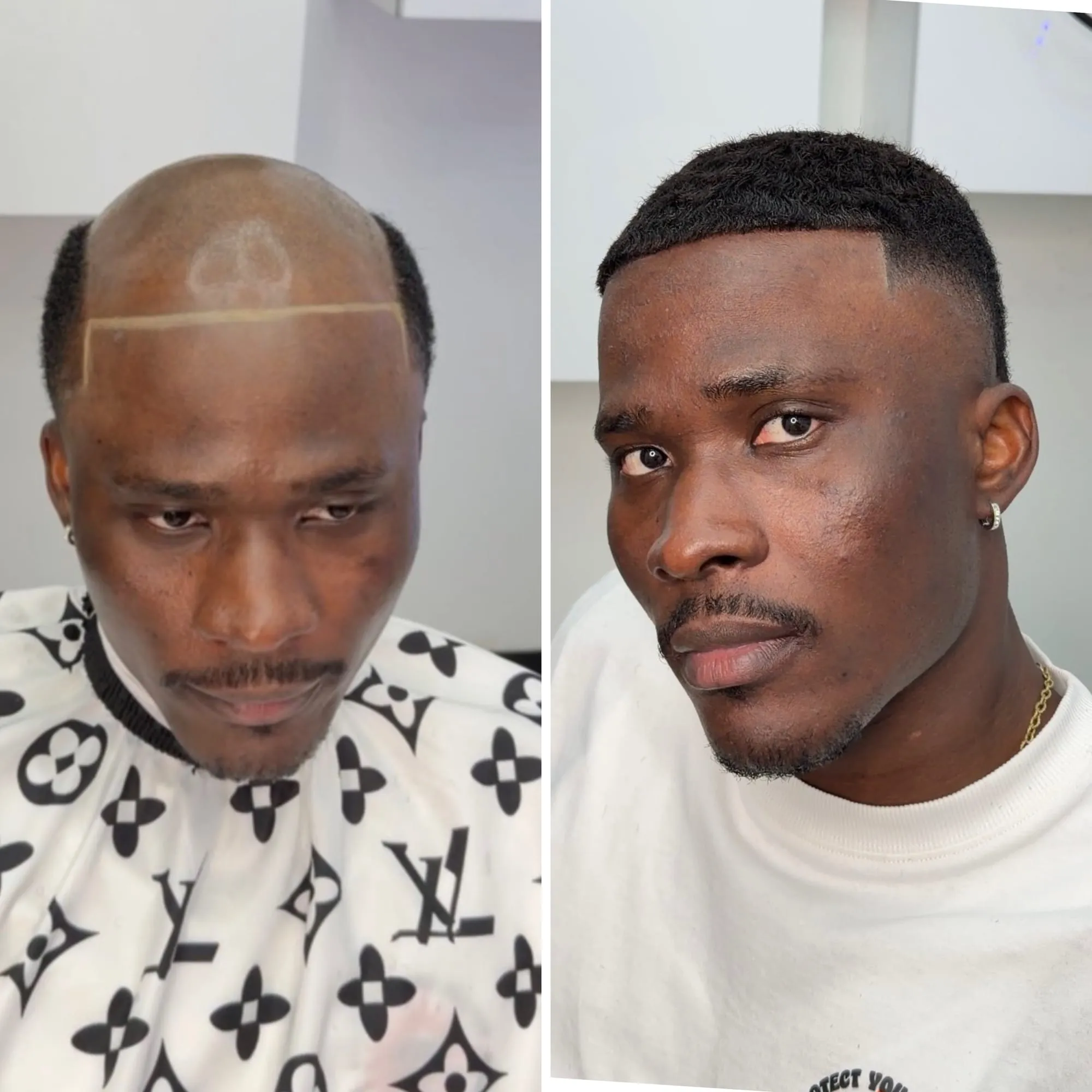
This is what it looks like.
A real client from our chair, photographed before and after his hair system was installed and cut in.
Questions, answered.
Is a mono base or a lace base more durable?
A monofilament base is more durable. Its resilient mesh holds knots under tension and tolerates re-ventilation, so it typically lasts roughly 6 to 12 months in daily wear, against roughly 3 to 6 months for fine lace. Lace trades that longevity for a more undetectable front.
Which base breathes better, mono or lace?
Lace breathes better. Its open weave lets the scalp breathe and sheds heat quickly, which is a real comfort factor in a hot climate. A mono base breathes too, but its tighter mesh and poly or skin perimeter cut airflow compared with full lace.
Does a mono base look as natural as lace at the hairline?
Not quite at the very front. Mono knots can read slightly less invisible than single, bleached lace knots. Many units solve this by adding a lace or skin front zone to a mono body, which is the hybrid approach and gives a natural front on a durable base.
Can a mono base carry higher density than lace?
Yes. Monofilament carries medium to heavy density comfortably, roughly 100 to 130 percent, because the mesh takes the tension. Fine lace is best at light to medium density, roughly 80 to 110 percent, since heavier density stresses the delicate weave.
Should I choose mono, lace, or a hybrid?
Choose mono for the longest wear life, higher density, and lower maintenance; choose lace for the most invisible hairline and the coolest, most breathable wear; choose a hybrid, a lace front on a mono body, when you want both. We map the right base to your routine and climate at consultation.
Keep reading
Related guides.
Options Compared
Hair systems, transplants, SMP, medication, shaving, or nothing. An honest side by side of coverage, reversibility, commitment, and upkeep.
Lace, Poly, or Skin
Lace breathes and looks natural, skin is invisible and easy to clean, poly holds longest. How we pick a hair system base by realism and upkeep.
Monofilament base
A monofilament hair system uses fine polyester or nylon mesh, the most durable base, holding the highest density. How we spec and build mono.
How Long Hair Systems Last
How long a hair system lasts depends on the base, your routine, and maintenance. Here is what to expect and how to make yours last longer.