

Last updated September 28, 2026
The three ownership questions that actually separate them
Almost every real difference between an independent studio and a franchise program collapses into three questions, and none of them is about the hair itself. The first is unit ownership. When you pay for a hair system, does the finished unit belong to you the way a pair of glasses does, or is it held by the program and effectively rented to you for as long as you keep paying. The second is specification ownership, meaning who holds your order form, your base measurements, your density and color codes, and your template or mold. The third is record ownership, meaning who controls your appointment history and can carry it forward if you ever move or switch providers.
These are brand-agnostic questions on purpose. A well run franchise can produce excellent work, and a careless independent can produce poor work, so the model alone does not decide quality. What the model does decide is your leverage later, which is why we frame the comparison structurally rather than by name. Ask the three questions at any provider and the terms become clear before you commit to anything.
The structural comparison
Here is how the two models tend to differ on the terms that outlast the first appointment. These are common patterns, not universal rules, so treat them as the checklist to confirm in writing rather than assumptions. The physical hair systems can be identical on both sides of this table. What changes is the paperwork around them.
| Structural question | Independent studio (typical) | Franchise or chain program (typical) |
|---|---|---|
| Who owns the finished unit | Yours outright once it is paid for | Often program-held, returned, or re-bought at exit |
| Your order form and codes | Shared with you, so any studio can reorder it | Frequently kept in-house as a house catalog code |
| Your template or mold | Kept for you and released on request | Held by the location, not always portable |
| Contract length | Commonly month to month, no minimum term | Multi-month to annual agreements are common |
| Appointment and client record | Yours and transferable if you move | Tied to the location's own system |
| How pricing is presented | Itemized against your actual specification | Bundled into a program or membership fee |
| Who you see each visit | The same practitioner where possible | May rotate across staff or locations |
What owning your specification actually means
Specification ownership sounds abstract until you see how many exact numbers and codes make up a single hair system. A unit is not one product, it is a stack of measurable decisions, and every one of them lives on an order form. When you own that form, any competent studio anywhere can reorder your unit without re-measuring you from scratch. When a program keeps the form as an internal catalog code, you can be locked to that program simply because no one else has your numbers.
Below are the specification axes that define a men's hair system, with the definitive ranges and codes the industry actually uses. None of these are prices, they are dimensions, percentages, and material codes. This is the sheet you want a copy of, because this is what you are really buying.
| Specification axis | Definitive range or code | Why owning it matters |
|---|---|---|
| Base dimensions | Stock sizes roughly 6 x 9 in to 9 x 11 in, or cut to a custom template | Sets fit and coverage, and lets any studio match your head |
| Skin base thickness | About 0.03 mm ultra-thin up to roughly 0.20 mm for durable skin | Controls realism against wear life, a repeatable number |
| Density | Light near 80 to 100 percent, medium 110 to 130 percent, heavy 140 to 180 percent | Defines how full the unit looks, exact per your order |
| Grey percentage | 0 to 100 percent, usually specified in 10 percent steps | Matches salt-and-pepper blends precisely on reorder |
| Front contour | Straight, curved (often coded CC), or receded, matched to a template | Shapes the hairline to your face, not a generic curve |
| Curl or wave | Straight, or a rod size roughly 10 mm for tight curl up to 40 mm and beyond for loose wave | Reproduces your texture from a single code |
| Wear life by base | Skin about 1 to 6 months, lace 3 to 6, mono 6 to 12, hybrid 4 to 9 | Tells you how often the spec gets reordered |
Contracts and lock-in
The contract is where the two models separate the most. Independent studios frequently work month to month, with no minimum term, because the relationship is meant to survive on the quality of each visit rather than on a signature. You buy a unit, you book maintenance when you need it, and you are free to stop or switch at any point without a penalty clause.
A franchise or chain program is more likely to sell a membership or a multi-month agreement that bundles units, maintenance, and sometimes products into a recurring commitment. That structure can be convenient, and for some men the predictability is genuinely worth it. The thing to read carefully is the exit. Ask what happens to the unit you are wearing if you cancel, whether your template and order form leave with you, and whether there is a term you are still liable for. If those answers are clear and fair, a program can be fine. If they are vague, that vagueness is the product.
- Ask whether the agreement is month to month or a fixed term, and how long
- Ask what you keep if you cancel, specifically the unit, the template, and the order form
- Ask whether maintenance pricing is itemized or folded into a recurring fee
- Ask who holds your appointment record and whether it transfers on request
Continuity of care and who holds your record
A hair system is a relationship, not a one-time purchase, because the fit gets dialed in over the first few appointments and the color and density get refined on reorder. That makes continuity valuable. At an independent studio you tend to see the same practitioner each visit, so the person cutting in your unit is the person who remembers how your hairline sits and how your scalp behaves in summer. Your record is a working memory that improves the result over time.
In a larger program you may see whoever is available, across staff or even across locations. That can still work when the record travels well, which is exactly why record ownership matters. If your notes, photos, and codes are all stored where the next practitioner can read them, rotation is survivable. If they are not, every new face starts closer to zero. The question to ask is simple: if I see someone new next time, will they have my full spec in front of them.
Cost transparency, without the price
Neither model should ask you to commit before you understand what drives the number, and this is often where a chain program that publishes nothing at all cannot answer a straight question. Independent studios tend to itemize against your actual specification, so you can see which choices move the figure. Ranked by how much they move it, the big levers are base construction, hair type and origin, and any fully custom template, followed by add-ons such as length over about six inches, a silk top, or a larger base. European hair and fully custom work sit at the higher end, stock and standard bases at the lower end.
We do not publish a blanket price on this page for the same reason a good studio will not quote one over the phone: two men can order what sounds like the same unit and need very different builds, so a real figure only exists once your specification does. What you should expect from either model is a clear, itemized quote against your own spec at consultation, with the drivers named rather than hidden inside a membership. If a program cannot break the number down, that is the answer to whether it is transparent.
How we work at The Hair Experience
We run as an independent studio in Peoria, Arizona and Eighty Four, Pennsylvania, and we build the relationship around the three ownership questions on purpose. You own your unit outright once it is paid for. You get a copy of your order form with your base size, density, color, grey percentage, contour, and curl code on it, so your specification is yours to take anywhere. Your template stays on file for you, and your record follows you between our two studios.
Nico Rigano, Ivette Rigano, and Denisse Diaz work month to month with the men we serve, no membership required, because we would rather earn the next appointment than lock in the last one. If you are weighing an independent studio against a franchise program, bring this page and the four questions in the list above to both, and hold each provider to the same standard. The right answer is the one that hands you your unit, your spec, and your record, and quotes you honestly against them.
Real work
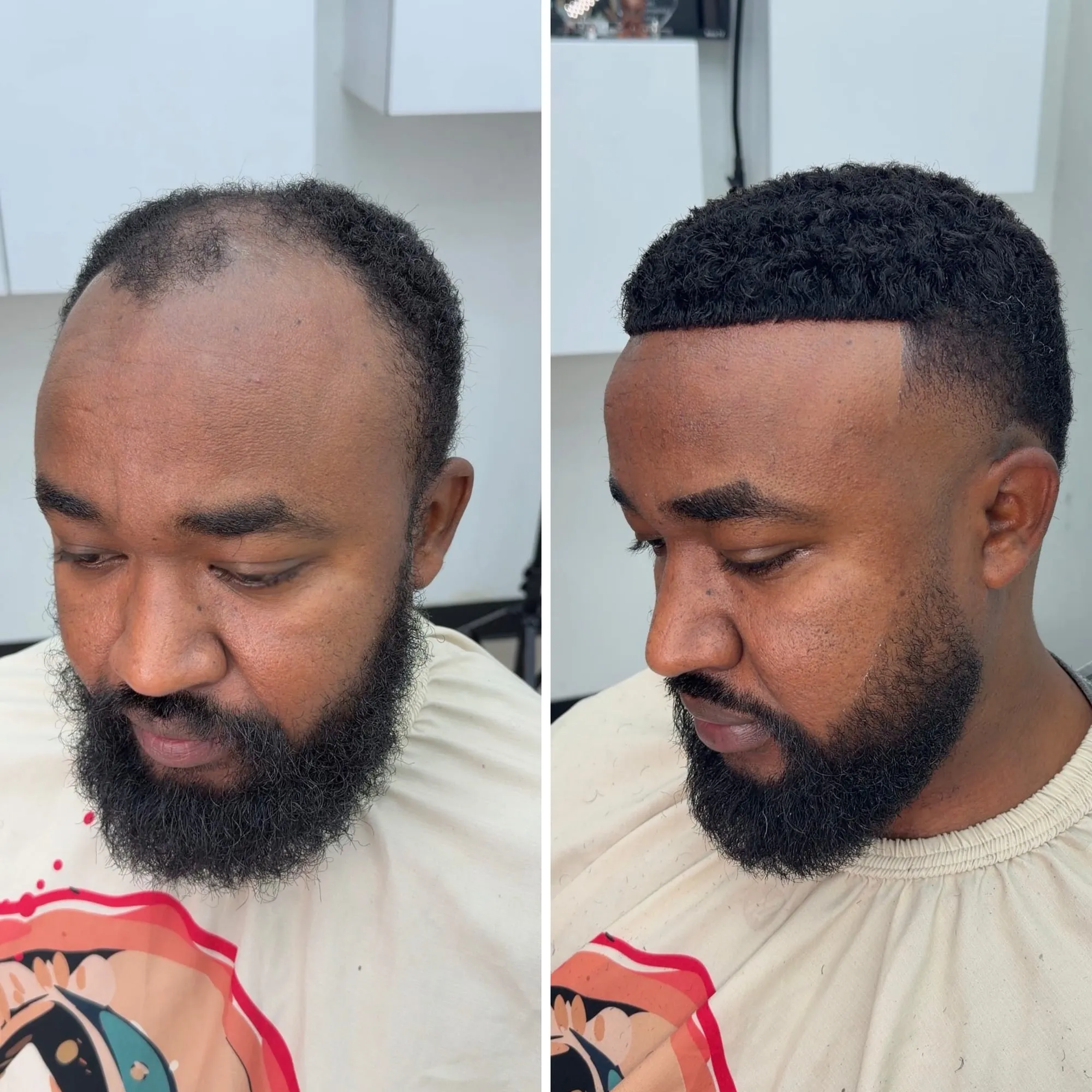
This is what it looks like.
A real client from our chair, photographed before and after his hair system was installed and cut in.
Questions, answered.
What is the real difference between an independent studio and a franchise hair replacement program?
The hair systems can be identical. What differs is the terms: who owns the finished unit, who holds your order form and template, how long the contract runs, and who controls your appointment record. Independent studios usually give you all of that outright and month to month. Franchise programs more often keep the spec in-house and sell a multi-month agreement.
Do I own my hair system, or does the studio?
At most independent studios the unit is yours outright once it is paid for. Some franchise or chain programs hold the unit or require you to return or re-buy it if you leave. Always confirm ownership and what happens at exit in writing before you commit.
Why does owning my order form matter?
Your order form carries the exact numbers that define your unit: base size, density percentage, grey percentage, contour, color, and curl code. When you hold a copy, any competent studio can reorder your system without re-measuring you. When a program keeps it as an internal code, you can be locked to that program because no one else has your numbers.
Are franchise programs more expensive than independent studios?
Not necessarily, and neither should ask you to commit before you understand the drivers. Independent studios tend to itemize against your actual specification, while programs often bundle units and maintenance into a recurring fee. The figure depends on base, hair type, template, and add-ons, so it is quoted at consultation either way. Ask for an itemized breakdown before you sign.
Should I sign a long-term membership for hair replacement?
Only if the exit terms are clear and fair. Ask what you keep if you cancel, specifically the unit, the template, and the order form, and whether you are liable for a remaining term. A program can be worth it for the convenience, but vague exit terms are a reason to slow down.
Keep reading
Related guides.
Options Compared
Hair systems, transplants, SMP, medication, shaving, or nothing. An honest side by side of coverage, reversibility, commitment, and upkeep.
Cost Drivers
Hair system cost is set by base size, base material, hair origin, density, wave, color, custom vs stock, and service cadence. Here is the ranked picture.
Reading the Order Form
Every field on a custom hair system order form explained in one place: base size, material, density, color, grey, curl, length, origin, and more.
Stock vs Custom
Stock hair systems are ready made and fast. Custom units are built to your head, color, and hairline. Here is how the two differ and when each makes sense.