

Last updated September 28, 2026
Why there is no single price to quote
A hair system is not one product, it is a set of decisions. Two men can both walk in wanting to cover the same amount of loss and leave with builds that cost very different amounts, because one wanted the most invisible front possible and the other wanted the longest lasting unit for an active life. Neither is wrong. They simply weighted the drivers differently.
That is why we quote at the consultation rather than on a page. Once we know how much scalp the base needs to cover, which material fits your skin and your climate, and how the hair should look and behave, the number falls out of those choices. This page ranks the drivers so you walk in already understanding what moves the figure and why.
The cost drivers, ranked
Below is the honest ranking, from the driver that moves cost most to the one that moves it least. Direction tells you which way each choice pushes the number. The exact figure for your build is set at the consultation once these are decided together, because the drivers interact and only make sense as a whole.
| Driver | Why it moves cost | Direction |
|---|---|---|
| Base size | More scalp to cover means more base material and more hand-ventilated hair. A full cap is a bigger build than a crown piece. | Larger coverage pushes cost up |
| Base material | Fine lace and ultra thin skin take more skill to build and wear out sooner than sturdier bases, so they carry a higher build and replacement component. | Finer, more delicate bases push cost up |
| Hair origin and processing | Where the hair comes from and how it is processed sets quality and match. European hair and lightly processed remy hair sit at the top of this driver. | European and remy origins push cost up |
| Density | Higher density means more strands knotted into the base by hand, which is more material and more labour. Age-appropriate density often looks better and costs less. | Higher density pushes cost up |
| Wave or curl | Straight is the baseline. Adding a specific wave or curl pattern is extra processing and matching work. | Pronounced wave or curl pushes cost up |
| Color complexity | A single natural color is simplest. Grey blending, root shadow, and multi-tone color take more work to build and to match. | Grey and multi-tone color push cost up |
| Custom vs stock | A stock unit is pre-made to standard specs. A custom unit is built to your exact template, hairline, and blend, which is more labour and lead time. | Custom pushes cost up over stock |
| Service cadence | How often you come in for maintenance and how often the unit is replaced set the ongoing side of cost, separate from the build itself. | More frequent service and replacement push cost up |
Base size and base material: the two that move it most
Base size is the first driver because it sets how much of everything else you are paying for. A small crown piece covers a fraction of the scalp a full cap does, and every strand in that base is ventilated by hand, so a larger footprint carries more material and more labour. We size the base to the loss, never larger than it needs to be, which is the single most direct way the build is kept honest.
Base material is close behind and it is a genuine trade-off, not an upgrade ladder. The finest lace and thinnest skin give the most undetectable front and hairline, and they also wear out faster, so they carry both a higher build component and a shorter replacement interval. A sturdier base gives up a little at the very front and lasts noticeably longer. In Arizona heat and heavy sweat, durability is a real factor, which is why we talk climate at the consultation rather than defaulting everyone to the most delicate option.
Hair origin, density, wave, and color: the hair itself
Hair origin and processing is the driver most men have never heard of and it matters more than they expect. Human hair for systems is graded by where it comes from and how gently it has been processed. European hair and lightly processed remy hair, where the cuticle is intact and running the same direction, sit at the top of this driver because they are scarcer and behave most like growing hair. Other origins are entirely good hair and land lower on the driver. There is also synthetic hair, which is a different category we can explain in person if it comes up.
Density is how much hair is knotted into the base. It is easy to assume more is better, but a density matched to your age and your remaining hair almost always looks more natural than a dense cap, and it costs less because it is less hand labour. Wave or curl adds processing on top of straight hair, so a specific pattern moves the number a little. Color is the last of the hair drivers: one natural shade is simplest, while grey blending and multi-tone work take more matching effort. None of these are cosmetic gimmicks, they are the levers that make a unit read as yours.
- Origin: European and remy hair sit highest on this driver
- Density: age-appropriate density usually looks best and costs less
- Wave or curl: a specific pattern is extra processing over straight
- Color: grey and multi-tone blending add matching work
Custom versus stock, and the ongoing side
Custom versus stock is a real fork. A stock unit is built to standard specifications and is ready sooner, which makes it the lighter option on this driver and a sensible starting point for many men. A custom unit is built to your own template, your exact hairline, your chosen density and color, and that added labour and lead time move the figure up. Which one fits depends on how particular your hair is and how much the finest match matters to you, and we are candid about that rather than steering everyone to custom.
Service cadence sits slightly apart from the build drivers because it is the recurring side rather than the one-time one. How often you come in for maintenance and how often a unit is replaced shape what a full year costs. It is covered in depth on the cost-per-year guide, but it belongs on this list because two identical builds can cost differently over time purely on how they are serviced.
How the drivers come together at your consultation
These drivers do not add up in isolation, they interact. A larger base in the finest material with high density and a custom build sits at one end. A right-sized base in a durable material with age-appropriate density from a stock unit sits at the other. Most men land somewhere sensible in between, guided by how their hair looks now and how they actually live day to day.
This page stays on the drivers rather than figures on purpose, because your number depends entirely on the choices above and quoting a range in the abstract would be dishonest. At the consultation we walk each driver with you, in our chair with Nico, Ivette, or Denisse, and land on the build and the exact figure together. There is no obligation attached, whether you come to Peoria in the West Valley or Eighty Four in the Pittsburgh metro.
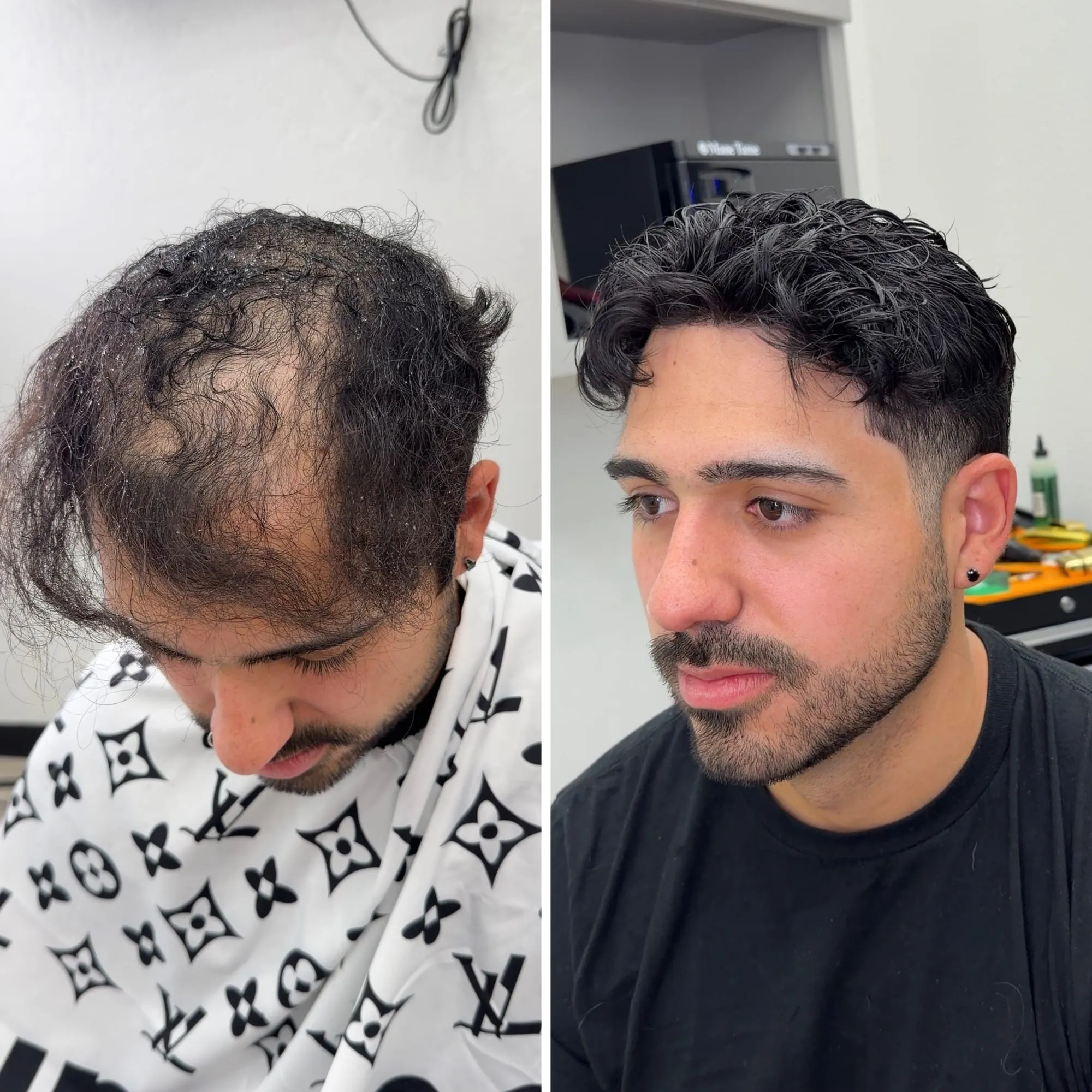
Real work
This is what it looks like.
A real client from our chair, photographed before and after his hair system was installed and cut in.
Questions, answered.
What makes a hair system expensive?
The biggest levers are base size, base material, and hair origin. A larger base in the finest lace or thinnest skin, built with European or remy hair at high density, sits at the top end. A right-sized base in a durable material with age-appropriate density costs less and often lasts longer.
Does a bigger base always cost more?
More coverage means more base material and more hand-ventilated hair, so a larger footprint does carry a larger build. We size the base to your actual loss and never larger than it needs to be, which keeps that driver honest.
Is a custom hair system worth more than a stock one?
It depends on your hair. A stock unit is built to standard specs and is ready sooner. A custom unit is built to your exact template, hairline, density, and color, which is more labour and lead time. We are candid at the consultation about which one actually fits you.
Why not just publish the price on the site?
Because the drivers interact and no single figure fits every man. Base size, material, hair, density, color, and custom versus stock all move the number, so an honest quote only comes after we walk those choices with you at the consultation.
Which driver should I focus on to control cost?
Base material and density give the most control without hurting how it looks. A durable base sized to your loss, with density matched to your age, tends to serve both the look and the budget better than defaulting to the finest, densest build available.
Keep reading
Related guides.
Cost Per Year
What a hair system costs to run per year and month comes down to how long it lasts, your maintenance rhythm, and supplies. Here is the whole picture.
Stock vs Custom
Stock hair systems are ready made and fast. Custom units are built to your head, color, and hairline. Here is how the two differ and when each makes sense.
Lace, Poly, or Skin
Lace breathes and looks natural, skin is invisible and easy to clean, poly holds longest. How we pick a hair system base by realism and upkeep.