

Last updated September 28, 2026
What a hybrid base actually is
Most men researching hair replacement online only hear about two extremes, an all skin unit or an all lace unit, so the base that sits between them rarely gets named. That is the hybrid, and it is what a lot of studios, ours included, reach for by default. The idea is simple. You do not need the same material across the whole unit, because the front and the perimeter are asked to do completely different jobs.
At the hairline, the goal is invisibility. A knotted lace front against your skin disappears better than anything else, so that is where the lace goes. Around the edges and often through the body, the goal is a bond that holds and an edge that does not tear when you lift the unit to clean it. That calls for a sturdier material, usually a poly (thin skin) perimeter or a monofilament body. A hybrid is any base that deliberately mixes the two, an undetectable lace or skin front on a stronger, bond friendly perimeter.
A full lace base takes the opposite approach and runs fine lace edge to edge. Every square of it breathes and the parting looks natural anywhere you push the hair, which is why full lace is prized by men who wear their hair off the face or want zero limits on styling. The trade is that the same fineness that makes it invisible also makes the whole unit fragile, so the perimeter that takes the most handling is the part most likely to wear first.
Hybrid base vs full lace, spec by spec
Here is how the two bases compare on the specifications that actually get written on an order form. The millimeter, percentage, and code values below are the ranges we work within on real builds. They move with your template, your hair, and how you wear the unit, so treat them as the honest working bands rather than a single fixed number. No amounts appear, because the figure is set to your specification at consultation.
| Spec criterion | Hybrid base | Full lace base |
|---|---|---|
| Front hairline material | Swiss or French lace across the front third | Swiss or French lace across the whole unit |
| Perimeter and body material | Poly (thin skin) or monofilament, reinforced for bonding | Fine lace edge to edge, no reinforced zone |
| Perimeter membrane thickness | Poly perimeter roughly 0.06 to 0.12 mm | Lace only, roughly 0.03 to 0.06 mm |
| Reinforced bonding strip width | Poly or mono edge roughly 5 to 10 mm wide | None, tape or glue sits directly on lace |
| Front hairline density | Light, roughly 80 to 100 percent | Light, roughly 80 to 100 percent |
| Crown and mid density | Medium to medium heavy, roughly 100 to 150 percent | Medium to medium heavy, roughly 100 to 150 percent |
| Hairline knot type | Bleached single knots or V-loop for a knot free front | Bleached single knots, single knots through the front |
| Curl or wave (perm rod size) | Set by rod size, roughly 10 mm tight curl to 32 mm loose wave | Set by rod size, roughly 10 mm tight curl to 32 mm loose wave |
| Front contour code | CC, C, or A contour to match your natural hairline shape | CC, C, or A contour to match your natural hairline shape |
| Standard base size | 8 by 10 inch stock, or cut to a custom template | 8 by 10 inch stock, or cut to a custom template |
| Typical wear life | Roughly 4 to 9 months | Roughly 3 to 6 months |
| Bond strength and reattachment | Strong, poly or mono perimeter takes tape and glue well | Gentler hold, lace bonds softly and handles carefully |
| Breathability | High at the lace front, moderate across the perimeter | Highest overall, breathes edge to edge |
Where a hybrid base wins
The reason hybrids are the workhorse base is that they solve the two problems men actually complain about at the same time. The lace front gives you a hairline that reads as your own scalp, and the reinforced perimeter gives you an edge that holds a bond for the full wear cycle and does not shred the first time you peel the unit back to clean it. Realism where it shows, security where it counts.
That reinforced perimeter is the quiet hero. Because a poly or monofilament edge takes tape and glue far better than fine lace, a hybrid tends to sit more securely and forgive a sweaty day or an active week. The stronger body also lengthens the wear life, which is why the hybrid range runs longer than full lace on the table above. For a first unit, or for anyone who is hard on their hair, that durability is usually the difference between loving the unit and fighting it.
Practically, a hybrid is also easier to live with during reattachment. When Nico or Denisse fits a hybrid at the Peoria or Eighty Four studio, the perimeter is where the adhesive does its work, so the delicate lace front is handled less and stays looking new longer. You get the invisible hairline of lace without asking the whole unit to survive the roughest part of the routine.
Where full lace wins
Full lace earns its place for two reasons, breathability and total freedom at the parting. Because the whole base is lace, air moves through every part of it, which many men prefer in heat or with an oily, sweat prone scalp. And since there is no skin or mono anywhere, you can push the hair in any direction and the parting looks natural wherever it lands, not only across the front. If you wear your hair back or change your style often, full lace removes the limits a reinforced body can put on you.
The cost of that freedom is fragility. Fine lace at the perimeter, the exact area that takes the most tension during removal and cleaning, is the first thing to give, so a full lace unit generally asks for more careful handling and a shorter replacement interval. It is the most invisible and the most breathable base, and also the one that rewards a gentle routine the most. Many men who choose full lace also rotate a second unit so each one rests between wears, which stretches the life of both.
Which base fits which man
Neither base is better in the abstract. The right call comes down to how you wear your hair, how active you are, and how much handling the unit will take week to week. Use these quick reads as a starting point, then let the consultation confirm the exact build.
- Want an invisible front with a bond that holds through an active week: a hybrid base is the safe default
- Wear your hair back or restyle often and want a natural parting anywhere: full lace gives you the freedom
- First unit, or hard on your hair, and want the longest wear life: hybrid usually lasts longer per cycle
- Run hot or have an oily, sweaty scalp and prize breathability above all: full lace breathes edge to edge
- Love a full lace front but worry about replacement frequency: rotate two units so each rests between wears
What is set at consultation
Base construction is one of the biggest levers on the final figure, and a hybrid is a more complex build than a single material unit, so it carries a cost component of its own. Ranked by how much they move the number, the drivers are base construction, hair type and origin, and any custom template, followed by add-ons such as hair length over about six inches, a silk top, or a larger base. European hair and fully custom work sit at the higher end, stock sizes and standard bases at the lower end. Every one of those figures is quoted against your actual specification at consultation, not published as a blanket price, because two men can order what sounds like the same unit and need very different builds.
What we can tell you before you sit down is the logic on this page. The hybrid is the base most studios install for a reason, an invisible lace front married to a perimeter that survives real life. Full lace is the choice when breathability and a limitless parting matter more than wear life. Bring how you live and how you style your hair to the consultation with Ivette or Nico, and we will map the right base to both.
Real work
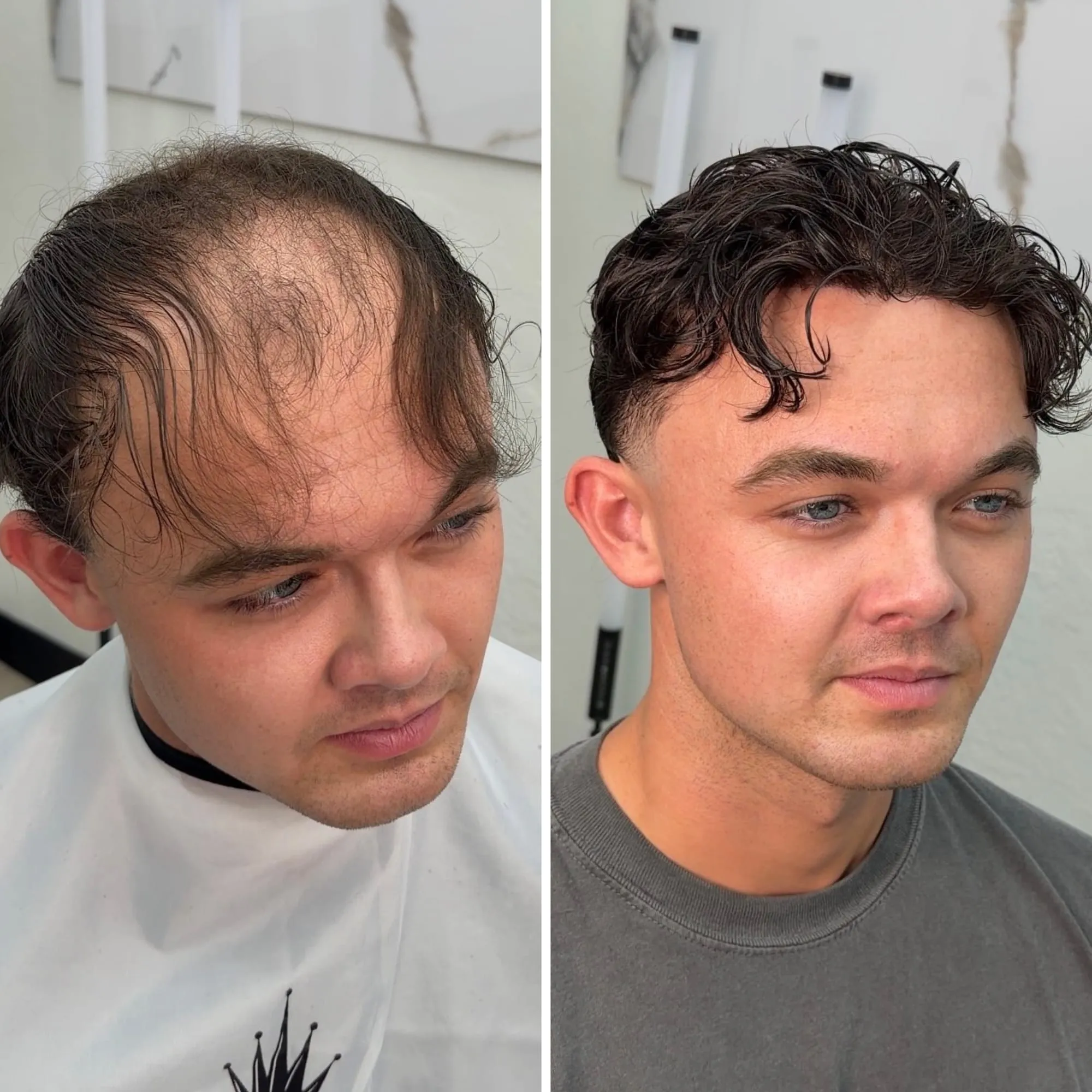
This is what it looks like.
A real client from our chair, photographed before and after his hair system was installed and cut in.
Questions, answered.
What is a hybrid hair system base?
A hybrid base mixes materials on purpose. It puts a lace or thin skin front where invisibility matters, on a reinforced poly or monofilament perimeter that holds a stronger bond and lasts longer. It is the base most professional studios install because it balances a natural hairline with everyday durability.
Is a hybrid base better than full lace?
Neither is better in every case. A hybrid gives you an invisible front plus a secure, longer lasting perimeter, so it wins for most daily wearers. Full lace breathes edge to edge and lets the parting look natural anywhere, so it wins if you restyle often or prize breathability, at the cost of a shorter wear life.
Does full lace last as long as a hybrid?
Usually not. Full lace runs roughly 3 to 6 months while a hybrid runs roughly 4 to 9 months, because the reinforced perimeter on a hybrid survives handling and bonding better than fine lace. Rotating a second unit extends the life of either base.
Which base gives the most invisible hairline?
At the front third they are equal, since both use knotted Swiss or French lace with bleached single knots or a V-loop. The difference is behind the hairline. Full lace stays invisible at the parting anywhere on the unit, while a hybrid keeps its stronger material at the perimeter and body.
Why are there no prices on this page?
Because the figure depends on your base construction, hair type, template, and any add-ons, and two men ordering what sounds like the same unit can need very different builds. We quote against your actual specification at consultation, with no obligation.
Keep reading
Related guides.
Options Compared
Hair systems, transplants, SMP, medication, shaving, or nothing. An honest side by side of coverage, reversibility, commitment, and upkeep.
Mono vs Lace Base
Mono bases last longer and carry more density; lace breathes better and hides the hairline best. A spec-by-spec durability versus airflow comparison.
Lace, Poly, or Skin
Lace breathes and looks natural, skin is invisible and easy to clean, poly holds longest. How we pick a hair system base by realism and upkeep.
Attachment Methods
Tape, bonding, and clip attachment for hair systems compared by hold, comfort, and how they suit your routine. How to attach a hair system.