

It starts with the base
The base is the foundation everything else is tied into. It sits against your scalp and carries the hair, so its material sets the tone for how the finished unit feels, moves, and reads up close. In our chair the base is the first thing we spec, because the rest of the build follows from it.
There are three families of base, and most units are one of them or a hybrid. Each trades off differently, which is why there is no single best answer, only the right answer for your hairline, your skin, and your routine.
- Lace: a fine breathable mesh, usually French or Swiss lace, that disappears against skin and gives the most natural hairline.
- Poly or skin: a thin polyurethane membrane that holds adhesive well, cleans up easily, and gives a very flat, undetectable front when made thin.
- Hybrid: lace at the front for realism, poly through the back and sides for durability and an easier bond.
Ventilation: the hair is tied in by hand
Ventilation is the craft at the center of the whole thing. A ventilating needle, which looks like a tiny hook, loops each strand through the base and pulls it into a knot. On a full custom unit that is thousands of individual knots, tied one at a time. It is slow, patient work, and it is why two units at the same price can look nothing alike.
The type of knot matters as much as the count. A single knot ties one or two hairs. A double knot is more secure but slightly more visible. The best makers use single knots and lighter tying near the front, then heavier, more durable knots through the interior where nobody is looking closely.
The hairline is where the skill shows
Anyone can pack hair into the middle of a base. The hairline is the tell. To make a front look like it grows out of your own skin, the maker uses fewer hairs per knot at the very edge, often single hairs with the knot hidden or bleached so no dark dot shows through.
Good construction also mixes hair directions and adds a slightly irregular, feathered edge instead of a hard straight line. Real hairlines are not perfectly even, so a unit that is too neat at the front is the thing that gives it away. When we install a unit we blend that front edge into your own hair at the temples so the transition has nowhere to hide.
Density, direction, and curl are built in
Density is how much hair is tied into a given area. More is not better. A unit knotted too dense looks like a helmet and photographs flat. A skilled maker tapers density, lighter and more see-through at the front, fuller through the crown, to mimic how hair actually grows on a scalp.
Direction and curl are set during the build too. The hair is tied so it falls the way your own hair would, and a base curl or wave is added to match your texture. This is also where color comes in: hair can be a single shade or blended from several to match the natural variation in your own head of hair.
Stock builds versus a fully custom unit
A stock unit is made ahead of time to common specs and can be fitted quickly, which is a real advantage when you want to walk out with hair the same day. A custom unit is built to a template of your head, your density map, your color, and your hairline, which takes weeks to produce but gives the closest match.
Neither is a shortcut past good work. Even a well made stock base still has to be cut in, blended, and installed properly to look like it belongs to you. The construction gets you most of the way. The person in the chair does the rest.
Real work
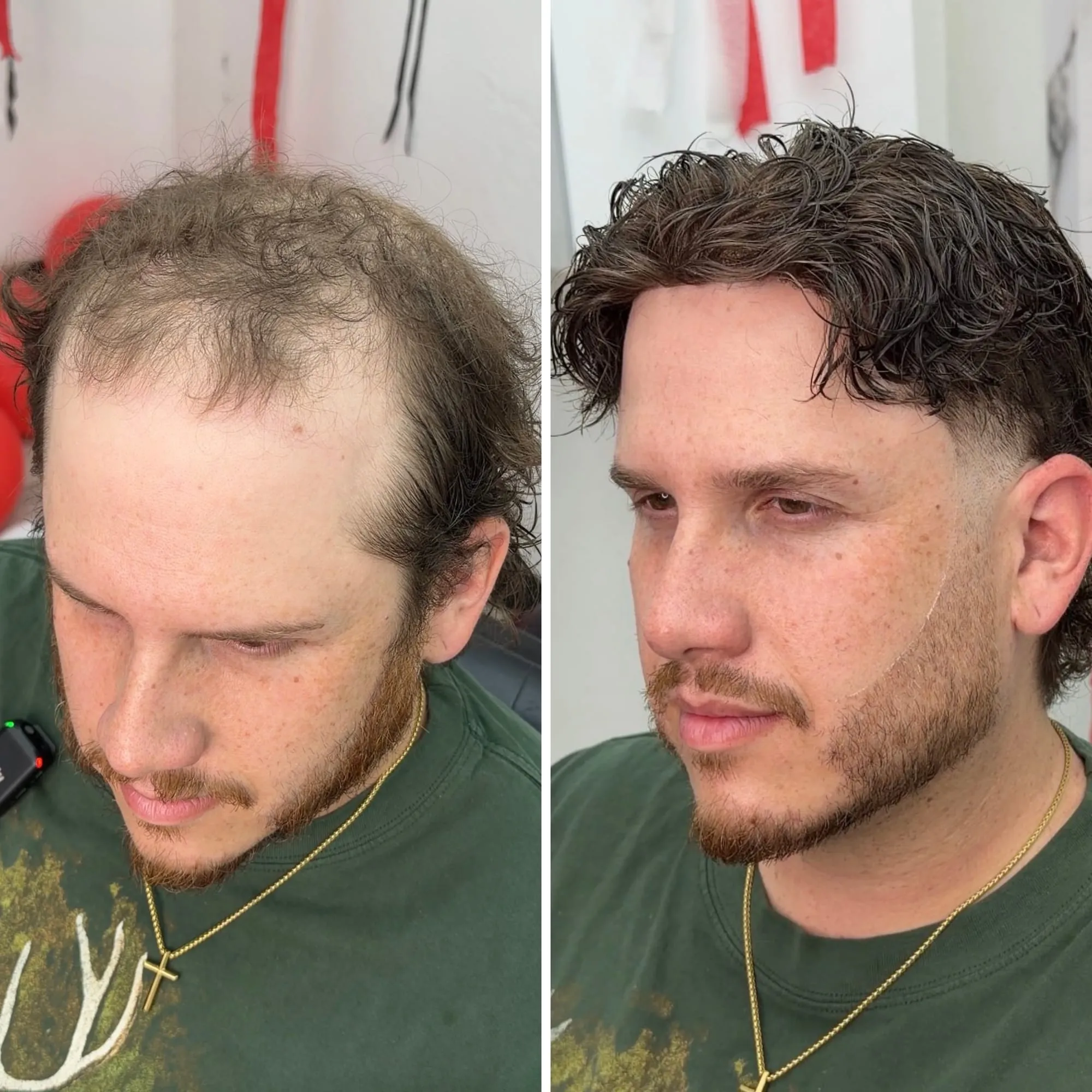
This is what it looks like.
A real client from our chair, photographed before and after his hair system was installed and cut in.
Questions, answered.
Are hair systems made by hand or by machine?
The hair is tied into the base by hand, knot by knot, using a ventilating needle. Some bases and wefts are machine assisted, but the realistic part, the hairline and the ventilation, is hand work. That hand labor is a big reason quality varies so much between units.
What is a hair system made of?
A thin base of lace, polyurethane skin, or a hybrid of both, with hair tied into it. The hair itself is usually human hair, though synthetic and blended options exist. We match the base and hair type to your skin, hairline, and lifestyle.
Why do some units look more natural than others?
It comes down to construction: single knots at a feathered hairline, tapered density instead of a flat wall of hair, hidden or bleached knots, and correct hair direction. A cheaper unit skips these steps, which is exactly what makes it look obvious.
How long does it take to make a custom unit?
A fully custom unit is typically built over several weeks because every hair is tied by hand to your specifications. A stock unit is made ahead of time and can be fitted much faster. We help you decide which path fits your timeline at your consultation.
Keep reading
Related guides.
Types of Hair Systems
Lace, skin, and poly hair systems compared by look, feel, durability, and upkeep, so you can choose the right base for your hair and lifestyle.
Lace, Poly, or Skin
Lace breathes and looks natural, skin is invisible and easy to clean, poly holds longest. How we pick a hair system base by realism and upkeep.
Density Guide
How much density actually reads as real hair by age and face, and why over-dense systems look fake. A practical density guide from our chair.
What Is a Hair System
A hair system is a custom hair unit fitted and blended into your own hair for a full, natural look. Here is how non surgical hair replacement works.