

Last updated September 28, 2026
What you are actually choosing between
The real question is not which one looks better in a photo. Both can look excellent. The real question is what you are committing to, and how far away the person who fixes it later is standing. A transplant is a one-way surgical decision. Follicles are moved from the back and sides of your head to the front, the donor area does not regrow once it is harvested, and the result is whatever grows in over the following year. If you love it, that is permanent good news. If the density or the hairline design disappoints you, that is also permanent, and the clinic that did it is overseas.
A hair system commits you to the opposite shape of decision. Nothing is cut, nothing heals, and the whole thing lifts off in minutes. You are trading a small, repeating maintenance rhythm for total reversibility and a result you can see and approve before you ever leave the chair. Neither answer is automatically right. The honest way to choose is to look at the two on the attributes that actually differ, which is what the table below does.
Turkey transplant vs hair system, attribute by attribute
These are the axes that genuinely separate the two. The transplant figures are typical industry ranges for follicular unit surgery, and they move with your donor supply, the surgeon, and how your body heals. The hair system figures are set to your specification. No amounts appear here on purpose, because money is quoted against your actual build at consultation, not published as a blanket number.
| Attribute | Turkey hair transplant | Hair system |
|---|---|---|
| Reversibility | Permanent, surgical, cannot be undone | Fully reversible, lifts off in minutes |
| Where aftercare happens | Clinic is overseas, roughly a flight away | Local studio, ongoing and in person |
| Time on the ground for the procedure | Typically a 3 to 5 day trip | First fitting in about 1 to 2 hours |
| What is moved | Roughly 2,000 to 5,000 grafts relocated in a session | Nothing is moved, the unit covers the area at once |
| Placement density | Around 30 to 50 grafts per square centimeter, below native 80 to 100 | Set by base density spec, commonly about 100% to 130% |
| Healing and downtime | Scabbing about 7 to 14 days, redness can linger longer | No healing, the unit is worn immediately |
| Shedding phase | Transplanted hairs commonly shed at 2 to 4 weeks before regrowing | No shed phase, nothing is implanted |
| Time to the final look | Commonly 12 to 18 months for the graft to mature | Full result the same day |
| Donor supply | Finite, the donor area does not regrow once harvested | Not a factor, fresh units are ordered as needed |
| Ongoing maintenance | Little unit upkeep, the result is what grew | Reattach roughly every 2 to 4 weeks, replace by base wear life |
| Longevity | Meant to be permanent once matured | By base: roughly 1 to 3 months thin skin, 3 to 6 lace, 6 to 12 mono |
| Main cost driver (figure deferred to consultation) | Travel plus a one-time surgical fee, paid up front | Base construction, hair origin, and wear life across the year |
What a transplant commits you to
A follicular unit transplant relocates hair you already own. A surgeon harvests grafts from the donor zone at the back and sides, where hair is genetically more stable, and places them across the thinning area, commonly at a density of around 30 to 50 grafts per square centimeter. That is meaningfully below the 80 to 100 units per square centimeter of undisturbed native hair, which is why a single session can look thinner than expected and why some men return for a second procedure.
The timeline is the part people underestimate. The transplanted hairs usually shed within 2 to 4 weeks, a normal and expected phase, and then regrow slowly. Early growth shows around 3 to 4 months, and the mature result is generally judged at 12 to 18 months. Throughout that year you are living with the in-between stages. The donor area is also finite. Once those grafts are harvested they do not come back, so the surgeon is spending a limited resource, and a design you dislike is not something a future session can fully reverse.
Why the aftercare distance matters
Turkey is a common destination for transplants because clinics there run at high volume. That volume is not the concern we would raise. The concern is geography. A transplant is not finished when you fly home. The first weeks involve careful washing, scab management, and watching for anything that looks off, and the honest assessment of the result is a year away. If a question comes up at week three, or at month nine, the team that performed the surgery is a flight and a time zone away, and local clinics are often reluctant to take on the follow-up for work they did not do.
This is the quiet trade in medical tourism. You save on the procedure itself, then absorb the cost and friction of managing everything afterward from a distance. For a permanent surgical result, distance from your aftercare is a real variable, not a footnote. It is the single biggest structural difference between flying abroad for a transplant and choosing an option you maintain at a studio you can drive to.
What a hair system commits you to
A hair system covers the area cosmetically from day one. It does not treat, cure, or regrow anything, and we are always straight about that. What it does is give you a full head of hair the same afternoon, at a density you choose rather than one that surgery has to build over a year, with a hairline you approve in the mirror before you leave. If you ever want out, the unit comes off and you are back to your own scalp with nothing altered.
The commitment is maintenance rather than surgery. Depending on the base and adhesive, you reattach roughly every 2 to 4 weeks, and you replace the unit on its own wear cycle, which runs from about 1 to 3 months for delicate thin skin up to 6 to 12 months for a durable monofilament base. That is a real, repeating routine, and it is honest to call it one. In exchange you get same-day results, full control of the look, and aftercare with practitioners who see you in person, here at our Peoria, Arizona and Eighty Four, Pennsylvania studios.
Who each option actually suits
Neither choice is universally better. The right one depends on how permanent a decision you want to make, how much travel and downtime you can absorb, and whether you would rather manage a surgical result from a distance or a wearable one up close.
- You want a permanent result, have healthy donor supply, and can absorb travel plus a year of maturing: a transplant may suit you
- You want a full result the same day with no surgery and no healing: a hair system leans your way
- You want the decision to be reversible and the aftercare local: a hair system fits
- You have limited donor hair or advanced loss that surgery cannot cover convincingly: a hair system covers where a transplant cannot
- You are still deciding and want to see the look before committing anything permanent: start with a hair system, since it forecloses nothing
What we quote at consultation
We do not publish a price against either path, because the honest figure depends on your specification. For a hair system, the cost drivers, ranked by how much they move the number, are base construction, hair type and origin, and any custom template, followed by add-ons such as hair length over about six inches, a silk top, or a larger base. European hair and fully custom work sit at the higher end, stock and standard bases at the lower end. Every one of those is quoted at consultation against your actual build.
What we can tell you before you sit down is the logic on this page. A transplant is a permanent surgical commitment with aftercare a flight away and a result you judge in a year. A hair system is a reversible cosmetic option you wear the same day and maintain locally. Bring your goals, your donor situation, and how much you travel, and we will map the right path with you, including telling you plainly when a transplant is the better fit for what you want.
Real work
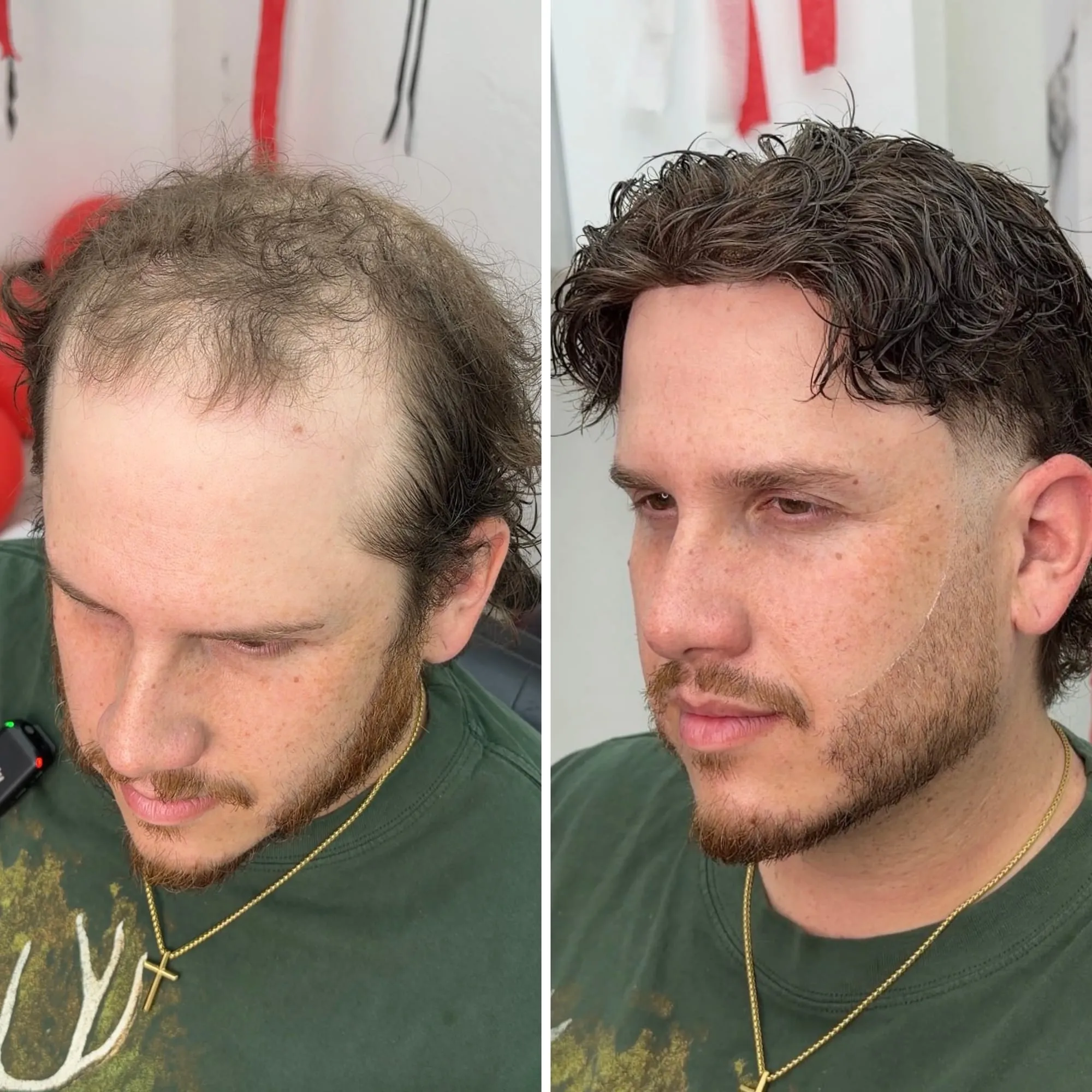
This is what it looks like.
A real client from our chair, photographed before and after his hair system was installed and cut in.
Questions, answered.
Is a Turkey hair transplant better than a hair system?
Neither is universally better. A transplant is a permanent surgical result with aftercare abroad and a look that matures over 12 to 18 months. A hair system is reversible, gives a full result the same day, and is maintained locally. The right choice depends on how permanent a decision you want and how far you can be from your aftercare.
Can I switch to a hair system if my transplant disappoints me?
Yes. A hair system covers the area cosmetically the same day and can be worn over a transplant that came in thin or with a hairline you dislike. Because it lifts off, it forecloses nothing and does not alter what the surgery left. Many men use one after a result that did not meet expectations.
Why is the aftercare distance such a big deal?
A transplant is not finished when you fly home. The first weeks need careful washing and scab management, and the honest result is a year out. If a question arises, the clinic that did the surgery is overseas, and local clinics are often reluctant to follow up on work they did not perform. Distance from aftercare is a real cost of going abroad.
How soon do each of them look finished?
A hair system looks finished the same day, at a density and hairline you approve before leaving. A transplant sheds its moved hairs at 2 to 4 weeks, shows early growth around 3 to 4 months, and is generally judged mature at 12 to 18 months.
Does a hair system regrow my own hair?
No. A hair system covers the area cosmetically. It does not treat, cure, or regrow hair, and we will never tell you otherwise. What it gives you is a full, natural looking result immediately, with total reversibility if you change your mind.
Keep reading
Related guides.
Options Compared
Hair systems, transplants, SMP, medication, shaving, or nothing. An honest side by side of coverage, reversibility, commitment, and upkeep.
Hair System vs Hair Transplant
A side by side look at hair systems and hair transplants: results, timeline, upkeep, and who each one suits. Non surgical vs surgical, honestly.
System vs Transplant Cost
How the cost of a hair system and a hair transplant compare over a decade: one-time surgery versus recurring replacement and scheduled service.
Is A Transplant Worth It
A transplant is worth it for the right candidate with a stable donor area and realistic goals. Here is when it fits and when it does not.