

Last updated September 28, 2026
Why base type sets the cost, not just the price
Every base does two things that pull against each other. It decides how invisible the front and the parting look, and it decides how long the unit survives daily wear before it is replaced. The materials that give the most undetectable result are usually the most delicate, and the materials that last the longest are usually a little less invisible at the very front. Cost sits right in the middle of that tension.
So a base has a build cost, which is what it takes to make the unit, and a wear life, which is how many months you get out of it. On its own, neither number tells you what a base actually costs you. A base that is inexpensive to build but replaced three times as often can be the more expensive choice once a year is counted. The only fair comparison divides one by the other, which is why we frame everything here as cost per month of wear.
The bases, ranked by build cost and wear life
Here is how the common bases compare on the two axes that matter, plus the cost-per-month framing that ties them together. The wear-life ranges are typical for how these bases behave in daily use, and they move with your climate, your activity, and how carefully the unit is maintained. No dollar figures appear here on purpose, because the actual number is set to your specification at consultation. What is definitive is the relationship between the bases.
| Base type | Relative build cost | Typical wear life | Cost per month of wear |
|---|---|---|---|
| Thin skin (poly) | Lower to moderate | Roughly 1 to 3 months for ultra-thin, up to about 6 for thicker skin | Low build cost, but the shortest lives push the per-month cost back up |
| Swiss or French lace | Moderate to higher | Roughly 3 to 6 months | Higher build cost over a short to moderate life, so per-month runs mid to high |
| Full lace | Higher | Roughly 3 to 6 months | Most invisible, but delicacy plus higher build cost make per-month among the highest |
| Monofilament | Moderate | Roughly 6 to 12 months | Longest life spreads a moderate build cost thin, so per-month is often the lowest |
| Hybrid (lace or skin front on a mono or stronger body) | Higher | Roughly 4 to 9 months | Higher build cost, but a durable body lengthens life, so per-month lands moderate |
Skin and poly bases
A skin base, sometimes called poly or thin skin, is a smooth polyurethane membrane that the hair is injected into. It gives a clean, tape-friendly surface and a realistic scalp look, and it is usually one of the more affordable bases to build. That is what makes people assume it is the cheapest option overall.
The catch is wear life. Thinner skin bases are the most natural looking but also the most fragile, and in a hot, sweaty climate they can need replacing on the shorter end of the range. A thicker skin base trades a little realism for real durability and shifts the per-month math in its favor. So skin is often cheaper to build than lace, but whether it is cheaper to own depends entirely on which thickness you choose and how hard you wear it.
Lace bases
Lace bases, whether Swiss, French, or full lace, are prized for the front. A knotted lace hairline against your skin is about as undetectable as hair replacement gets, which is why many men want lace at least across the front third of the unit. That performance carries a higher build cost, and the finer the lace, the more delicate it is.
Because fine lace is fragile, it does not always last as long as a sturdier base, so it can sit high on cost per month even though it looks the best. This is the core answer to whether skin is more expensive than lace: on build cost, lace usually costs more, but on cost per month of wear the two move closer together, because the delicacy that makes lace look so good is the same delicacy that shortens its life.
Mono and hybrid bases
Monofilament is a breathable mesh built for durability. It is not as invisible at the very front as fine lace, but it holds up to daily handling far better, which stretches the interval between replacements. That longer life is why a mono base often lands at the lowest cost per month even though its build cost is only moderate. For a first unit, or for someone hard on their hair, it is frequently the most economical honest choice over a year.
Hybrid bases try to get the best of both. They put a lace or skin front where invisibility matters most and a stronger mono or reinforced body everywhere else. The build cost is higher because you are paying for a more complex construction, but the durable body lengthens the wear life, so the per-month figure usually settles in the moderate band rather than the top of it. For many men this balance of a natural front and a base that lasts is the sweet spot.
- Want the most invisible front and accept more frequent replacement: lace leans your way
- Want the lowest cost per month and are hard on your hair: mono usually wins
- Want a natural front without a fragile whole unit: a hybrid base splits the difference
- Want an affordable, realistic scalp look and will choose thickness carefully: skin fits
Turning base choice into cost per month
To compare two bases fairly, take each one's build cost and divide it by the months you realistically expect to wear it, then compare those per-month figures rather than the upfront ones. Done that way, the delicate lace that looked expensive and the affordable skin that looked cheap often end up much closer, and a durable mono can quietly undercut both. The base that is cheapest to build is regularly not the base that is cheapest to own.
The other lever is rotation. Owning two units so each one rests between wears extends the life of both, which lowers cost per month for any base and softens the penalty on the more delicate ones. If you love a lace front but worry about how often it will need replacing, a second unit is often the move that makes it affordable to live with.
What is set at consultation
Base is only one of the cost drivers, and it interacts with the others. Ranked by how much they move the number, the big levers are base construction, hair type and origin, and any custom template, followed by add-ons such as hair length over about six inches, a silk top, or a larger base. European hair and fully custom work sit at the higher end, stock and standard bases at the lower end. Every one of those figures is quoted at your consultation against your actual specification, not published as a blanket price, because two men can order what sounds like the same unit and need very different builds.
What we can promise before you sit down is the logic on this page: pick the base that matches how you live, judge it on cost per month rather than build cost, and the honest cheapest option often turns out to be a durable base you replace less often, not the lowest sticker in the room. Bring your routine and your climate to the consultation and we will map the right base to both.
Real work
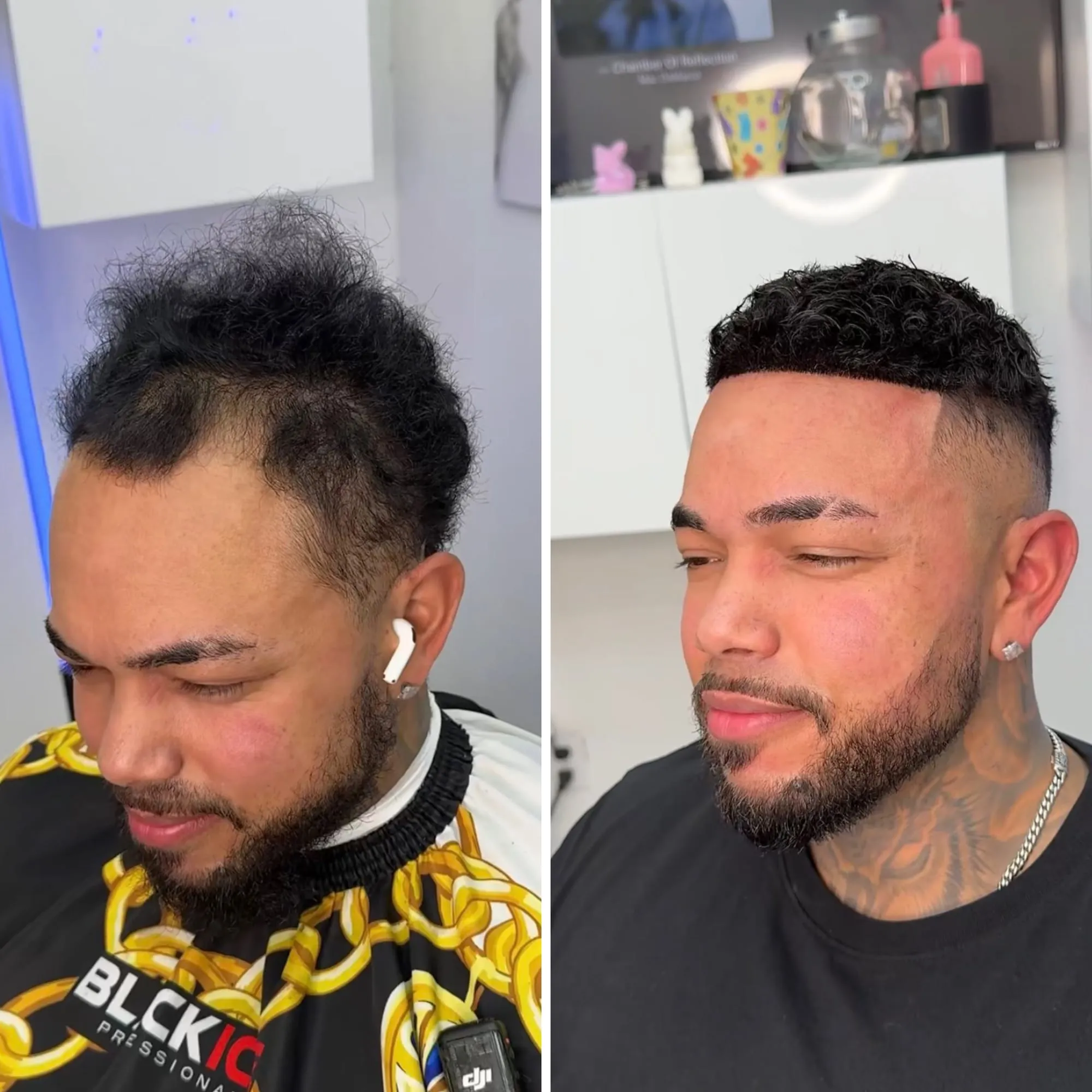
This is what it looks like.
A real client from our chair, photographed before and after his hair system was installed and cut in.
Questions, answered.
Are skin hair systems more expensive than lace?
Usually skin costs less to build than a comparable lace base. But thin skin can wear out faster, so on cost per month of wear the two move closer together, and a thicker skin base can even come out ahead. Build cost and cost of ownership are not the same thing.
Which base is the cheapest to own over a year?
Often monofilament, because its longer wear life spreads a moderate build cost across more months. The base that is cheapest to build is frequently not the one that is cheapest to own once replacement frequency is counted.
Does a more invisible base always cost more per month?
Not always, but the finest lace tends to, because the delicacy that makes it look so natural also shortens its life. A hybrid base gives you a natural front on a more durable body, which usually keeps the per-month figure moderate.
How do I lower cost without a worse-looking base?
Match the base to how you actually live rather than defaulting to the finest one, keep maintenance on schedule, and consider rotating two units so each rests between wears. Rotation extends the life of any base and lowers cost per month.
Why are there no prices on this page?
Because the figure depends on your base, hair type, template, and any add-ons, and two men ordering what sounds like the same unit can need very different builds. We quote against your actual specification at consultation, with no obligation.
Keep reading
Related guides.
Lace, Poly, or Skin
Lace breathes and looks natural, skin is invisible and easy to clean, poly holds longest. How we pick a hair system base by realism and upkeep.
Cost Per Year
What a hair system costs to run per year and month comes down to how long it lasts, your maintenance rhythm, and supplies. Here is the whole picture.
How Long Hair Systems Last
How long a hair system lasts depends on the base, your routine, and maintenance. Here is what to expect and how to make yours last longer.