Last updated September 28, 2026
Start with the license you already hold
Most people who add hair replacement in Pennsylvania are already licensed barbers or cosmetologists, and that existing license is usually the foundation the service is built on. Hair replacement is not a separate trade with its own standalone credential in most states. It is a specialty that sits on top of a barber or cosmetology license, because the core actions, cutting hair and working directly on a client's scalp, are the exact activities those licenses already govern.
That is why the practical question is rarely "what new license do I need" and almost always "does the license I hold already cover this work, and if so, under what conditions." Getting that answer from the board first, before you take a client, protects the business you are trying to build.
What the state actually regulates
Licensing boards care about a short, predictable list of things, and hair replacement touches most of them. Understanding that list tells you where the questions will land when you call the board. None of this is about the hair unit as a product. It is about what your hands do to a paying client and the sanitation around it.
Frame your own service against these categories before you ask, so the conversation with the board is specific rather than vague. A specific question gets a specific answer you can rely on.
- Cutting and styling hair, which is squarely inside a barber or cosmetology scope
- Working on the scalp and skin, including cleaning and prepping the attachment area
- Using adhesives, tapes, and removers on a client's skin
- Sanitation, tool disinfection, and station standards the board can inspect
- How your license renews, and any continuing-education expectations tied to it
Confirm it with the Pennsylvania board, not a forum
The single most common mistake here is trusting a Facebook group or a supplier's sales page over the actual regulator. Rules change, they vary by the exact service you offer, and a confident stranger online is not who answers to the state if you get it wrong. The board is the only source that counts.
Pennsylvania publishes its licensing rules through the state's professional licensing bureau and its cosmetology and barber boards. Contact them directly with your specific plan and get the answer in writing where you can. Use this checklist so you cover the ground in one call instead of five.
- State exactly what you plan to do: template, cut in, and attach hair systems on paying clients
- Ask which license your specific service falls under, and whether your current one already covers it
- Ask about adhesive and scalp-contact rules, since these are where scope questions usually surface
- Confirm sanitation and station requirements the board would check on an inspection
- Ask what your renewal cycle and any continuing-education requirements are
- Get the answer in writing, or note the date, the representative, and what you were told
Why Pennsylvania matters to us, and to the Eighty Four class
Pennsylvania is our second home. Alongside our Peoria, Arizona studio, we run a studio in Eighty Four, Pennsylvania, and we train barbers there who want to add hair replacement the right way. That means the licensing question is not abstract for us. It is something Nico Rigano, Ivette Rigano, and Denisse Diaz walk through with every barber who comes through the door thinking about this specialty.
If you are taking a class with us in Eighty Four, we will point you at the correct boards and help you frame the questions, but we will never tell you the rule is settled when it is not. The verification is yours to do and yours to keep on file. Our job is to make sure you know what to confirm and why it matters before you ever charge a client.
What a license does not replace
A license is permission to do the work. It is not proof that the work will be good. Pennsylvania can confirm your barber or cosmetology credential covers hair replacement, and you can still deliver a hairline that sends a client to someone else. Compliance and competence are two separate things, and clients only ever see the second one.
So treat licensing as the floor, not the finish line. Once your paperwork is honest and confirmed, the real differentiator is skill: templating cleanly, cutting a believable front, matching density and color, and choosing an attachment method that fits a specific head and lifestyle. That is what turns a licensed barber into a hair replacement artist clients travel for.
- Confirm the license first, so the business rests on solid ground
- Then get real hands-on training, because a license does not teach the craft
- Document your results honestly, since your work is your marketing in a local market
Real work
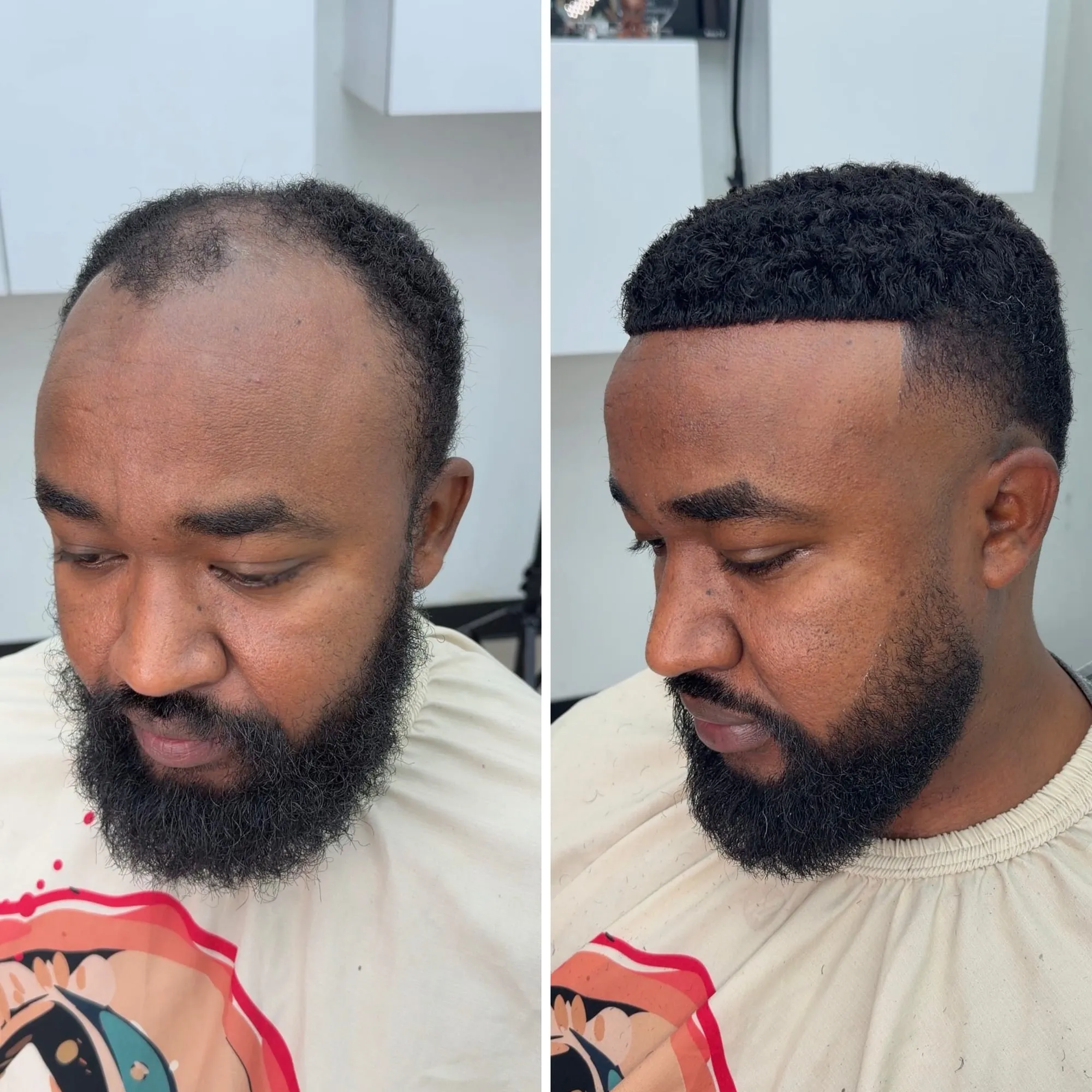
This is what it looks like.
A real client from our chair, photographed before and after his hair system was installed and cut in.
Questions, answered.
Do I need a special hair replacement license in Pennsylvania?
In most cases there is no separate hair replacement license. The work is usually covered by an existing barber or cosmetology license, because it involves cutting hair, working on the scalp, and using adhesives. Confirm with the Pennsylvania board that your specific service falls under the license you already hold before you take clients.
Barber license or cosmetology license for hair systems in PA?
Either can apply depending on the exact service and how the board classifies it, which is why you confirm directly rather than assume. Both trades involve cutting and scalp work, so both are plausible foundations. Ask the board which one your planned service falls under and whether your current license already covers it.
Can I attach hair systems without any license in Pennsylvania?
You should treat that as a question for the board, not something to assume. Because the work involves cutting hair and working on a client's scalp and skin with adhesives, it typically falls inside a regulated trade. Confirm what Pennsylvania requires for your specific service before charging anyone.
Does my Arizona license work in Pennsylvania?
Licenses are state-specific, so an Arizona credential does not automatically authorize you to work in Pennsylvania. If you are moving or working across both, ask the Pennsylvania board about reciprocity or endorsement and what steps they require. We run studios in both states, and we still treat each one's rules as separate.
Keep reading
Related guides.
Licensing
Do you need a license to do hair replacement? What barbers and stylists should know about requirements in Arizona, Pennsylvania, and beyond.
Licensing by State
A state-by-state index of hair replacement licensing that links our Arizona and Pennsylvania pages. More states coming; always verify with your board.
Scope of Practice
Can a barber do hair replacement, or does it need a cosmetology license? Where the scope line sits, and why cutting and coloring the unit is the trigger.
Start a Business
The real steps to add hair replacement to a barber business: training, first clients, pricing, and building recurring maintenance revenue.