

Last updated September 28, 2026
Where the scope line actually sits
Most barbers assume hair replacement is a brand new service that no board has written a rule for, so nobody can tell them what they can and cannot do. That is the wrong way to read it. State boards almost never regulate a category called hair replacement. They regulate the underlying acts: cutting hair for pay, working on the scalp, using chemicals or color, and in some states shaving and skin work.
So the question is not whether hair replacement is licensed. The question is which of the individual tasks you perform already map to acts your license covers. Break the service into its steps and the answer usually becomes obvious task by task, rather than as one big yes or no.
What usually is not a licensed act
A good part of hair replacement happens off the client's growing hair, and those steps are generally not the ones a board is concerned with. You are not cutting their hair or applying a chemical to their skin when you plan and order the unit.
This is where a lot of the value lives, and it is also where a barber can start learning safely before the finish work is involved. Confirm this locally, because a small number of states do write rules around scalp treatment and adhesives.
- The consultation and setting expectations with the client
- Templating or molding the shape of the scalp
- Measuring the base size, density, and contour for an order
- Ordering a custom unit or fitting a stock unit off the head
The scope trigger: cutting and coloring the unit
Here is the nuance that decides almost every scope question, and the one most people miss. A believable result does not come from the glue. It comes from cutting the unit's front into a natural hairline and blending it into the client's own growing hair, and sometimes coloring the unit or the surrounding hair so the two match. Both of those are core licensed acts.
Cutting hair for pay is the definition of barbering and cosmetology. Applying color is a chemical service that most boards regulate closely. The instant your scissors or your color touch the client's own growing hair on their head, you are doing the exact work your license exists to cover. That is the trigger. The attachment method is rarely the issue. The cut-in and the blend are.
- Cutting the unit into a hairline on the client's head is a cutting service
- Blending the unit into their own growing hair is a cutting service
- Coloring the unit or the surrounding hair to match is a chemical service
- These finish steps, not the bond, are what a license needs to cover
Barber license versus cosmetology license
Because the finish work is cutting and often color, the practical question becomes what your specific credential includes. A barber license generally covers cutting and styling, and in many states shaving, but color and chemical privileges vary widely from state to state. A cosmetology license generally covers cutting plus color and chemical services more broadly. Several states also issue combined or master credentials that cover both.
So a barber who only cuts and blends a unit may be fully inside scope, while the same barber who then colors the unit to match may need color privileges their license does not grant. That is not a reason to avoid the service. It is a reason to know exactly what your credential includes before you offer the coloring step, and to decide whether you add that privilege or partner with someone who holds it.
- Confirm whether your barber license includes any color or chemical privileges
- Check whether coloring a unit off the head is treated differently from coloring on the head
- Ask whether your state offers a combined or master credential that covers both
- Decide honestly whether to add a privilege or refer the color work out
How to verify with your board
Do not rely on a forum post, a vendor, or this page for your final answer. Boards differ, they update their rules, and the only opinion that protects you is your own board's. Calling them is quick, free, and worth doing before your first paying client rather than after a complaint.
When you call, describe the actual tasks in plain language rather than using the phrase hair replacement, which a board may not recognize. Walk them through what your hands actually do, and write down what they tell you.
- Describe the real tasks: attaching a unit, cutting it in, blending, and any coloring
- Ask directly whether cutting an attached unit is inside your license
- Ask directly whether coloring to match is inside your license
- Ask about any rules on adhesives, scalp contact, and tool sanitation
- Note the date, the rule they cite, and who you spoke with
Keep it cosmetic, and keep it honest
One more line that keeps you out of trouble. Hair replacement is a cosmetic service. A hair system covers the appearance of thinning; it does not treat, cure, regrow, or diagnose anything. Framing it that way is not only honest marketing, it also keeps you clear of claims that would put you outside any barber or cosmetology scope and into territory that belongs to a physician.
If a client mentions a scalp condition, a medical diagnosis, or a situation tied to treatment, that is the moment to refer them to their own doctor or dermatologist rather than advise them yourself. We hold this line at both our Peoria, Arizona and Eighty Four, Pennsylvania studios, and Nico Rigano, Ivette Rigano, and Denisse Diaz teach it the same way to every barber we train. Stay inside your license, stay cosmetic, and verify the rest with your board.
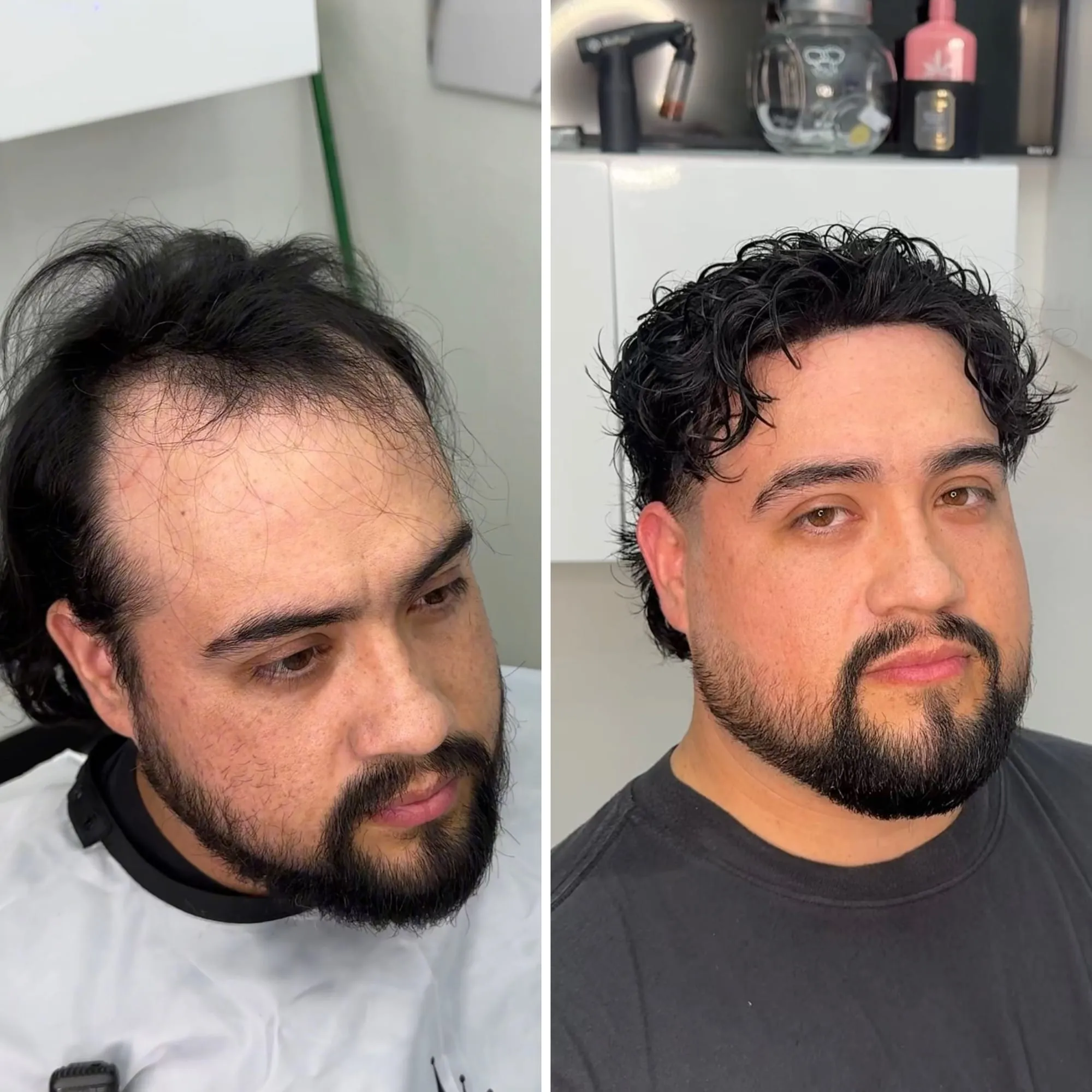
Real work
This is what it looks like.
A real client from our chair, photographed before and after his hair system was installed and cut in.
Questions, answered.
Can a barber do hair replacement, or do I need a cosmetology license?
In most states a licensed barber can attach, cut, and blend a hair system, because those are cutting and styling acts a barber license already covers. The line to watch is color. If your service includes coloring the unit or the surrounding hair to match, that is a chemical service, and whether your barber license covers it varies by state. Confirm your specific scope with your board before you offer the coloring step.
Is templating or measuring a client considered a licensed service?
Generally no. Consulting, templating the scalp shape, measuring for an order, and fitting a unit off the head are usually not the regulated cutting or chemical acts a board is concerned with, because you are not cutting the client's growing hair or applying a chemical to their skin. A small number of states do write rules around scalp work and adhesives, so verify this locally rather than assuming.
Do I need a separate hair replacement license?
Almost never. Boards regulate the underlying acts, not a category called hair replacement, so there is usually no separate credential to earn. What matters is that your existing barber or cosmetology license covers the cutting and coloring you actually perform. Training and certification build your skill and credibility, but they are not a legal license and do not replace what your board requires.
What if my state board has never heard of hair replacement?
That is common, and it is why you should describe the tasks instead of the label. Do not ask whether hair replacement is allowed. Ask whether cutting an attached unit and coloring hair to match are inside your license, since those are the acts they actually regulate. Get the answer tied to a specific rule, note who you spoke with, and keep it on file.
Keep reading
Related guides.
Licensing
Do you need a license to do hair replacement? What barbers and stylists should know about requirements in Arizona, Pennsylvania, and beyond.
How to Become a Hair Replacement Artist
The path from barber to hair replacement artist: the skills, the training, and how to add hair systems as a high margin service line.
Hair System Barber
A hair system barber installs, cuts in, and maintains hair systems for men. Here is what the role involves and why barbers are adding it.
Training
What hair replacement training for barbers covers, how classroom and mentorship fit together, and how to choose a program that builds a paying service.