Last updated September 28, 2026
How to use this index
Licensing for hair replacement is not set at the national level. It is set state by state, and usually inside the same cosmetology or barbering license that already governs cutting and styling hair. That means there is rarely a separate hair replacement credential to chase. What changes from one state to the next is which board governs the license, what that license requires, and how the board treats work done from a suite, a booth, or a mobile setup.
Because of that, the honest job of this page is not to summarize fifty sets of rules from memory. It is to point you at the two states we have verified in depth, tell you plainly which states are still being added, and hand you a short checklist so you can confirm your own state at the only reliable source, which is the board itself. Find your state in the table, open the detail page if we have one, and if we do not, use the checklist to get a clear answer directly.
The state coverage index
Here is where our coverage stands today. The two studios behind this site operate in Arizona and Pennsylvania, so those are the states we can speak to with real detail, and each has its own page. Every other state routes to your own board on purpose, because we will not print a rule we have not confirmed. Board names below are generic descriptions rather than exact agency titles, since those titles and their rules can change.
| State | Who governs the license | Credential that usually applies | Where to go next | Status |
|---|---|---|---|---|
| Arizona | State cosmetology and barbering board | A cosmetology or barbering license, since you cut and style hair | /resources/hair-replacement-licensing-arizona | Published |
| Pennsylvania | State cosmetology and barbering board | A cosmetology or barbering license, since you cut and style hair | /resources/hair-replacement-licensing-pennsylvania | Published |
| Your state (not yet listed) | Your own state board of cosmetology or barbering | Usually a cosmetology or barbering license, but confirm | Contact your board directly (see checklist below) | Being added |
What almost every state has in common
Even though the details differ, a few patterns hold up across most of the country and are worth understanding before you read any state page. First, if you are working on paying clients, you almost certainly need a license, because you are cutting, styling, and attaching hair, which is regulated work. Second, hair replacement is generally folded into the existing cosmetology or barbering scope rather than carved out as its own permit. Third, the board that issues that license is the authority, not a training company and not a manufacturer.
Those patterns are why our Arizona page at /resources/hair-replacement-licensing-arizona and our Pennsylvania page at /resources/hair-replacement-licensing-pennsylvania both start from the same place and then get specific. If your state is not listed yet, you can still reason from these commonalities: assume a license is required, assume it is your standard cosmetology or barbering credential, and then verify both assumptions with the board rather than acting on them.
Why we will not summarize rules we have not verified
It would be easy to fill this page with a row for every state and a confident sentence next to each one. It would also be irresponsible, because licensing language changes, boards reorganize, and a rule that was true last year can be reworded this year. A wrong summary that reads as authoritative is worse than no summary at all, since it can send someone into paid work on a bad assumption.
So the rule we hold ourselves to is simple. We publish a state page only once we have done the work to verify what it says, and until then that state routes you to its own board. As we complete more states, they move from the being added row into their own published pages, and this index grows with them. If your state matters to you and is not here yet, the checklist below gets you a reliable answer today without waiting on us.
Your verify-with-the-board checklist
Whether or not we have a page for your state, this is the sequence that gets you a dependable answer. Work through it with your own state board, not a forum, a supplier, or a training brochure, and note the date you got each answer since these things move.
- Find the exact board that governs cosmetology or barbering where you physically work
- Ask whether hair replacement falls inside that license or requires anything additional
- Confirm the training or exam requirements the license itself carries
- Ask how the rule applies if you work from a suite, a booth rental, or a mobile setup
- Check whether reciprocity applies if you are licensed in another state and moving
- Get the answer in writing or record the date, because the rules can be revised
Certification is not a license
One distinction trips up almost everyone, so it belongs on any licensing page. A certification, including the training we offer, means you have been taught the craft of building, fitting, and cutting in a hair system. It is not a legal permit and it never replaces a state license. No training provider can issue you the right to work on paying clients, because only your state board can do that.
Read it in that order. The license from your board is what makes the work legal, and certification is what makes the work good. You want both, but they come from different places and they are not interchangeable. When you are ready to move from orientation to the specifics, open your state page if we have published it, or run the checklist above to confirm your state directly, then book a consultation and we will talk through the craft side with you.
Real work
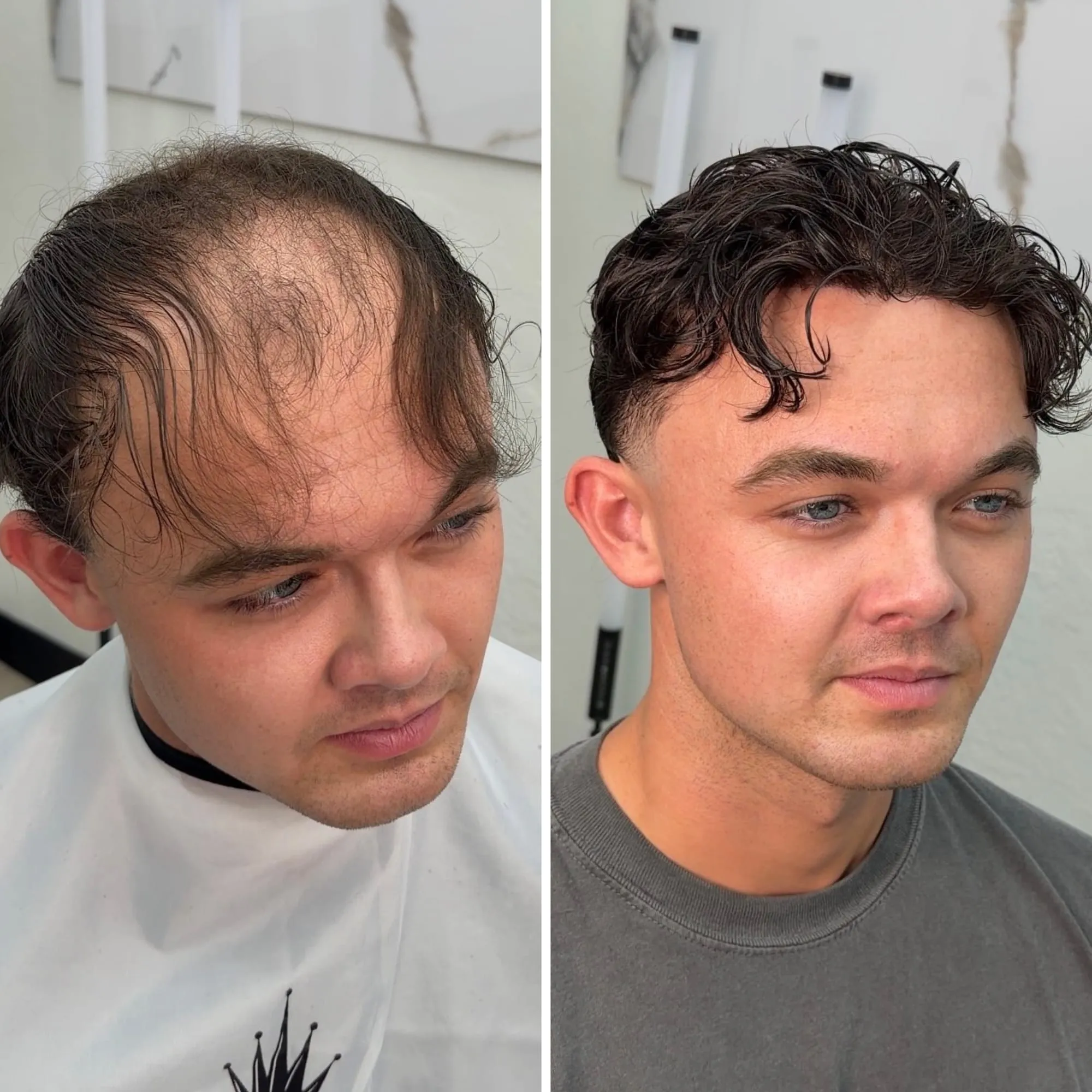
This is what it looks like.
A real client from our chair, photographed before and after his hair system was installed and cut in.
Questions, answered.
Which states does this index cover in detail right now?
Arizona and Pennsylvania, because those are where our studios operate and where we can speak with verified detail. Every other state currently routes you to your own board, and we add states one at a time as we confirm them.
Do the licensing rules really differ that much by state?
The core pattern is similar almost everywhere, since paying work generally requires a cosmetology or barbering license. What differs is which board governs it, what that license requires, and how the board treats suite, booth, and mobile arrangements. That is why you confirm with your own board.
Is hair replacement usually a separate license?
In most places, no. It is generally treated as part of the cosmetology or barbering scope you already hold, because you are cutting and styling hair. Confirm this with your board rather than assuming, since a few states word their scopes differently.
My state is not listed yet. How do I get a reliable answer?
Use the verify-with-the-board checklist on this page. Contact the exact board that governs cosmetology or barbering where you work, ask whether hair replacement sits inside that license, and get the answer in writing. The board is the only authoritative source.
Does your certification cover the license requirement?
No. Certification shows you have been trained in the craft. Your legal right to work on paying clients comes from your state license, which only your board can issue. You want both, but they are not interchangeable.
Keep reading
Related guides.
Licensing
Do you need a license to do hair replacement? What barbers and stylists should know about requirements in Arizona, Pennsylvania, and beyond.
Scope of Practice
Can a barber do hair replacement, or does it need a cosmetology license? Where the scope line sits, and why cutting and coloring the unit is the trigger.
How to Become a Hair Replacement Artist
The path from barber to hair replacement artist: the skills, the training, and how to add hair systems as a high margin service line.
Certification
What non-surgical hair replacement certification covers for barbers, what it proves, and how it de-risks adding hair systems to your chair.