

What a frontal system actually covers
Think of coverage as a map of your head rather than a single product. A frontal system sits over the hairline, the temples, and the crown-side of the top, which is the zone that thins earliest and matters most to how you read in a mirror or a photo. It stops where your own growth is still strong enough to blend into.
A full system, by contrast, covers the entire top of the head from front hairline to crown, and is built for men who have lost most or all of the hair across that whole area. The frontal is the smaller cousin: same craft, same materials, less real estate.
- The front hairline and temples, where recession shows first
- The top and part-line, where thinning reads as scalp in bright light
- Only as far back as needed before your own density takes over
Who it suits
The honest test is what is happening at the back and sides. A frontal works when the front and top have receded or thinned but the back is still dense enough to blend into and to hide the rear edge of the unit. That describes a lot of men in the earlier and middle stages of hair loss, which is exactly when people start looking for an answer.
It is a poor fit if the thinning has spread across the whole top and the crown is going too. At that point the back cannot carry the look and a full system is the more honest recommendation. We would rather tell you that at a consultation than fit a frontal that fights your own hair.
Why men choose partial over full
When your own hair is still doing real work, there is no reason to cover it. Keeping your natural hair in play at the back and sides means the unit has less to blend into on only one edge instead of a full perimeter, and it keeps more of your own growth in the picture.
There is also a practical side. A smaller unit means a smaller bonded area, which some men find lighter and simpler to live with day to day. None of that makes a frontal automatically better than a full system. It is only better when your remaining hair earns it.
- Keeps your own back and sides in the look
- A smaller bonded area to maintain
- Blends on one working edge rather than a full perimeter
The join is where the skill lives
With a full system the demanding edge is the front hairline. With a frontal you have that front edge plus a second challenge: the back edge of the unit has to vanish into your own hair. Get that blend wrong and the transition line gives the whole thing away in daylight.
This is why a frontal is not a shortcut or a cheaper starter option. It asks the same hairline work as a full unit and adds a rear blend on top. In our chair the cut is what does that work, feathering the unit into your growth so there is no line to find. Real clients wear frontals out of our studio precisely because that join is finished properly.
How coverage affects the build
Because a frontal has to marry into living hair, matching is stricter than you might expect. Your color, your texture, and your density all have to line up with the hair right next to the unit, not an average. Density in particular is set to what is believable beside your own hair rather than the maximum available, because a frontal that is heavier than the hair behind it looks like two different heads of hair.
As your natural hair keeps changing over the years, a frontal has to keep pace with it. That is normal and it is part of what maintenance visits are for. It is worth understanding before you choose, so the ongoing blend is a plan rather than a surprise.
Some people still call this other things
Some people still call a partial unit a patch, which we do not, because it describes the coverage poorly and undersells the work. What you are getting is a hair system built to a specific coverage map for your head, fitted and cut in by hand. The name matters less than whether the person doing it can make the join disappear.
Real work
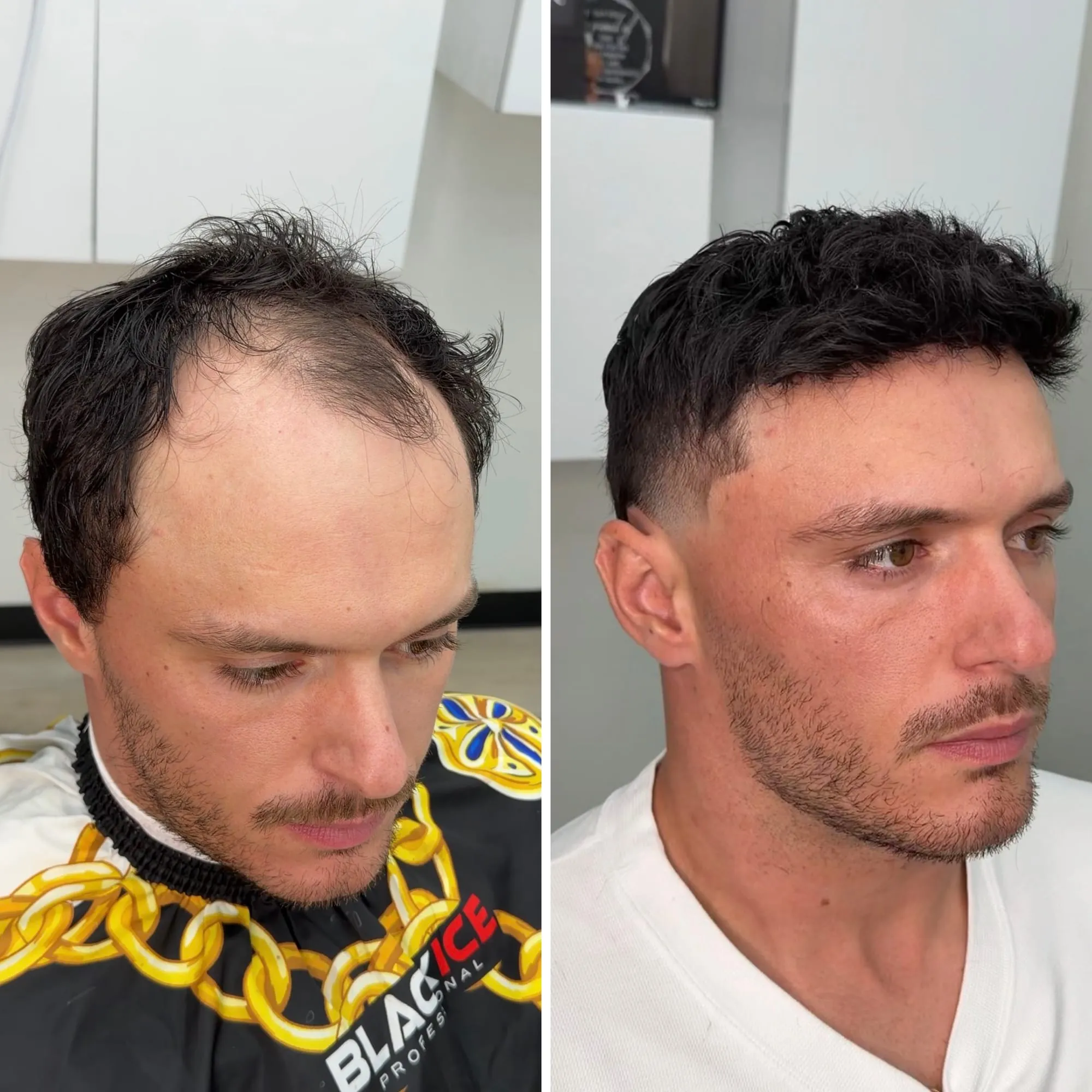
This is what it looks like.
A real client from our chair, photographed before and after his hair system was installed and cut in.
Questions, answered.
Is a frontal system cheaper than a full one?
It is a smaller unit, but the front hairline and the rear blend both take skilled work, so it is not a budget version of a full system. What it costs depends on the build and your maintenance, which we go through at a consultation.
Will the line where it meets my own hair show?
Not when it is blended properly. The rear edge is feathered into your own growth in the cut, so there is no transition line to spot. That blend is the part that decides whether a frontal works.
What if my back and sides thin later?
Then we reassess. A frontal depends on the back carrying the look, so if that changes over time, moving to a fuller coverage may make more sense. Book a consultation and we will map where you are now.
Can I switch from a frontal to a full system?
Yes. Plenty of men start with a frontal while their own hair still helps and move to fuller coverage later as things change. Your template and details are on file, which keeps that straightforward.
Keep reading
Related guides.
Types of Hair Systems
Lace, skin, and poly hair systems compared by look, feel, durability, and upkeep, so you can choose the right base for your hair and lifestyle.
The Hairline
A natural hair system hairline is built from irregularity, a soft density gradient, and careful placement. Here is how we design one that reads as yours.
Does It Look Natural
A well fitted, well cut hair system blends into your own hair and hairline. Here is what makes a hair system look natural and undetectable.
What Is a Hair System
A hair system is a custom hair unit fitted and blended into your own hair for a full, natural look. Here is how non surgical hair replacement works.