

Last updated September 28, 2026
The number that actually matters is cost per month of wear
Men shopping for the first time compare one unit against another and pick the lower figure. That is the wrong denominator. A hair system is not a one time object, it is worn, maintained, and eventually retired, so the honest comparison is how much a month of good looking hair costs you once everything is counted.
Cost per month of wear is a ratio, not a price. Take what a unit and its upkeep add up to over its life, then divide by the months it stayed believable on your head. A bargain unit that looks tired in a few weeks has a short denominator, which drives the ratio up even though the number on the tag was low. A well built unit spreads its cost over many more months, and the ratio falls.
This is the same logic anyone uses on tires or work boots. The cheapest pair replaced three times a year is not cheaper than one good pair that lasts. Hair systems behave exactly this way, and the trap is that the front of a unit hides its wear until it is well past its best.
Where a bargain unit quietly costs you
The savings on a cheap system are real on day one and gone by month three. The cost does not disappear, it moves to places that are harder to see on a price tag: how often you replace, how much labor it takes to make it pass, and how much of your own time you spend fighting it.
None of these are hypothetical. They are the same four levers we walk every new wearer through in our chair, because a wearer who understands them makes a better first choice and spends less over the year.
- Wear life: thin, loosely built bases and lower grade hair break down faster, so the unit stops looking believable sooner
- Replacements per year: a shorter wear life means more units bought in the same twelve months
- Correction labor: a poor hairline, wrong density, or a color that does not match takes chair time to cut in, thin, or blend, and that labor repeats every replacement
- Detectability: an unbleached knot, a bulky front, or a flat, overdense look is what people notice, and fixing it after the fact costs more than specifying it right once
Bargain unit versus a properly specced unit
The table below compares the two on the levers that set cost per month of wear. It carries no figures because your exact intervals depend on your base, your climate, and your routine, all of which we set at the consultation. What it does show is the direction each lever moves, which is the part that decides the ratio.
Read it top to bottom as one story. A shorter wear life feeds more replacements per year, more replacements multiply the correction labor, and weaker realism is what forces that correction in the first place. The levers compound, which is why the gap between cheap and well built is wider over a year than it looks on any single unit.
| Lever | Bargain unit | Properly specced unit |
|---|---|---|
| Wear life | Shortest, base and hair break down early | Longer, built and matched to how you live |
| Replacements per year | More units in the same twelve months | Fewer, because each unit lasts |
| Realism at the hairline | Often detectable, bulky or unbleached knots | Cut in and bleached to disappear on you |
| Correction labor | Recurring, repeated at every replacement | Front loaded once, then it holds |
| Upkeep predictability | Erratic, lifts and shine appear early | Steady, a rhythm you can plan around |
| Cost per month of wear | Higher once the year is counted | Lower, cost spread over more good months |
Why the hairline is where cheap gets caught
The front is the tell. A believable hairline needs a fine enough base at the edge, the right density stepped down toward the face, and knots bleached so no dark dots sit at the parting. Bargain units cut all three to hit a lower number, and the result reads as a unit rather than as hair.
The expensive part is not noticing the problem, it is correcting it. Thinning an overdense front, softening a hard hairline, and blending the unit into your own growth is skilled chair time, and it has to be redone on every replacement. A unit that arrives with the right spec is cut in once and stays right, which is cheaper across the year even before you count how much better it looks.
The cost drivers worth paying for, ranked
Spending more is not the point. Spending on the drivers that extend wear life and cut correction labor is the point, and a few of them do most of the work. Ranked by how much they move your yearly total, these are where a higher spec earns its keep, with the actual figure for each set at your consultation once we have seen your hair and heard your routine.
Everything on this list buys you months of believable wear or removes recurring labor. That is why a unit built around them lands at a lower cost per month even though the single unit costs more than the bargain option.
- Hair grade and origin, with European hair carrying a cost component for its fineness and longevity
- Base construction matched to your life, where a silk top or a custom template adds cost but extends wear and realism
- Hair length over roughly six inches, which adds a cost component and needs proportionate care to last
- A larger base area, which covers more but carries more cost and more surface to maintain
- Density specified correctly for your age and face, so the front is never overbuilt and never needs thinning down later
How to buy so cheap does not cost you
The way out of the false economy is not to overspend, it is to match the unit to how you actually live and then keep it on a schedule. A wearer who trains hard and swims wants a build that survives sweat and water, not the most delicate lace that will shred in a month. A wearer in an office can carry a finer front for longer. Buying to your life is what keeps the denominator long.
The second half is upkeep on rhythm. A lifting bond or a tired unit left too long usually costs more to put right than the maintenance visit would have, so a steady schedule protects the ratio. This is the whole reason we quote drivers rather than a headline number: your cost per month of wear is set by your choices, and a consultation is the only honest place to turn those choices into figures, with no obligation attached.
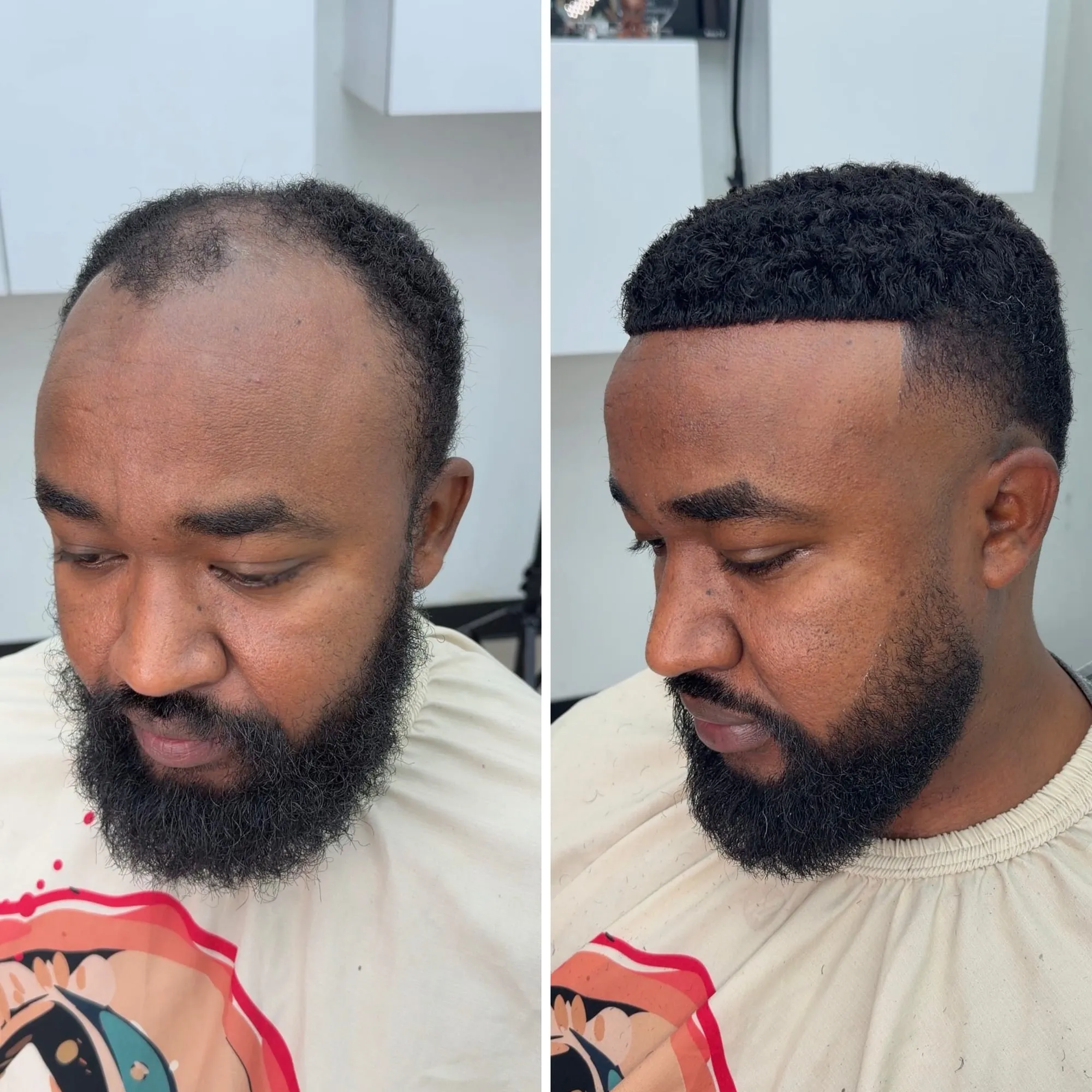
Real work
This is what it looks like.
A real client from our chair, photographed before and after his hair system was installed and cut in.
Questions, answered.
Are cheap hair systems worth it?
Rarely, once you count the full year. A bargain unit wears out sooner, so you replace it more often, and the labor to make it look believable repeats with every replacement. On cost per month of wear, which is the honest measure, a properly specced unit usually comes out lower.
What is cost per month of wear?
It is a ratio, not a price. Take what a unit and its upkeep add up to over its life, then divide by the months it kept looking believable. A cheap unit with a short wear life pushes that ratio up, and a well built unit that lasts pulls it down.
What actually goes wrong with a cheap hair system?
Four things, usually together: the base and hair break down early, so you replace it sooner, a poor hairline or wrong density needs recurring chair time to correct, and detectable knots or a bulky front give it away. Each one adds cost that never showed on the tag.
Do I need to buy the most expensive unit to avoid this?
No. The goal is matching the unit to how you live, not buying the top of the range. A slightly sturdier build for an active wearer, or a finer front for an office routine, plus upkeep on schedule, is what lowers cost per month of wear. We set the right spec at the consultation.
Keep reading
Related guides.
Cost Per Year
What a hair system costs to run per year and month comes down to how long it lasts, your maintenance rhythm, and supplies. Here is the whole picture.
Stock vs Custom
Stock hair systems are ready made and fast. Custom units are built to your head, color, and hairline. Here is how the two differ and when each makes sense.
How Long Hair Systems Last
How long a hair system lasts depends on the base, your routine, and maintenance. Here is what to expect and how to make yours last longer.