

Last updated September 28, 2026
Start from the template, not from memory
Every custom order begins with a physical record of the client's head. That is the template or mold you took at the consultation, plus your written measurements and a hairline drawing. Before you fill in a single field, lay that record next to the order form so the numbers on the page match the shape in your hand. We never order from memory or from a photo alone, because a base that is a few millimeters off at the front is a base the client feels lifting all day.
If you are new to this, read our companion guide on how to read a hair system order form first, so the vocabulary below maps onto the boxes your vendor actually prints. Templating and measurement is its own discipline, and the order is only as good as the mold it came from.
The order form, field by field
Here is the definitive set of fields on a custom order, what each one controls, and the judgment call behind it. No figures or codes are invented here, because the exact number is set by the client's head and the vendor's own chart, not by a blanket rule. What is definitive is what each field decides and how a wrong entry shows up on the finished unit.
| Field | What it controls | How you decide it | What a wrong entry does |
|---|---|---|---|
| Base size | The overall footprint and shape of the unit | Trace the client's area of loss from the template, adding your standard margin | Too small leaves scalp exposed at the edges, too large wastes base and lifts |
| Front contour | The curve of the hairline, from flat to deeply recessed | Match the client's natural or desired hairline shape from your drawing | The wrong contour reads as fake at the one line everyone looks at |
| Base design | The materials and zones, such as lace front on a skin or mono body | Balance how invisible the front must be against how long the unit must last | A mismatch trades away either realism at the front or durability across the body |
| Hair type | The origin and grade, such as Indian, Chinese, or European hair | Match the client's own hair texture, then set grade to budget and wear | A texture mismatch fights the client's growing hair and never blends |
| Color ring code | The base shade of the hair against a standardized ring | Hold the ring to the client's mid-shaft in natural daylight and read the code | The wrong code arrives visibly off, and dyeing to correct it costs a unit |
| Density | How much hair is ventilated in, from light to heavy | Match the client's remaining density and age, lighter at the very front | Too heavy looks like a helmet, too light shows base through the hair |
| Wave or curl | The curl pattern set into the hair | Match the client's own wave so the two blend as the hair grows out | A pattern mismatch means the unit never styles the same way twice |
| Hair direction | The way hair is knotted to fall across each zone | Map the client's growth pattern and part onto the base by zone | Wrong direction fights the comb and the part will not sit where it should |
| Per-section variation | Density, color, or gray blended differently across named zones | Note where the client is lighter, grayer, or finer and spec each zone | A single flat spec across the whole base looks uniform and unnatural |
Color: read the ring, do not eyeball it
Color is the field that gets returned most, and almost always because someone read it in the wrong light. We match against the vendor's physical color ring, held to the middle of the client's hair shaft, in natural daylight near a window rather than under warm studio bulbs. The root, the mid-shaft, and the tips are often three different shades, so we read the mid-shaft, which is what the eye treats as the true color.
Gray is a percentage, not a color, and it belongs in its own field. Rather than picking a lighter base code to fake gray, we spec the base shade and then add the gray percentage the client actually carries, higher at the temples if that is where they are lighter. That is a per-section note, not a whole-unit setting. Writing gray as a flat number across the base is one of the most common reasons a custom unit reads as obviously fake instead of the client's own hair.
Density: match the man, not the mirror
Density is where a new artist most wants to over-order, because a full, heavy unit looks impressive on the block. On a real head it looks like a helmet, and it ages the client instead of matching him. We set density to the client's own remaining hair and to his age, and we always taper it lighter at the very front so the hairline looks like individual hairs rather than a wall.
Because density is rarely uniform on a natural head, this is another field that benefits from per-section variation. A lighter front, a fuller crown, and a medium mid-scalp read far more naturally than one number applied everywhere. Note the zones on the order the same way you noted them on the template, and the finished unit will sit like hair that grew there.
- Front hairline: lightest, so the edge looks like single hairs, not a line
- Mid-scalp: medium, carrying the everyday look
- Crown: fuller if the client wants coverage through the swirl
- Temples: match the client's own recession so the sides read honest
Hair type, wave, and direction
Hair type covers origin and grade. The origin drives texture, and the texture has to match the client's own hair or the two will never blend as his hair grows past the base. Grade drives how the hair behaves over months of wear. We match texture first, then set grade to what the client's routine and wear will support, and we spec the wave to the client's natural curl so the styled result holds instead of fighting the comb.
Hair direction is the field beginners skip and regret. It tells the vendor which way the hair is knotted to fall in each zone, mapped from the client's own growth pattern and the side he parts on. A part specified on the order arrives built in, sitting exactly where the client wants it. A part left unspecified arrives generic, and no amount of styling makes hair sit against the direction it was knotted. Map it by zone from the template and write it down.
Confirm, log, and keep the record
Before we submit, we read every field back against the template one last time, out loud if a second artist is in the room. Base size and front contour against the mold, color code against the ring under daylight, density and gray by zone, hair type and wave against a saved cutting, direction against the drawing. A five minute confirmation is far cheaper than a remake and a client waiting weeks longer than promised.
We log the full spec in the client's file the moment the order goes out, because the reorder is where custom work pays off. When the client comes back for their next unit, a complete record means we order an identical build without re-measuring from scratch, or we adjust one field on purpose rather than guessing at all of them again. At our Peoria, AZ and Eighty Four, PA studios, that saved spec is what turns a one-time custom order into a client who never has to start over.
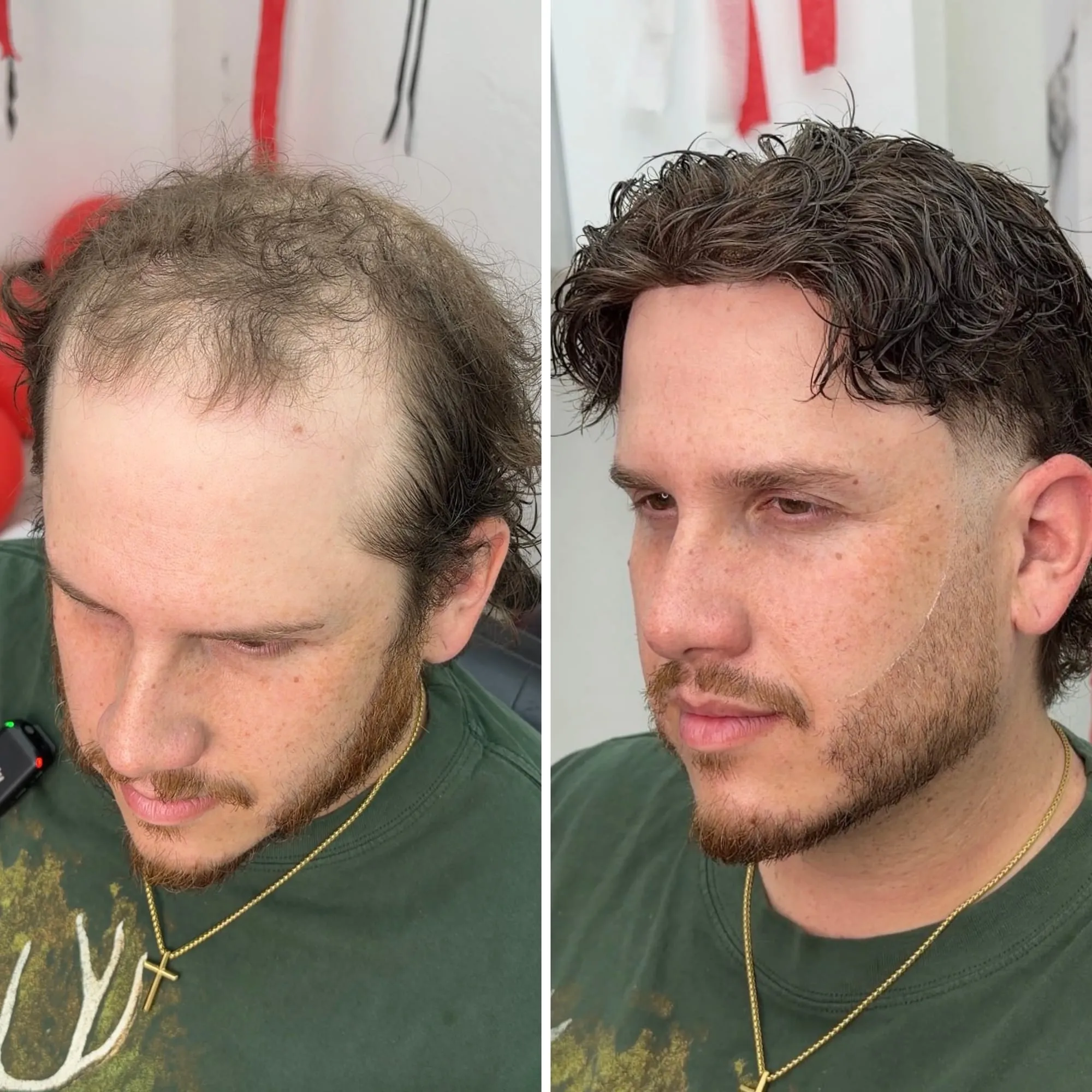
Real work
This is what it looks like.
A real client from our chair, photographed before and after his hair system was installed and cut in.
Questions, answered.
What are the essential fields on a custom hair system order?
Base size, front contour, base design, hair type, color ring code, density, wave or curl, and hair direction, plus any per-section variation for zones that differ. Each field is entered from the client's template and measurements, never from memory.
How do I match color for a custom order?
Hold the vendor's physical color ring to the mid-shaft of the client's hair in natural daylight, not under warm studio bulbs, and read the code there. Spec gray as a separate percentage by zone rather than faking it with a lighter base shade.
How much density should I order?
Match the client's own remaining density and his age, and taper lighter at the very front so the hairline reads as single hairs. Over-ordering density is the most common beginner mistake, because a heavy unit that looks full on the block looks like a helmet on a head.
Why does hair direction matter on the order?
Direction tells the vendor which way the hair is knotted to fall in each zone. A part specified on the order arrives built in and sits where the client wants it. A part left off arrives generic, and no styling makes hair sit against the direction it was knotted.
What is per-section variation and when do I use it?
It is spec'ing density, color, or gray differently across named zones instead of one flat setting for the whole base. Use it whenever the client is lighter, grayer, or finer in one area than another, which on a natural head is almost always.
Keep reading
Related guides.
Reading the Order Form
Every field on a custom hair system order form explained in one place: base size, material, density, color, grey, curl, length, origin, and more.
Templating and Measurement
A vendor-neutral studio method for templating and measuring a client for a custom hair system, with a numbered process and a full measurement chart.
Tools & Supplies
The categories of tools and supplies a hair system barber needs, and how to choose each one, with no brand endorsements and no prices.
Pricing Framework
A pricing framework for barbers adding hair replacement: the factors that set install and maintenance fees, and how to build a menu that holds.