

What people usually mean by permanent
When a man asks us this in the chair, he almost always means one of two things. Either he wants to know if the hair will fall off or shift during the day, or he is comparing us to a transplant and wants to know if this is a one and done fix. Those are two different questions and they deserve two different answers.
Day to day, the hair stays put. It is bonded to your scalp, not resting on it, so it holds through work, sleep, weather, and a normal week. In that sense it is as dependable as your own hair. What is not permanent is the unit itself. Hair, whether yours or a system's, wears with time, and the bond is refreshed on a schedule rather than lasting untouched forever.
Why nothing here is actually permanent, including a transplant
It is worth being clear that even surgery is not as permanent as the word suggests. A transplant moves your own follicles, and it is a one-time procedure, but the hair around the transplanted zone can keep thinning, which is why some men need more than one session over the years. Every real approach to thinning is a relationship with time, not a full stop.
The difference is what you are committing to. A transplant asks for a surgical decision you cannot easily undo. A hair system asks for a routine you can adjust, pause, or stop whenever you want. Neither is magic. One is permanent in the sense of irreversible. The other is permanent in the sense of continuous.
How the result stays continuous
The result holds because of a rhythm, not a single install. You come in, we service the unit, refresh the bond, and cut and blend it back into your own hair so the line disappears. Between visits you follow a simple at home routine. Over a longer cycle the unit is replaced with a fresh one that has been matched to you.
Done consistently, there is never a visible gap. You do not go from having hair to not having hair. The transition from one unit to the next happens in our chair, and you walk out looking the same as you did walking in.
- Regular maintenance visits to refresh the bond and reblend
- A straightforward at home care routine between visits
- Periodic replacement of the unit itself over a longer cycle
- Color and density matched each time so nothing shifts on you
What maintenance actually asks of you
This is the part men underestimate in both directions. Some assume it is constant work, and some assume it is zero. The truth sits in between. There is a routine, it is learnable, and after the first few weeks most men stop thinking about it. It becomes part of getting ready, like anything else.
How often you come in depends on the attachment method you choose, how much you sweat, and Arizona heat if you are near our Peoria studio. We are straight with you about that cadence up front so there are no surprises. The system stays reliable because the maintenance is real, not because it never needs attention.
The upside of not being permanent
Because a system is renewed rather than implanted, you are not locked into a single decision made once. If you want to change your hairline, adjust the density, or go a shade different, we do it at the next replacement. Your look can evolve with you instead of being fixed at whatever you decided years ago.
It also means you can stop. If you ever decide a system is not for you, you remove it and you are back to where you started, with no surgical footprint left behind. For a lot of men, that reversibility is the reason they try it in the first place.
So how should you think about it
Treat it like a haircut you keep up rather than a surgery you recover from. The commitment is ongoing but light, the result is dependable, and the door stays open in every direction. If you want the full permanence tradeoff spelled out against surgery, the comparison guide covers it, and the best way to get a straight read on your own head is to come in and talk it through.
Real work
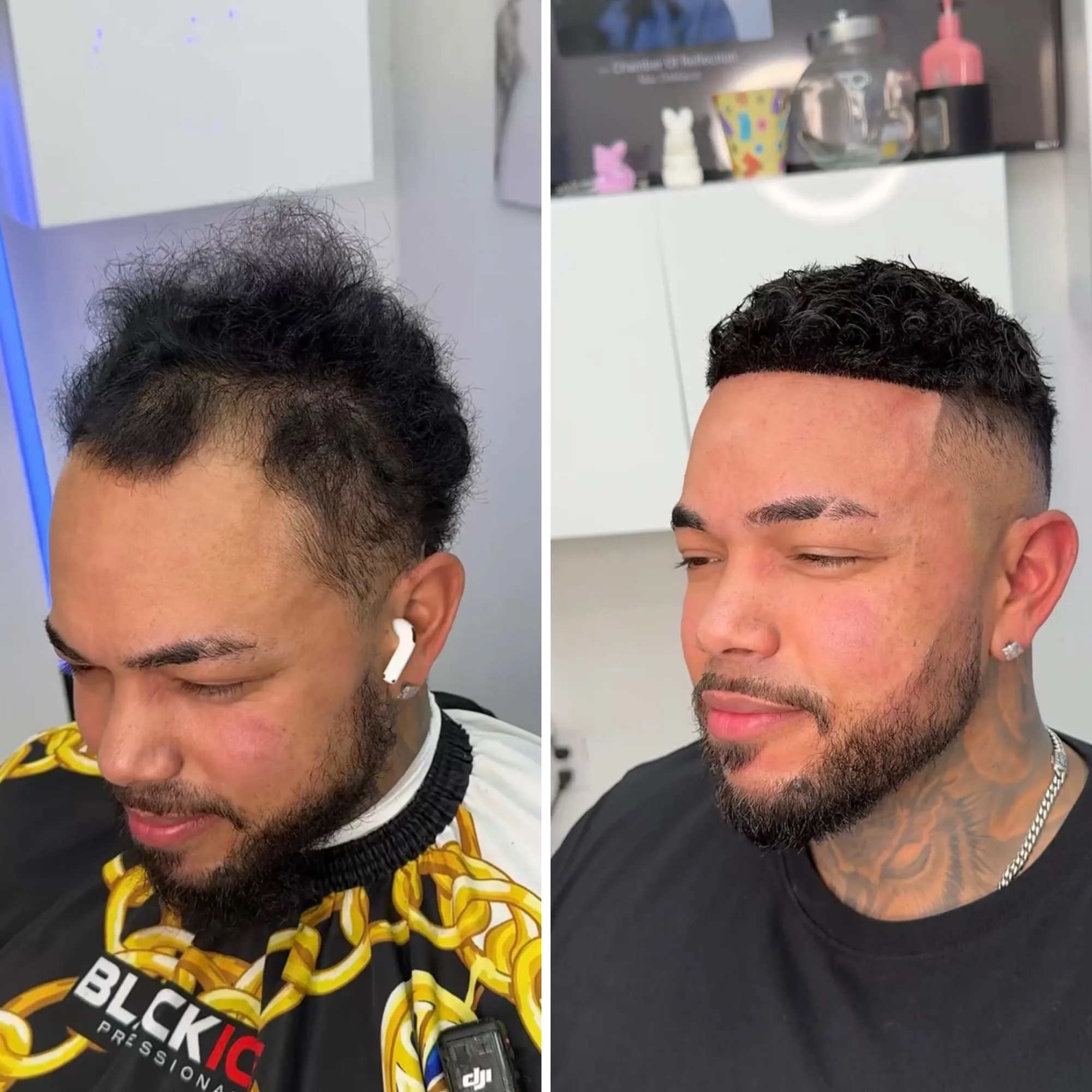
This is what it looks like.
A real client from our chair, photographed before and after his hair system was installed and cut in.
Questions, answered.
Will the hair fall off during the day?
No. A properly installed system is bonded to your scalp and holds through a normal day, including work, sweat, and sleep. The bond is refreshed on a schedule at your maintenance visits, not because it fails between them.
How often does the unit need replacing?
The unit is replaced on a longer cycle rather than daily or weekly. How long a given unit lasts depends on the type of hair, how you care for it, and your routine. We give you an honest replacement cadence during your consultation.
Is this more or less permanent than a transplant?
A transplant is permanent in that it is a one-time surgical procedure you cannot undo, though thinning around it can continue. A hair system is not surgical and is fully reversible, but the result is continuous as long as you keep up maintenance and replacement.
Can I stop using a hair system later?
Yes. Because nothing is implanted, you can stop at any time. The unit is removed and you return to your natural state with no surgical footprint. That reversibility is one of the main reasons men choose this route.
Does keeping it up require a lot of work?
There is a real routine, but it is learnable and most men stop thinking about it within a few weeks. The exact cadence of visits depends on your attachment method, activity level, and climate, and we set that expectation with you up front.
Keep reading
Related guides.
How Long Hair Systems Last
How long a hair system lasts depends on the base, your routine, and maintenance. Here is what to expect and how to make yours last longer.
Hair System Maintenance
How to keep a hair system clean, secure, and natural: your at home routine, the maintenance schedule, and what a studio visit covers.
Hair System vs Hair Transplant
A side by side look at hair systems and hair transplants: results, timeline, upkeep, and who each one suits. Non surgical vs surgical, honestly.
Do Systems Damage Hair
Do hair systems damage the hair you still have? Done right they protect it. Done badly they can harm it. What we do in our chair to keep your hair safe.