

The short version
The hair on a system is either real human hair or a man-made fiber engineered to look like it. That single choice ripples through everything else: how it catches light, how you can style it, how long it lasts, and how much attention it needs from you between visits.
There is no universally correct answer. There is only the right answer for your face, your routine, and how you want the unit to behave. Below is how we actually weigh it with clients, without the sales gloss.
Look and realism
Human hair has the clear edge here, and it is not close in the wrong light. Real hair reflects light unevenly the way your own hair does, takes a natural range of color, and moves with a softness that fiber struggles to match. In photos, in sunlight, and in close conversation, that difference is what separates a unit that reads as hair from one that reads as hair-like.
Modern synthetic has come a long way and can look genuinely good, especially in shorter, structured cuts. Where it tends to give itself away is a faint uniform sheen and a fiber that sits a little too perfectly. If your priority is a unit nobody clocks up close, human hair is the safer call.
Styling and heat
This is where human hair earns its keep day to day. You can blow-dry it, use hot tools, restyle it, and let us recut it as your taste changes, because it behaves like the hair growing at the sides of your head. That matters for blending, since the unit has to disappear into your own hair, not sit next to it.
Most synthetic fiber does not take heat the same way. Standard fiber can be damaged by a hot iron or a hot dryer, so styling options are narrower and you generally live with the style it was cut and set into. Heat-friendly synthetics exist and widen that window, but they still do not give you the full freedom of real hair.
- Human hair: full styling range, restylable, blends into your own hair over time
- Synthetic: holds a set style well, limited or no heat styling, less flexible for blending
Longevity and how it ages
Human hair lasts longer in calendar terms and, more importantly, ages the way hair should. It can lift or lose a little tone with sun and washing, but that is gradual and correctable, and a well-cared-for unit holds up through months of daily wear.
Synthetic fiber tends to show its age differently. It resists color change but can develop frizz and a dulled, tangled look at friction points like the collar and where you sleep, and once fiber breaks down there is no reviving it. For a lot of men that means a synthetic unit is retired sooner even if the base is still sound.
Care and daily upkeep
Human hair is the higher-maintenance choice, and we would rather you know that going in. It needs conditioning, gentle handling, and restyling after washes, closer to caring for real hair because that is what it is. The payoff is the look, but it is a commitment.
Synthetic is the lower-effort option. Because the style is largely locked in, it often springs back to shape after a wash with less fuss, which makes it appealing for men who travel, work long hours, or simply do not want a styling routine. If ease is your top priority and you can accept the look tradeoff, that is a fair trade, not a compromise you should feel bad about.
How we decide in our chair
We start with what you actually want the unit to do. If you want it invisible in every setting and you are willing to maintain it, we point you toward human hair. If your life leaves no room for upkeep, or you want a second unit in rotation so one can rest, synthetic makes real sense.
Budget is part of the honest conversation too. Human hair generally carries a higher cost and a higher care load, and we would rather set that expectation clearly than have you surprised later. What drives the price is the hair itself, the base, and the custom work, and we walk through all of it before you commit to anything.
Real work
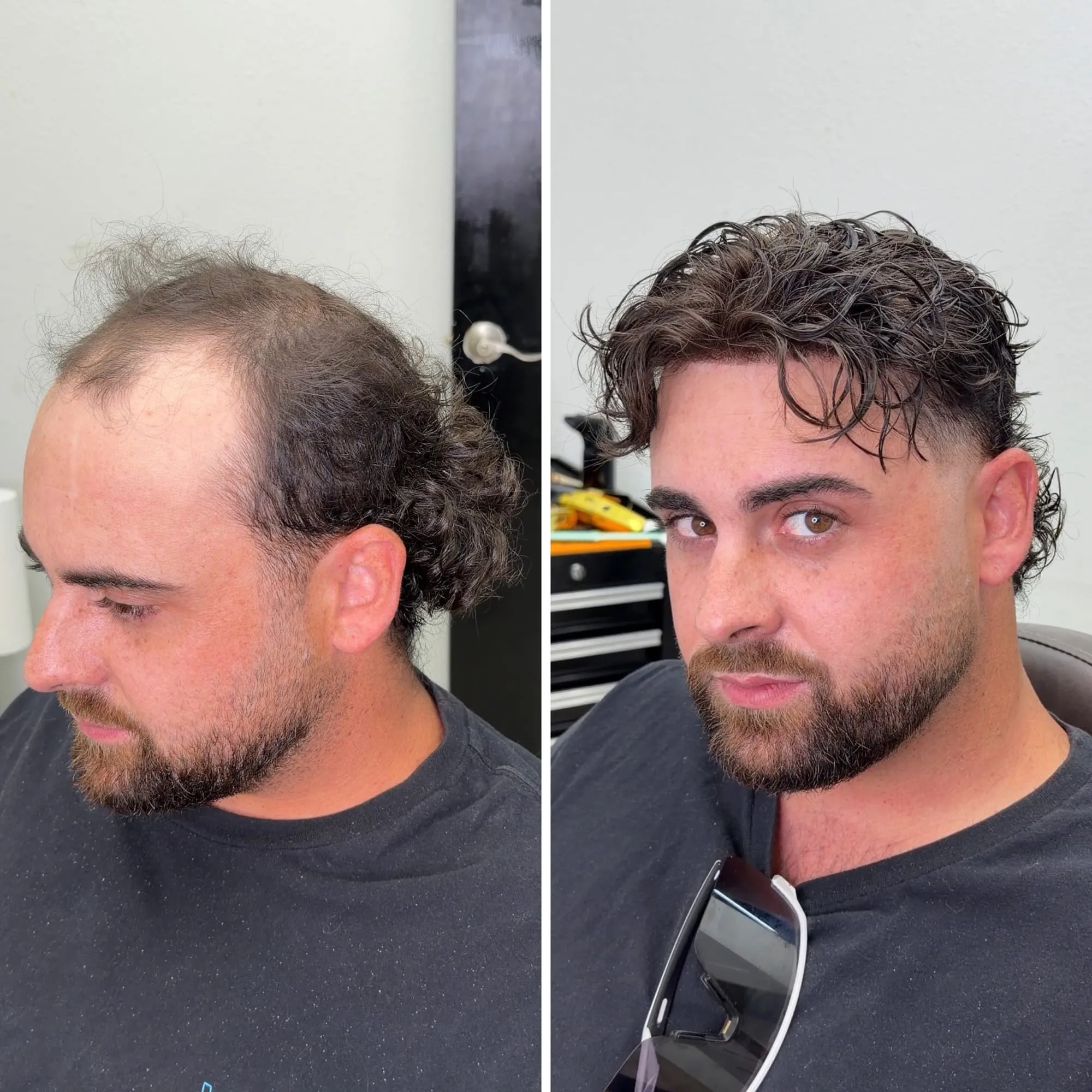
This is what it looks like.
A real client from our chair, photographed before and after his hair system was installed and cut in.
Questions, answered.
Is human hair or synthetic more realistic?
Human hair is more realistic, especially up close, in daylight, and in photos, because it reflects light and moves like your own hair. Good synthetic looks convincing but can carry a faint uniform sheen.
Can I use a flat iron or blow-dryer on a synthetic system?
Usually not on standard synthetic fiber, since heat can damage it. Some heat-friendly synthetics tolerate limited styling, but human hair is the choice if you want full heat styling.
Which lasts longer?
Human hair typically lasts longer in daily wear and ages more gracefully. Synthetic resists color change but tends to frizz and tangle at friction points sooner, which shortens its useful life.
Is synthetic a downgrade?
No. For men who want low maintenance, a backup unit in rotation, or a style that holds without a routine, synthetic is a legitimate choice, not a lesser one. It just trades some realism for ease.
Which do you recommend for most men?
For a unit that reads as your own hair in every setting, we usually recommend human hair and we make sure you understand the upkeep first. We fit both and match the choice to your life.
Keep reading
Related guides.
Lace, Poly, or Skin
Lace breathes and looks natural, skin is invisible and easy to clean, poly holds longest. How we pick a hair system base by realism and upkeep.
Types of Hair Systems
Lace, skin, and poly hair systems compared by look, feel, durability, and upkeep, so you can choose the right base for your hair and lifestyle.
Best Hair System
There is no single best hair system for men. Here is how to choose the right one for you by base, hair type, budget, and lifestyle.
Does It Look Natural
A well fitted, well cut hair system blends into your own hair and hairline. Here is what makes a hair system look natural and undetectable.