

Last updated September 28, 2026
Why a studio, not a supplier, is the honest place to ask
Most of the vendor advice a new hair replacement artist finds is written by someone selling the units. That is a conflict, and it shapes every recommendation. A supplier will always tell you their base is the most consistent and their lead time is the shortest, because the next sentence is an order form.
We do not sell you units and we do not take a cut of who you order from. We buy hair systems the same way you will, we live with the reorders, and we have been let down by vendors who looked flawless on the first sample and fell apart on the third batch. That is the whole value of asking a studio: we have no reason to steer you anywhere, so we can tell you what actually goes wrong and how to catch it before a client is sitting in your chair waiting on a unit that never shipped.
Judge repeatability, not the first unit
Any serious vendor can make one beautiful sample. A sample is a marketing exercise, built with time and attention that a production order will not get. The trait that keeps your business alive is repeatability: the fifth unit matching the first closely enough that your client cannot tell you switched batches.
So the real test is not how good the first order looks. It is whether the second, third, and fourth orders match it on density, hair direction, color, base thickness, and knotting. A vendor who nails the sample and drifts on reorders is worse than a merely average one who is boringly consistent, because inconsistency is the thing you cannot fix in the chair and cannot explain to a paying client.
The vetting criteria that actually matter
Here is the matrix we use before we trust a vendor with client work. Run a candidate against every row. None of these involve a figure or a named brand, on purpose: the point is a repeatable standard you can apply to any supplier, in any price bracket, anywhere they are based. Score honestly, and treat a single red-flag column as a reason to keep looking, not a detail to overlook because the sample was pretty.
| What to check | What good looks like | Red flag |
|---|---|---|
| Lead time honesty | A stated production window they hit consistently, plus a realistic reorder window quoted separately | Vague promises, a window that quietly slips every order, no distinction between first build and reorder |
| Batch consistency | Reorders match the original on density, base, and color close enough to be interchangeable in the chair | Noticeable drift between batches, or a shrug when you ask how they hold a spec across runs |
| Reorder matching | They keep your spec on file and can rebuild from a saved template or a returned worn unit | Every reorder is treated as a fresh order you have to fully re-specify from scratch |
| Minimums and flexibility | Clear minimum order terms, and a path to order single custom units for individual clients | Hidden minimums, or pressure to buy stock in bulk before you have the clients to place it |
| Samples policy | They will send a paid sample so you can inspect real construction before committing volume | No samples at all, or only a hand-picked showpiece you are not allowed to test hard |
| Knotting quality | Clean, consistent knots, appropriate bleaching at the front, hair that survives a comb and a wash | Bulky or uneven knots, over-bleached brittle front hair, visible shedding on first handling |
| Hair transparency | Straight answers on hair type and origin, and no claims they cannot back up | Evasive origin answers, or grand claims about the hair that no one can verify |
| Communication | A named contact who reads a spec sheet correctly and flags problems before production | Slow replies, spec details lost in translation, mistakes you only discover on arrival |
Lead times and what they really tell you
Lead time is not just a scheduling number. It is a window into how a vendor runs. A supplier who quotes one honest window for a first custom build and a separate, usually shorter window for a reorder from a saved spec is telling you they think about your workflow. A supplier who gives one fuzzy answer for everything has not, and that fuzziness turns into a client waiting weeks longer than you promised them.
Ask specifically what happens when a batch fails quality control on their end. A vendor with a real process will tell you they catch it and rebuild, which extends the timeline but protects you. A vendor without one will ship the flawed unit and let you discover it. Build your own client promises on the honest reorder window, never the best-case first-sample window, and pad it, because the day a supplier slips is the day you look unreliable to someone paying you.
Batch consistency and reorder matching
This is the single hardest thing for a vendor to do well and the single most important thing for your business. A client who loves their unit will expect the next one to feel identical. If your supplier cannot hold density, base thickness, hair direction, and color across batches, you inherit that gap in the chair, and there is no cut or blend that fully hides a base that came back thinner or a color that came back warmer.
The practical test is to order the same spec twice, a few months apart, and compare them side by side before you ever put either on a client. Keep a returned worn unit as a physical reference the vendor can match against, not just a written spec, because two shops can read the same order form and build differently. A supplier who welcomes a worn unit as a matching reference is one who understands what reorder matching actually requires.
Minimums, samples, and testing before you commit
New artists get burned most often on minimums. A vendor built for large distributors may want a bulk stock commitment before you have the client base to move it, which ties up cash in units that may not match what your clients end up wanting. Favor a supplier who will build single custom units per client, at least while you are establishing demand, even if the per-unit terms are less aggressive than a bulk arrangement.
Before any volume commitment, buy samples and abuse them. Wash a sample, comb it, wear-test it if you can, and inspect the knotting under good light. Check the front for over-bleaching that leaves the hair brittle, look for shedding when you handle it, and confirm the base thickness matches what was promised on the spec sheet. A vendor confident in their work will happily sell you a real sample to test hard. One who only offers a curated showpiece is protecting something.
- Order the same spec twice and compare the two units side by side
- Keep a worn unit as a physical matching reference for reorders
- Wash, comb, and inspect a paid sample before any volume order
- Confirm the vendor keeps your spec on file for repeat builds
- Base client timelines on the reorder window, not the first-sample window
How we think about it in the studio
We treat a vendor relationship the way we treat any other part of the service: it either holds up in front of a client or it does not. A supplier earns trust slowly, over consistent reorders, and loses it in a single batch that drifts. That is why we vet on repeatability rather than on the prettiest first sample, and why we keep worn units as references rather than relying on paperwork alone.
If you are adding hair replacement to a barbershop or building a studio from scratch, do not shortcut this. The vendor you choose becomes invisible to your client and entirely your responsibility. Vet slowly, test hard, and keep a second option warm so you are never captive to one supplier's bad month. If you want to talk through how we approach sourcing and ordering, that is exactly the kind of thing we cover in mentorship, and you are welcome to book a conversation.
Real work
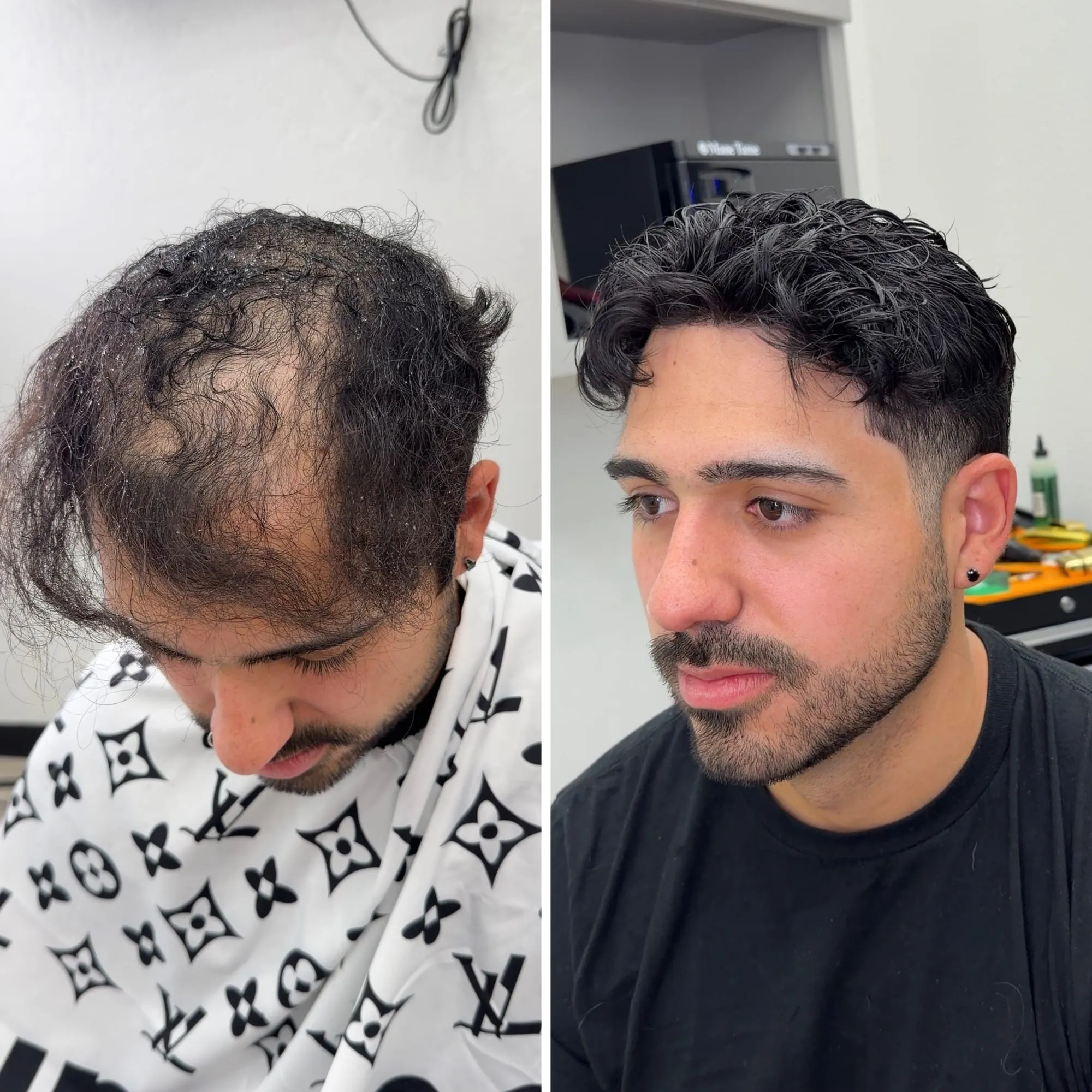
This is what it looks like.
A real client from our chair, photographed before and after his hair system was installed and cut in.
Questions, answered.
How do I choose a hair system supplier as a new artist?
Vet on repeatability, not on the first sample. Check lead time honesty, batch consistency, reorder matching, minimums, samples policy, and knotting quality against a fixed checklist, and order the same spec twice to see whether it comes back matching.
Why does batch consistency matter more than the first unit?
Any vendor can build one good sample. Your clients expect every reorder to feel identical to the first, so a supplier who drifts on density, base, or color across batches creates a gap you cannot fully fix in the chair.
Should I commit to a vendor's bulk minimum early?
Usually not. A bulk stock commitment ties up cash in units that may not match future client demand. Favor a supplier who will build single custom units per client while you establish your book, then revisit volume terms later.
What should I inspect on a vendor sample?
Wash it, comb it, and check it under good light. Look for clean, consistent knotting, front hair that is not over-bleached and brittle, minimal shedding on handling, and a base thickness that matches the spec sheet.
Why ask a studio instead of the supplier about vendors?
A supplier has a reason to recommend themselves. We do not sell units and take no cut of your orders, so we can tell you honestly what goes wrong with vendors and how to catch it before a client is waiting on a unit that never shipped.
Keep reading
Related guides.
Reading the Order Form
Every field on a custom hair system order form explained in one place: base size, material, density, color, grey, curl, length, origin, and more.
Tools & Supplies
The categories of tools and supplies a hair system barber needs, and how to choose each one, with no brand endorsements and no prices.
Start a Business
The real steps to add hair replacement to a barber business: training, first clients, pricing, and building recurring maintenance revenue.
Certification vs Mentorship
Certification teaches the method in a structured block. Mentorship builds real chair skill over time. Here is how to pick, from a studio that runs both.