Last updated September 28, 2026
Why the certificate is not the thing you are buying
There is no single national license for non-surgical hair replacement in the way there is for cosmetology or barbering, so a certificate from a hair replacement program is a private credential, not a government one. That is not a knock on it. It just means the paper by itself proves nothing about your skill, and no client or studio owner will hire on the certificate alone. What they respond to is whether you can measure a scalp, order the right unit, attach it cleanly, and cut it in so it disappears.
So the real question is not which program hands out the most impressive-looking certificate. It is which program builds the skill that stands behind it. Everything below is a way of testing that before you commit, because the marketing on a training page will always sound confident and the only honest signal is in the structure of the class itself.
The five criteria that actually matter
Here is the checklist we would run any hair replacement program through, ranked roughly by how much each one predicts real competence at the chair. Use it as a scorecard. A program does not have to be perfect on all five, but the closer it lands to the strong column, the more likely you leave able to work rather than able to describe the work.
| Criterion | Weak signal | Strong signal | Question to ask |
|---|---|---|---|
| Hands-on hours | Mostly lecture, slides, or watching demos, with a short window to try it yourself | Most of the clock is you attaching, cutting, and blending under supervision | What share of the class is me working with my own hands on a unit? |
| Live models | You practice only on a mannequin block or a training head | You work on at least one live model with a real scalp, real hairline, and real movement | Do I attach and cut in on a live person before I finish? |
| Class size | Large room, one instructor, little individual correction | Small group so the instructor can watch and correct your hands in real time | How many students per instructor, and how much one-on-one time do I get? |
| Post-class support | The relationship ends when the class ends | A defined way to ask questions, send photos, and get feedback for weeks or months after | What support exists after I leave, and for how long? |
| Vendor neutrality | The class is built to sell you one supplier's units, tools, and adhesives | You learn to evaluate bases, hair, and adhesives on their merits from any source | Am I learning skills, or am I being onboarded to one product line? |
Hands-on hours are the whole game
Attaching and cutting in a hair system is a physical skill, closer to barbering than to a lecture subject. You cannot learn to feather a lace front into growing hair by watching someone else do it, any more than you can learn to fade by watching. That is why the single most important number in any program is the share of the clock that has a unit and a pair of scissors in your hands.
Be direct when you ask. A program that leads with hands-on time will answer plainly and often frame the whole day around it. A program that changes the subject to certificates, course platforms, or how many modules there are is telling you where its value actually sits. You want the day structured so that you attach, cut, and blend repeatedly, make mistakes while an instructor is standing there, and correct them before they become habits.
Live models versus a training head
A mannequin block is fine for the first few reps of a new motion, but a block does not sweat, does not have an irregular hairline, and does not turn its head when you are mid-cut. Every hard part of this work lives in the gap between a static block and a real person, so a program that never puts you on a live model has skipped the part that is actually difficult.
Ask specifically whether you attach and cut in on a live scalp before the class ends, and how many models you get time on. Working on a real person is also where you learn the consultation side, reading a hairline, matching density to what already grows, and setting a look that suits the face rather than a textbook.
Class size and post-class support
Class size decides how much correction you get while it still counts. In a small group the instructor can watch your hands, catch a bad angle before it sets, and give each student real attention. In a large room you can spend the day quietly reinforcing a mistake nobody had time to see. Ask for the ratio of students to instructors, not just the head count.
Support after the class is where a lot of programs quietly fall short, and it matters more than people expect. Your first solo attachments are when the real questions arrive, and a program that disappears the moment you leave has left you to figure those out alone. Look for a defined channel to send photos, ask questions, and get feedback for a set stretch of time after class. That ongoing loop is often worth more than an extra day in the room.
- Ask for the student-to-instructor ratio, not the total class size
- Confirm you get individual correction on your hands, not just group demos
- Find out exactly how post-class questions are answered, and for how long
- Ask whether you can return to review or observe a later class
Vendor neutrality, and why it protects you
Some training is really a sales funnel for one supplier's units, tools, and adhesives. The class is free or cheap because the business model is the products you buy afterward. That is not automatically bad, and a good supplier can teach a genuinely useful class, but it is a conflict you should see clearly before you enroll, because it shapes what you are taught and what you are steered away from.
Vendor-neutral training teaches you to evaluate a base, a hair type, and an adhesive on its merits so you can source what is right for each client from anywhere. That skill outlasts any single supplier and keeps your studio independent. If a program will only teach you to work with one product line, you are learning that company's catalog, not the craft, and you will have to relearn the moment you want to offer something they do not sell.
How to run the checklist before you commit
Put the five criteria in an email or a phone call and ask them plainly, in order of weight: hands-on share, live models, student-to-instructor ratio, post-class support, and vendor independence. A program confident in its training will answer all five specifically and quickly. Vague answers, or a pivot back to the certificate and the marketing, are their own answer.
We teach hands-on hair replacement from our studios in Peoria, Arizona and Eighty Four, Pennsylvania, and we would tell any prospective student to hold us to exactly this list. If you are weighing options, book a call and ask us these five questions directly. The right program for you is the one whose answers hold up, wherever you end up training.
Real work
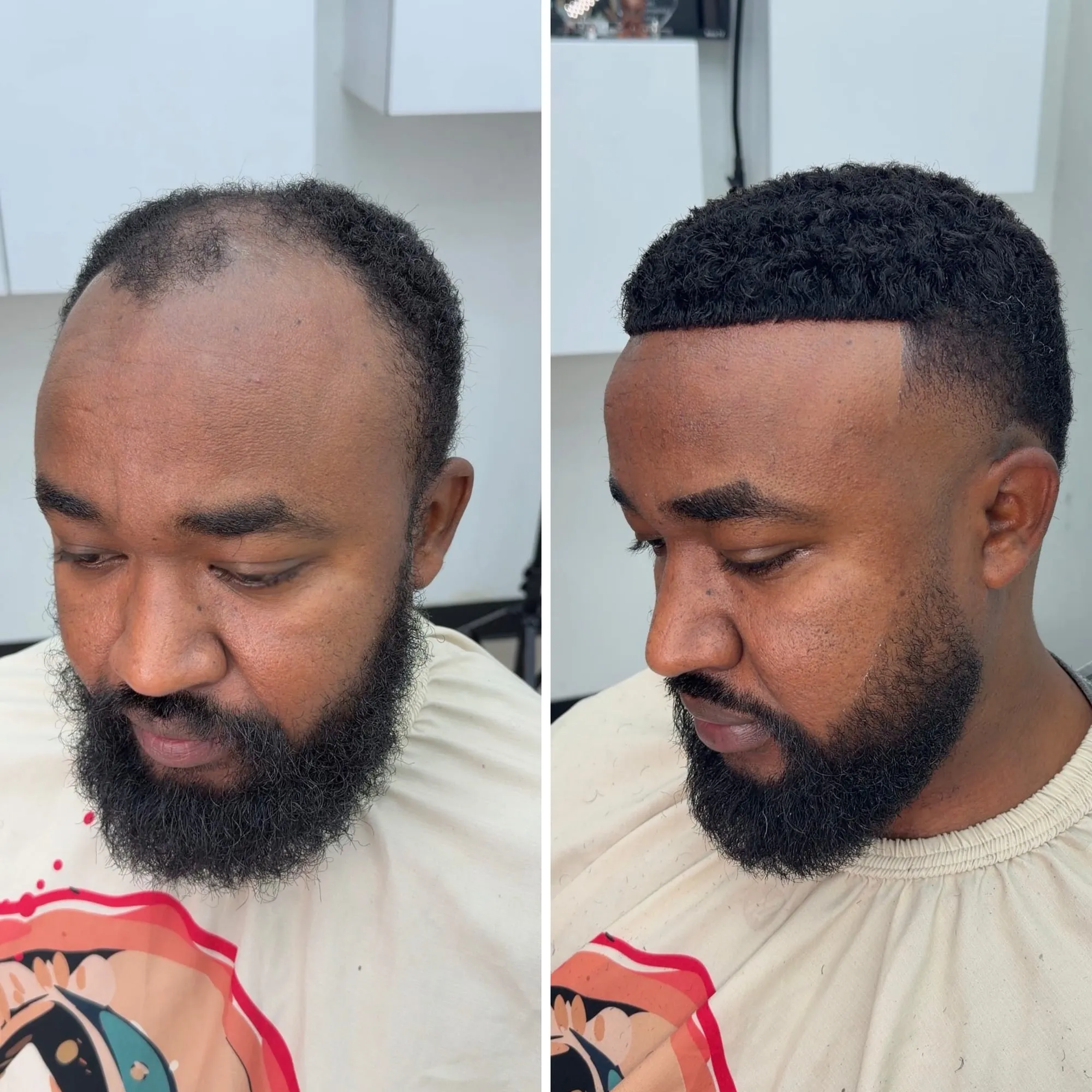
This is what it looks like.
A real client from our chair, photographed before and after his hair system was installed and cut in.
Questions, answered.
What is the single most important thing in a hair replacement program?
Hands-on hours. Attaching and cutting in a hair system is a physical skill, so the share of the class that has a unit and scissors in your own hands, under supervision, predicts real competence better than anything else on the page.
Does the certificate itself matter?
Less than people assume. There is no single national license for non-surgical hair replacement, so a certificate is a private credential. Studios and clients respond to whether you can do the work, not to the paper, so judge the training behind it.
Why does vendor neutrality matter in training?
Some programs are built to sell you one supplier's products. Vendor-neutral training teaches you to evaluate any base, hair type, and adhesive on its merits, so you can source what is right for each client and keep your studio independent of a single catalog.
Is practicing on a mannequin enough?
For the first reps of a motion, yes, but not to finish. A block does not sweat, move, or have an irregular hairline. Confirm the program puts you on at least one live model before it ends, since that is where the genuinely difficult parts live.
What should I ask about support after the class?
Ask how questions are answered once you leave and for how long. Your first solo attachments raise the real questions, so a defined channel to send photos and get feedback for weeks after class is often worth more than an extra day in the room.
Keep reading
Related guides.
Certification
What non-surgical hair replacement certification covers for barbers, what it proves, and how it de-risks adding hair systems to your chair.
Training
What hair replacement training for barbers covers, how classroom and mentorship fit together, and how to choose a program that builds a paying service.
Certification vs Mentorship
Certification teaches the method in a structured block. Mentorship builds real chair skill over time. Here is how to pick, from a studio that runs both.
How Long It Takes
A realistic timeline from your first hair replacement class to a confident, booked artist, plus the specific things that speed it up.