Last updated October 27, 2026
The short version
Every result moves through the same five stages. You sit down for a consultation and we match a hair unit to your hair. That unit is built or selected to your spec. On install day it is bonded to your scalp. It is then cut into your own hair so the join disappears. From there you come back on a cycle to have it re-bonded, cleaned, and re-cut. None of it is surgical, and nothing goes under the skin.
- Consultation and match
- Building or selecting the unit
- Install and bond
- Cut-in and blend
- Re-bond and maintenance cycle
Stage one: the consultation and the match
The first appointment is where the whole result is decided, long before any hair goes on. We look at how much hair you have and where, the shape your hairline used to take, and the color, grey percentage, wave, and caliber of the hair you still have. Those readings become the spec the unit is built to, which is why a rushed consultation tends to produce an obvious result.
The part people underestimate is the template. We take a mold of your scalp that captures its exact outline and curvature, something a tape measure cannot do. A base built to a real mold sits flat and follows the contour of your head, and that is a large part of why a well made unit does not read as sitting on top of it.
Stage two: building or selecting your unit
With the spec and the template in hand, your unit is either built to order or selected from stock and customized. The base is chosen first, because it decides the trade between an invisible front and how long the unit lasts. A finer base gives the most undetectable hairline and wears faster, while a sturdier base holds more density and takes repeated bonding better.
Then the hair is tied into the base at the density we agreed, in your color and texture. Density is the single most common thing a studio gets wrong, because real hair at your age is rarely as thick as men expect, so we build to what is believable for you rather than the maximum the base can carry. The hairline at the very front is built irregular and graduated, never as a hard even edge, because a real hairline is never a straight line.
Stage three: install day and the bond
On install day the unit is bonded to your scalp. We clean and prep the skin, mark your hairline so the front edge lands in the right place, then attach with tape, a liquid or soft bond adhesive, or a combination of the two. The adhesive has to reach its tack before the unit goes on, and the unit is set from front to back so no air is trapped under the base.
The bond is what lets you live normally in it. It is attached to your scalp, not balanced on it, so it holds through showering, training, and sleep. Which attachment we use is matched to your skin, how much you sweat, and the climate, which in our Peoria, Arizona studio means the heat is a genuine variable rather than a footnote.
Stage four: the cut-in and blend
This is the step that separates an undetectable result from an obvious one, and it is the part no stock product can replicate on its own. Once the unit is bonded, it is cut into your surrounding hair by hand, feathering the perimeter so the density and the join between the unit and your real hair disappear. The hairline is softened, the top is textured to match your growth, and the whole thing is styled as one head of hair.
It is worth being clear that the unit arriving is only half of the work. An identical unit can look seamless in one chair and obvious in another, and the difference is almost entirely this cut. You walk out with a finished haircut, not a project to take home and figure out.
Stage five: the re-bond and maintenance cycle
Non-surgical hair replacement is maintained on a cycle rather than installed once and forgotten. As the adhesive ages and your own hair grows underneath, the bond loosens slightly and the blend drifts, so you come in to have the unit lifted, the scalp and the unit cleaned properly, the hair re-cut and blended to your current growth, then re-bonded. You leave with what amounts to a fresh install.
The interval is set to you rather than applied as a blanket rule, because sweat, heat, and how you wear it all change how fast a bond ages. We agree the cadence at your install so it fits your routine instead of surprising you. Many men also rotate two units so each one gets a rest, which extends the life of both.
What daily life actually looks like
Between visits you live in it like your own hair. You shower, train, swim, and sleep in it, with a short learning curve on washing and drying that we walk you through before you leave. The honest adjustment is the routine and the schedule, not a list of things you can no longer do.
- Shower, swim, and sweat in it, drying it properly afterwards
- Sleep in it, which most men stop noticing within a few nights
- Style it day to day much like your own hair
- Keep the maintenance schedule, which is the part that actually protects the result
Real work
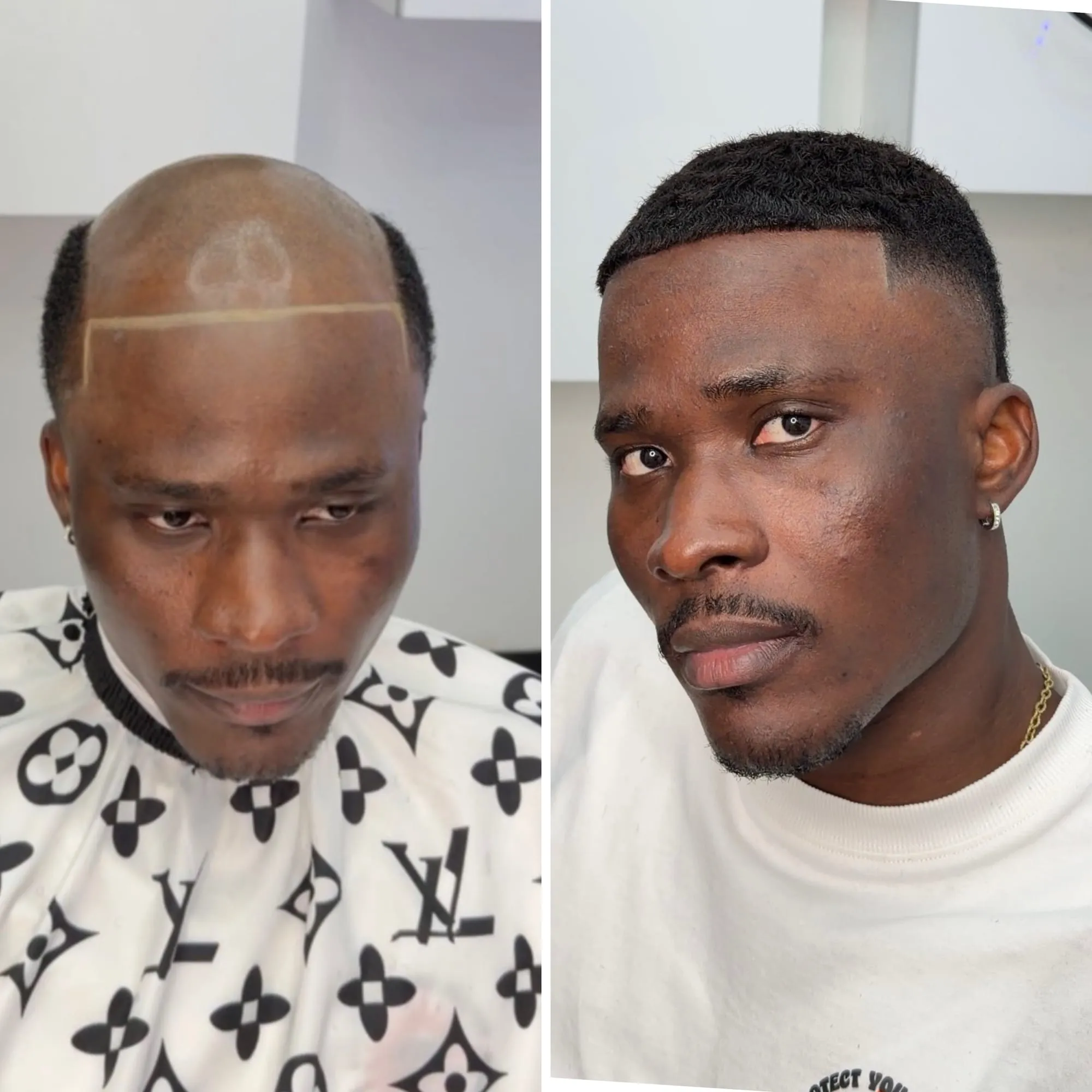
This is what it looks like.
A real client from our chair, photographed before and after his hair system was installed and cut in.
Questions, answered.
Is non-surgical hair replacement permanent?
No, and that is part of how it works. A hair system is worn, maintained on a schedule, and eventually replaced, which also means it is fully reversible. Nothing is fixed to you permanently, so you can stop or change course at any point.
Does non-surgical hair replacement hurt?
No. Nothing is cut and nothing goes under the skin, so there is no pain and no recovery period. Most men describe the install as a long haircut. The adhesive sits on the scalp, and we match it to your skin so it is comfortable to wear.
How long does the whole process take?
The consultation is around half an hour. Install day, where the unit is bonded and cut in, is a single same-day visit, so you walk in thinning and walk out with a full head of hair. After that, maintenance visits are shorter and recur on a schedule we set to you.
Does it work if I have very little hair left?
Yes. Non-surgical hair replacement adds hair rather than relying on the density you have left, so it works at any stage, from a receding hairline to full loss. That is one of the main differences from a transplant, which depends on having enough donor hair to move.
Will people be able to tell?
Not when it is matched, bonded, and cut in properly. The front hairline and the cut are where the work shows, which is why the match and the blend matter more than the unit itself. Done well, it holds up close, in photographs, and in daylight.
Keep reading
Related guides.
What Is Non-Surgical Hair Replacement
What non-surgical hair replacement is, the methods that count, and how it differs from a transplant and from medication. Adds hair, no surgery.
What Is a Hair System
A hair system is a custom hair unit fitted and blended into your own hair for a full, natural look. Here is how non surgical hair replacement works.
Hair System Maintenance
How to keep a hair system clean, secure, and natural: your at home routine, the maintenance schedule, and what a studio visit covers.