

Last updated September 28, 2026
Think in cadence, not transactions
Most barbers evaluate this service the way they evaluate a haircut: one client, one visit, one ticket. That framing is why so many of them decide it is not worth it. A hair system is not a single transaction. It is the front door to a recurring relationship, and the relationship is what pays.
A properly attached hair unit needs regular re-service. The bond loosens over time, the base and hair need cleaning, and the hairline needs a re-cut to stay honest as the client's own hair grows around it. That work happens on a rhythm, usually every few weeks, for as long as the client wears the system. Once you see the service as a rotation instead of a sale, the profitability question answers itself.
- A haircut client returns when they feel like it
- A hair replacement client returns on a fixed maintenance cadence
- That cadence is bookable in advance, so it fills your calendar
- Every install adds one more recurring slot to your rotation
The drivers that actually move the numbers
If you want to judge whether this is worth adding, stop looking for a headline figure and look at the drivers underneath it. These are the levers that decide whether the service earns its place in your shop, and every one of them is about time and consistency rather than a rate you set once.
Chair time per visit is the first lever. An install takes a real block of time, but a routine maintenance visit is shorter and highly repeatable once your process is dialed in. The tighter and more consistent your maintenance workflow, the more visits fit into a day without cutting corners.
Cadence is the second. A client on a steady rotation is a slot you can count on, which is worth far more than an unpredictable walk-in. Retention is the third. A maintenance client who trusts you rarely leaves, because switching providers mid-relationship means starting the trust and the fit over from scratch.
- Chair time: install block versus shorter, repeatable maintenance block
- Cadence: how often each client returns for re-service
- Retention: how long a client stays on your rotation
- Capacity: how many maintenance slots your week can hold
- Consistency: whether every visit takes the time you planned
Capacity is the real ceiling
The question is not whether one install is profitable. It is how many recurring maintenance clients your chair can hold before you run out of hours. That ceiling, not any single ticket, is what determines the size of the service.
Here is the compounding part. Every new install you complete does not just earn once. It adds a permanent slot to your maintenance rotation. Do a handful of installs a month and, within a year, you are carrying a steady book of clients who return like clockwork. The rotation grows install by install until your capacity, not your demand, becomes the limit.
That is a very different business from selling haircuts. Haircut demand resets every single week and you start from zero. A maintenance book carries forward. It is closer to a subscription you have to earn and keep than to a string of one-time sales, and it is why a small number of loyal hair replacement clients can anchor a barber's week.
Why the recurring model smooths your week
Installs are unpredictable. A prospect books when they are ready, not when your calendar has a gap, so you cannot plan a week around new installs alone. Maintenance is the opposite. Because it happens on a known cadence, you book the next visit before the client leaves the chair, which means large parts of your future weeks are already filled.
That predictability is the quiet advantage. A calendar with a reliable maintenance base underneath it lets you plan your time, staff your shop, and take on new installs into the gaps rather than scrambling to fill empty chairs. The recurring rotation is what turns a volatile side service into something you can actually run a schedule around.
It also protects you from slow seasons. Haircut traffic ebbs and flows, but a maintenance client on a rotation returns regardless of the season, because a worn bond does not wait for a busy month. That steady floor under your calendar is one of the most valuable things this service adds.
What eats the margin if you let it
The model works, but it is not automatic. The same drivers that make it profitable will quietly erode it if you ignore them, so it is worth naming the failure modes before you build around the service.
The biggest one is treating installs as the goal and letting maintenance slip. A barber who installs and never books the return visit is throwing away the entire recurring model and keeping only the hardest, least repeatable part. The second is a sloppy maintenance process that runs long every time, which quietly caps how many clients your week can hold. The third is under-delivering on quality, because a client who loses trust leaves your rotation and takes their referrals with them.
- Not booking the next maintenance visit before the client leaves
- A maintenance workflow that runs long and unpredictable
- Skipping the cut-in, so the hairline stops looking honest
- Losing a client's trust, which ends the recurring relationship
How we run it at The Hair Experience
In our Peoria, AZ and Eighty Four, PA studios, Nico Rigano, Ivette Rigano, and Denisse Diaz treat the maintenance rotation as the core of the practice, not an afterthought to the install. Every client leaves with their next re-service already on the books, and the maintenance workflow is standardized so each visit takes a known block of time.
That discipline is what makes the model predictable. It is also what we teach barbers who train with us. Learning to attach a hair unit is only half the craft. The other half is building the recurring relationship and the consistent process that let a small book of clients fill your week reliably. Get the figure specifics for your own market from a consultation and a proper pricing framework, and build the rest on cadence, chair time, and capacity.
Real work
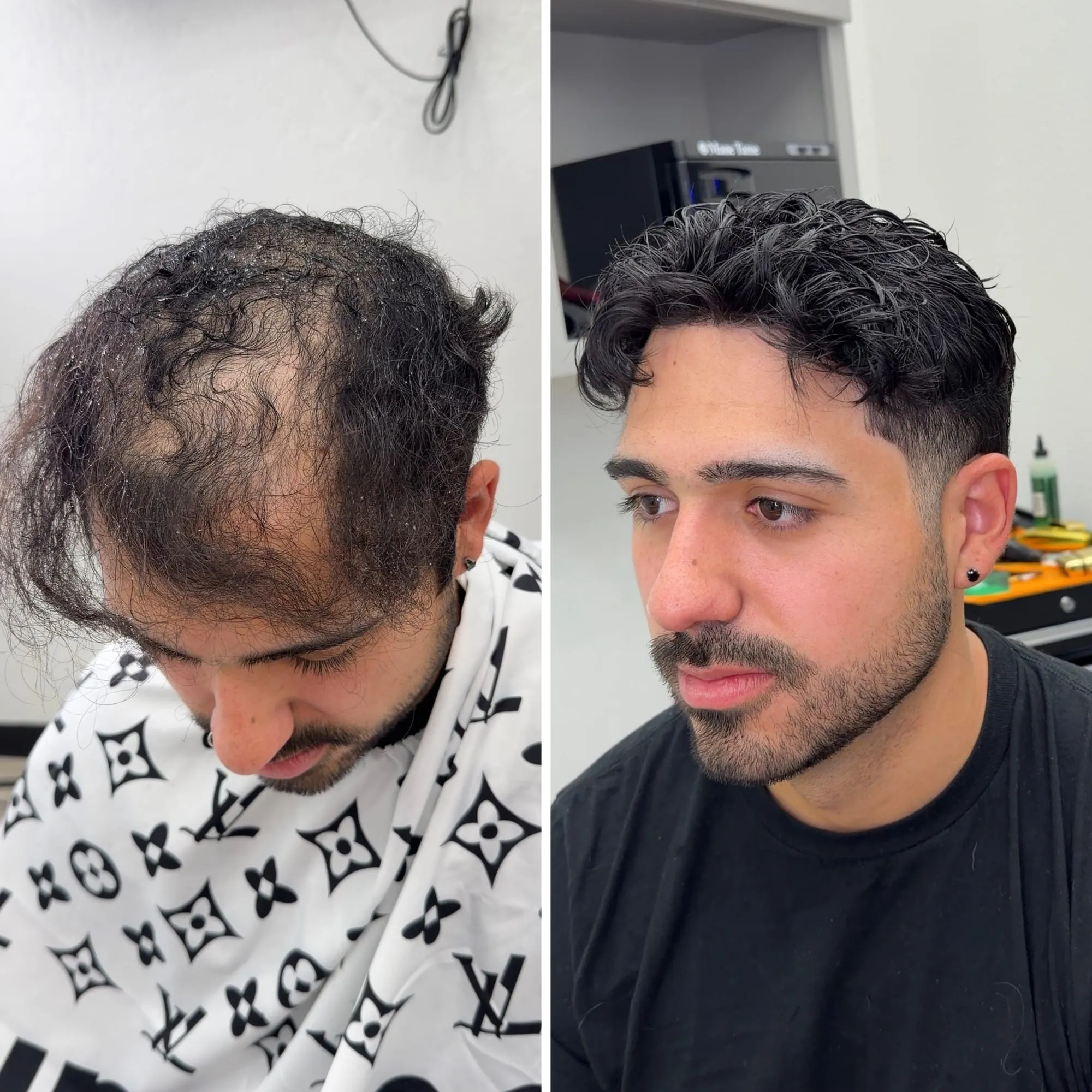
This is what it looks like.
A real client from our chair, photographed before and after his hair system was installed and cut in.
Questions, answered.
Is offering hair systems profitable for a barbershop?
It can be, but the profit comes from maintenance, not the install. Each hair replacement client returns on a regular cadence for re-service, so installs compound into a recurring book of clients who fill your chair time predictably. Evaluate the service on cadence, retention, and capacity rather than on a single ticket.
Where does the actual revenue come from, the install or the upkeep?
The upkeep. An install is a one-time event, but the hair system needs re-bonding, cleaning, and cut-ins on a steady rotation for as long as the client wears it. That recurring maintenance is what turns each install into an ongoing client, and the rotation is where the real, plannable revenue lives.
How many maintenance clients can one chair hold?
That depends on your maintenance cadence, how long each visit takes, and how many hours your week has. Capacity, not demand, is usually the ceiling. A tighter, more consistent maintenance workflow lets more recurring clients fit into the same week without rushing any of them.
Why not just judge it by the price of one install?
Because one install understates the model. The value is the recurring relationship it starts, which pays out over many visits rather than one. Judging the service by a single install is like judging a subscription by its first payment. The cadence and retention are what matter.
Keep reading
Related guides.
Artist Income
What actually decides a hair replacement artist income: service mix, rebooking, chair capacity, and client retention. A business framework for barbers.
Pricing Framework
A pricing framework for barbers adding hair replacement: the factors that set install and maintenance fees, and how to build a menu that holds.
Start a Business
The real steps to add hair replacement to a barber business: training, first clients, pricing, and building recurring maintenance revenue.
Add It to Your Shop
A shop owner playbook for adding hair replacement: menu placement, book blocking, private space, and converting the regulars already in your chairs.