

Last updated September 28, 2026
Run it as a service line, not a bolt-on
Most guides tell a barber how to leave and start a standalone hair replacement business. That is a different decision. You already have a shop, a name, a book, and foot traffic, and the smart move is to graft this service onto what works without breaking the thing that pays your rent today.
The trap is treating hair replacement like another item on the price board next to a beard trim. It is not a quick service and it is not a walk-in. An install runs long, needs quiet, and needs a client who has had a real consultation first. Slot it into your walk-in flow and it will either run late and back up your floor or get rushed into a bad hairline. Both cost you more than the service earns.
Decide up front that this is a booked, private, standalone lane inside the business. Everything else here follows from that one decision.
- Appointment only, never a walk-in add-on
- Consultation first, install on a separate day
- Its own lane on the book, not squeezed between fades
- One operator responsible for it end to end, at least to start
Where it fits on your menu
Keep hair replacement understated on the public menu and route it to a consultation rather than a listed rate. Men researching this are private and are comparing outcomes, not line items, so a booked consultation converts far better than a number on a board. It also protects you, because what a client pays should reflect the factors that drive the work, and those are set per head at the consultation, not printed on a wall.
Position it as its own category, separate from your cutting services, with a short honest description and one clear action: book a private consultation. That framing signals the service is deliberate and skilled rather than a novelty, and it filters for people who are ready instead of the merely curious who eat your chair time.
- A distinct menu category, not a footnote under haircuts
- One call to action: book a private consultation
- Cost drivers explained in person, never a public price
- Plain, confident wording that avoids hype
Block the book before you sell a single install
The calendar is where this service quietly succeeds or fails. An install needs a long, uninterrupted block, and a consultation needs its own shorter slot on a different day. If you try to fit either around a full walk-in schedule you will resent the service within a month.
Reserve fixed hair replacement blocks each week, the way you would protect time for a standing client, and hold them even before demand fills them. Empty protected time feels wasteful for a few weeks and then becomes the backbone of the whole thing. Maintenance is the reason. Unlike installs, which arrive unpredictably, maintenance is bookable weeks out, so a growing book of maintenance clients on a regular rotation is what turns scattered installs into a schedule you can plan a week and a month around.
Book the next maintenance visit before the client leaves the chair, every time. That single habit is the difference between a one-time install you never see again and a recurring client who anchors your calendar.
- Fixed weekly blocks for installs, protected in advance
- Separate, shorter consultation slots on other days
- The next maintenance visit booked before the client leaves
- Buffer time after installs so a long job never backs up your floor
Solve the privacy problem in an open shop
Privacy matters here far more than square footage, and an open barbershop floor is the wrong environment for this work. Men getting into hair replacement do not want an audience for the consultation, the templating, or the first reveal. A busy open floor with a clear line of sight to the waiting area will cost you clients who would otherwise have said yes.
You do not need a build-out or a second location to fix this. You need one space that can be made private and well lit when you need it: a back room, a partitioned station away from the front windows, or a quiet private hour all work. The requirement is simple. The client goes through the whole process without feeling watched, and your operator has clean light and room to work.
- A room or station that can be closed off from the floor
- Strong, even lighting for color and density matching
- A sightline away from the waiting area and front windows
- Somewhere clean to store adhesives, tools, and client units
Your first clients are already in your chairs
This is the biggest advantage a shop owner has over someone starting cold. You already cut for men who are thinning, receding, or shaving down because they believe they have no good option, and you already have their trust. Those are your warmest possible leads, and you have them on a first-name basis.
Start with a straight, low-pressure conversation, not a pitch. Let regulars know the shop now offers hair replacement, that it is private and appointment based, and that a consultation is the first step. Then let the work sell itself. Clean before and after photos and short video of a real reveal, captured with permission, are the only marketing that reliably moves this service, because prospects believe footage of a real head far more than words. Build that library from your first installs, because it compounds.
Price those first installs as learning reps rather than your eventual rate. Get the framework for what drives cost right and let the number follow your skill as it grows.
- Start with existing regulars who are already thinning or shaving down
- A quiet heads-up, not a hard sell
- Before and after photos plus reveal video, captured with consent
- First installs priced as reps while you build the portfolio
Decide who runs it, and get them trained
To start, one operator should own this service end to end, whether that is you or a barber on your team who wants the skill. Hair replacement sits next to barbering but is not the same craft. Templating a scalp, cutting a lace front into a believable hairline, matching density and color, and choosing an attachment method for a specific head and lifestyle are all taught and then repped, not picked up from clips between clients.
Send that person for hands-on training on a live head, backed by mentorship for their first installs, so an experienced practitioner corrects mistakes before they become habits. That protects both the client and the shop's name while the skill is new. At our studios in Peoria, AZ and Eighty Four, PA, Nico Rigano, Ivette Rigano, and Denisse Diaz train and mentor exactly this way, because a supervised first install is worth more than any amount of watching alone.
Once your first operator is fluent and the book is consistent, decide whether to train a second. Do not spread the skill thin before anyone is genuinely good at it.
- One operator owns the service line at the start
- Hands-on training on a live head, not video learning
- Mentorship on the first installs and cut-ins
- A second operator only once the first is truly fluent
Protect the shop's name and stay compliant
Your existing reputation is the asset you are borrowing against, so protect it. Confirm the licensing and scope-of-practice rules in your state before you take money, since requirements for cutting hair, working on the scalp, and using adhesives vary and getting this wrong is an avoidable way to damage the business you already built.
Then hold the same standard on the work itself. Never overpromise, set honest expectations about upkeep and the factors that drive cost, and never let a client walk out with a result your operator would not wear. In a local market your work is your marketing, and a client who feels misled about hair replacement can undo goodwill you spent years earning on haircuts.
- Confirm state licensing and scope of practice before charging
- Honest expectations on upkeep and cost drivers, set in the consultation
- No result leaves the shop that your operator would not wear
- Treat every install as a reflection of the whole shop
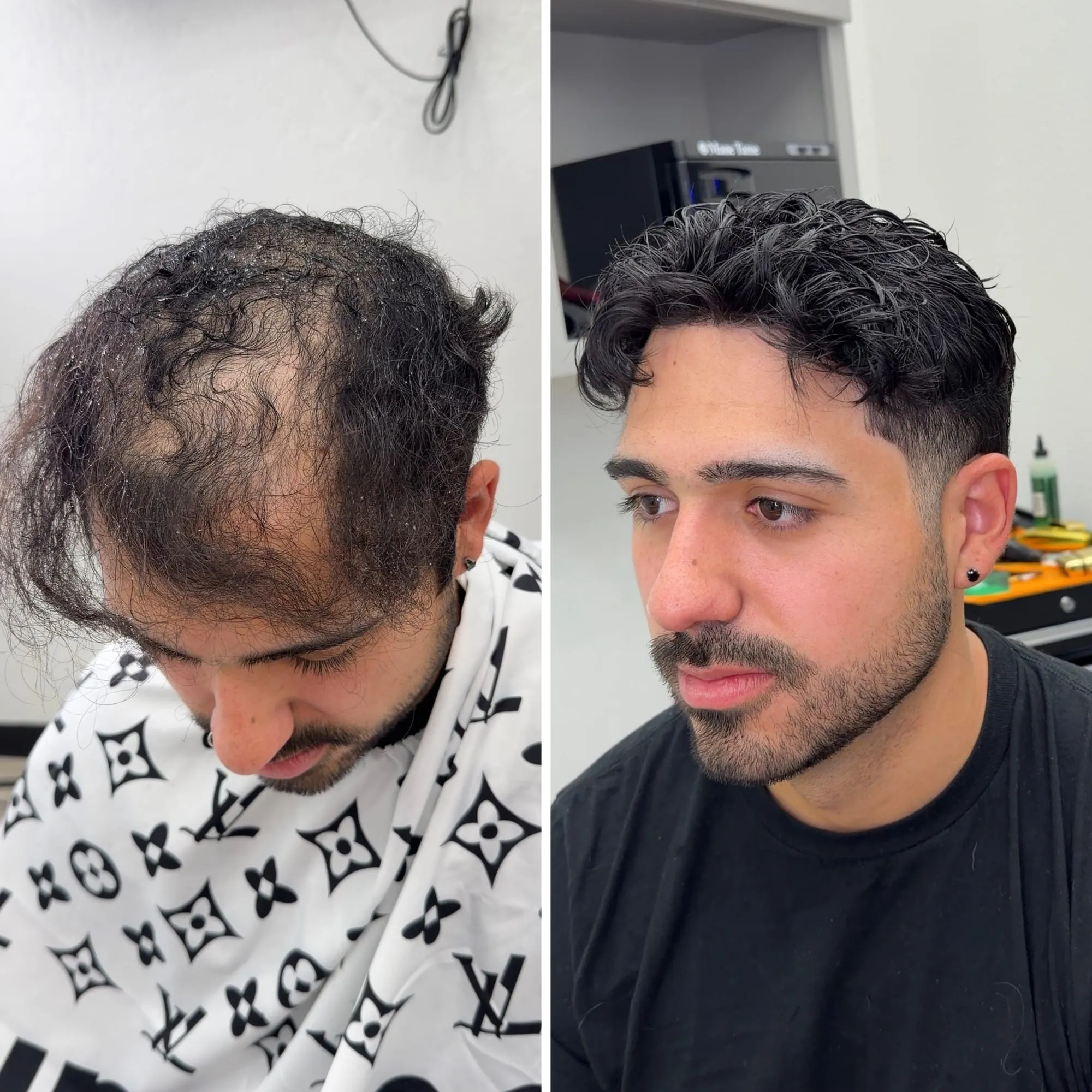
Real work
This is what it looks like.
A real client from our chair, photographed before and after his hair system was installed and cut in.
Questions, answered.
Should I list a price for hair replacement on my menu?
No. Route it to a private consultation instead. What a client pays depends on factors set per head, like base construction, hair type, and how the unit is attached and maintained, so a listed number would be misleading. A consultation also converts better, because men researching this compare outcomes rather than line items.
Can I offer hair replacement as a walk-in service?
No. An install needs a long, uninterrupted block and a client who has already had a consultation, so it belongs on the book, not in your walk-in flow. Forcing it into a busy floor either backs up your other chairs or rushes the work into a bad hairline. Keep it appointment only from day one.
Do I need to renovate or add a room?
Not usually. You need a space that can be made private and well lit when you need it, not a build-out. A back room, a partitioned station away from the front windows, or a quiet private hour all work. Privacy and clean light matter far more than square footage for this service.
Where do my first clients come from?
From the chairs you already fill. You cut for men who are thinning, receding, or shaving down and who trust you, which makes them your warmest leads. Let them know the shop now offers hair replacement by consultation, then let real before and after footage from your first installs do the rest of the selling.
Keep reading
Related guides.
Start a Business
The real steps to add hair replacement to a barber business: training, first clients, pricing, and building recurring maintenance revenue.
Training
What hair replacement training for barbers covers, how classroom and mentorship fit together, and how to choose a program that builds a paying service.
Hair System Barber
A hair system barber installs, cuts in, and maintains hair systems for men. Here is what the role involves and why barbers are adding it.
Tools & Supplies
The categories of tools and supplies a hair system barber needs, and how to choose each one, with no brand endorsements and no prices.