Why the hairline is the first thing you notice
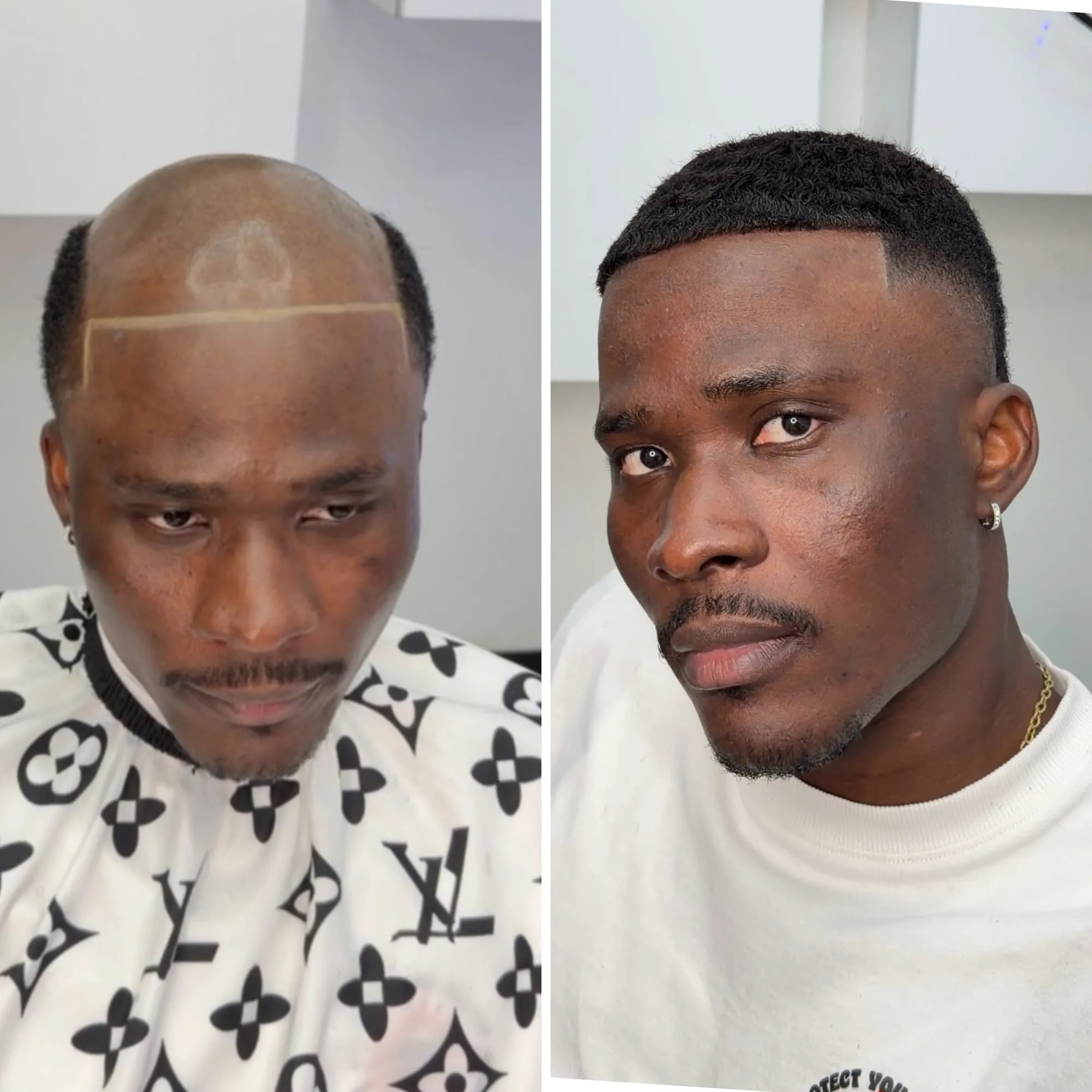
Almost every strong before and after lives or dies at the hairline. In the before shot the front is usually receded, uneven, or soft, and there is no clear line for the eye to land on. In the after, there is a defined front edge again, set at a height that suits the age and shape of the face rather than the lowest line we could physically build.
The detail that sells it is irregularity. A natural hairline is not a ruler-straight border. We work in a slightly broken, uneven front with finer hair at the very edge, because that is how hair actually grows out of skin. When you compare the two frames, the front is doing most of the honest work.
Density: filling the top back in
The second obvious change is coverage across the crown and mid-scalp. Before, scalp shows through under light and the hair reads thin from above. After, the top has weight and shadow again, so overhead light stops finding scalp and the hair looks like it has body.
We are careful not to overshoot this. A unit packed with far more density than a real head of hair is one of the fastest ways to look off, especially in the before and after where the eye can compare. We match the density to what is realistic for your age and to the hair you still have, so the two blend instead of competing.
Framing: what the whole face gains
This is the change people feel but cannot always name. Hair frames a face. When the front and temples are restored, the forehead reads shorter and more in proportion, the eyes sit better inside the frame, and the face looks more like the one the client remembers.
In a good before and after the jaw and features look sharper in the after even though we never touched them. That is framing at work. It is also why a photo taken straight on tells a different story than one taken from above, and why we shoot the same angles before and after so the comparison is fair.
The blend into your own hair
A hair unit is not the whole head. The sides and back are usually your own hair, and the win is in the seam where the two meet. In the before, there is nothing to blend. In the after, the unit is cut and tapered into your existing hair so there is no visible line, no shelf, and no obvious transition from front to back.
This is the part a camera is toughest on. Direct light, wet hair, hands pushed through it, all of it gets checked in the chair before you ever leave. Some people still call this a hairpiece, but the point of the blend is that it does not sit on top like one. It reads as one head of hair.
What a real before and after will not do
We keep this honest because the gap between the photo and the mirror is where trust is lost. A before and after captures day one, at its cleanest, right after a fresh fit and cut. That is a true result, but it is a starting point, not a permanent state.
Two things to hold in your head when you look at any gallery:
- It ages between visits. Hair grows, adhesive loosens, and the front edge softens, which is exactly why maintenance exists.
- It is styled for the shot. Your everyday version is the same hair, cut for your routine rather than for one clean photo.
- It is one person's head. Your density, hair color, and starting hairline are yours, so your result will read differently than the one on screen.
How to read our gallery like a professional
When you look through real clients from our chair, do not just check whether it looks good. Look for whether it looks like hair. Study the front edge for that broken, uneven line. Look at the part and the crown for density that matches the face, not density that shows off. Look at the sides for a blend with no shelf.
Then look for someone whose before looks like yours. A receding front, a thinning crown, and a soft hairline are all different starting points, and the fairest preview of your own after is a before that started where you are now. If you want us to walk you through which examples map to your situation, that is what a consultation is for.
Real work
This is what it looks like.
A real client from our chair, photographed before and after his hair system was installed and cut in.
Questions, answered.
Are the before and after photos taken on the same day?
The after is shot the same day the unit is fitted and cut, so it shows a genuine day-one result. It is the cleanest version of that hair, not a state it holds forever without maintenance.
Will my result look exactly like the photos?
No, and it should not. Your hairline, density, hair color, and the hair you still have are yours, so your after is built to suit your head. The photos show what the work looks like, not a result you copy.
Why do some before and afters look fake?
Usually too much density, a hairline set too low or too straight, or a hard seam where the unit meets real hair. A natural result uses a broken front edge, realistic density, and a clean blend, which is what we check in the chair.
Does the after hold up in person and in bad lighting?
That is the real test. We check the fit under direct light, with hair pushed around and moved, before you leave, because a result that only works for one angle is not a result we would show.
Keep reading
Related guides.
Does It Look Natural
A well fitted, well cut hair system blends into your own hair and hairline. Here is what makes a hair system look natural and undetectable.
The Hairline
A natural hair system hairline is built from irregularity, a soft density gradient, and careful placement. Here is how we design one that reads as yours.
What Is a Hair System
A hair system is a custom hair unit fitted and blended into your own hair for a full, natural look. Here is how non surgical hair replacement works.
Choosing a Studio
The questions to ask, the red flags to avoid, and what separates a great hair replacement studio from an average one.