

Last updated September 28, 2026
What you are actually specifying when you buy online
A hair system is not one product, it is a stack of about eight independent specifications that all have to be right at once. Order online and every one of them is a field you fill in yourself, off a photo and a size chart, with no one checking your work before the unit is built. Get one wrong and the whole unit reads as off, because the eye catches a mismatch anywhere along the front or the parting.
The table below is the honest version of that order form. It lists the specs you have to nail, the definitive numbers each one moves within, and who is realistically getting it right: you at a keyboard, or a practitioner with your head in front of them. None of these carry a figure here on purpose. Where a spec adds cost, it is flagged as a driver and the number is set at consultation, not published.
| Spec you must nail | Definitive range or code | Online, from a screen | In a studio, in the chair |
|---|---|---|---|
| Base material and thickness | Thin skin roughly 0.03 to 0.12 mm (ultra-thin near 0.03 mm, standard 0.06 to 0.08 mm); lace and mono have no mm thickness but different feel and wear | You pick a material and a thickness blind, trading realism against wear life with no sample to touch | We show you skin, lace, and mono on the head and match thickness to your skin and climate |
| Hair density | Roughly 80% (light) to 150% (heavy); a natural adult result usually sits 100 to 130% | A percentage on a dropdown, easy to over-order, and heavy density reads like a unit | We set density against your existing hair so the crown and edges blend, not overshoot |
| Color and grey | Codes run #1 jet black through #7 lightest, with #1B off black; grey added in 10% steps, e.g. 1B10 to 1B50 | Matched off a screenshot under your room light, where warm or cool casts throw the code | Matched against your own hair under neutral light, greys and root shade dialed in |
| Base size and shape | Stock commonly 8 by 10 inches (also 7 by 9, 6 by 8); custom cut to a paper template of your scalp | You measure your own thinning area and hope the stock rectangle covers it | We take a template of your exact scalp so the base sits inside your growing hair |
| Curl and wave | Set by perm-rod diameter, roughly 22 to 32 mm for straight to loose wave, down toward 13 mm for tighter curl | A rod code chosen from a chart, hard to picture against your natural pattern | We match the rod size to how your own hair falls so styled hair moves as one |
| Front contour and hairline | Coded CC, A, or AA for the hairline shape, plus recession depth and any temple points | A contour code with no cut-in; the unit ships with a straight, blunt, unworn front | We choose the contour to your face and hand-cut the hairline so it disappears |
| Hair type, origin, and length | Length measured in inches; length over about 6 inches, and European hair, are ranked cost drivers | You choose origin and length from text, with quality you cannot verify until it arrives | We advise origin and length for your look and budget and inspect the hair on arrival |
| Knots and hairline finish | Single or double knots; bleached knots and a graduated front soften the hairline | Knot and bleach options selected blind, often heavier than a natural front wants | We specify knotting and bleaching for an undetectable front, then refine it in person |
Color and density are the two that break online
Of the eight specs, color and density are where a screen fails you most reliably. A hair swatch photographed under a warm bulb and viewed on a cool phone screen can be two full shades off the code you think you are ordering, and skin tone, root shade, and how much grey you carry all shift what actually blends. We match against your own hair under neutral light, comparing the unit to the strands at your temples and crown, because that is the only comparison that holds up in daylight.
Density is the other trap. It is easy to over-order a heavy percentage online because more hair feels safer, but a unit set at 150% against thinning native hair reads as a unit the moment it catches light. A natural adult result usually lands between 100 and 130%, tapered lighter at the very front, and matching that to what you already have is a judgment call made better with your hair in front of us than off a dropdown.
The base template problem
A stock base is a rectangle, commonly around 8 by 10 inches. Your thinning area is not a rectangle, and it is not the same shape as anyone else's. Buying online, you measure your own scalp, choose the nearest stock size, and accept that the base may sit over hair you still have or fall short of an area you wanted covered. There is no mold of your head in the process, so the perimeter that should tuck inside your growing hair is an approximation.
In a studio we take a template, a thin transparent film pressed and traced to the exact contour of your scalp, and the base is cut to that. That template is also what lets a custom unit follow your recession and temple points instead of a generic hairline. A custom template is a ranked cost driver, and it is the single biggest reason a studio base sits and blends where a stock base ordered from a size chart often does not.
The cut-in nobody ships
Even a perfectly specified unit arrives from an online vendor uncut. The hairline is blunt, the length is uniform, the density is even from front to crown, and the base is untrimmed. None of that is how hair grows. The work that turns a hair system into your hair is the cut-in: hand-trimming the base to your scalp, cutting a soft irregular hairline, tapering density at the front, and blending the length into a style that suits your face. That step is not included in the product you buy online, it is a skill.
This is exactly where install-your-own routes diverge. Some experienced wearers do learn to cut in and attach their own units, and for them a known spec ordered online and finished at home is a genuine option. For a first-time wearer, a unit that is technically correct on paper but never cut in will still look like a unit, which is why the studio version bundles the specification and the cut-in as one job rather than shipping half of it in a box.
- Base trimmed to your scalp, not left as a stock rectangle
- Hairline cut soft and irregular, never a blunt shipped edge
- Density tapered lighter at the front so it fades into skin
- Length and style blended to your face, not a uniform cut
Recourse when the spec is wrong
The quiet cost of buying online is what happens when a spec comes back wrong. A color a shade too warm, a base half an inch short, a density too heavy, a curl that does not match your natural fall. Custom units are built to your order, which usually means they are not returnable, so a wrong spec is a wrong unit you have already paid for and now have to live with or reorder. The cost drivers, base construction, hair origin, length over about 6 inches, a custom template, a silk top, all still apply on the reorder, with the figure set at consultation, but the recourse does not.
In a studio, the spec is checked before the unit is built and the result is checked after. If the color is off we match it again, if the cut is not right we refine it, and the person who specified the unit is the person you come back to. That accountability is not a line item, it is the difference between a product and a service. You are not paying only for hair, you are paying for someone whose name is on the result.
Where buying online genuinely fits
We are not going to pretend online never works, because it does, for a specific person. An experienced wearer who already knows their exact spec, their base size to the inch, their color code with grey percentage, their density and curl, and who has learned to attach and cut in their own unit, can reorder a known-good build online and finish it at home. For that person the studio markup on a repeat order they can execute themselves is a fair thing to skip, and we say so.
What does not work is treating a first unit like that reorder. The first time, every one of the eight specs is an unknown, the cut-in is a skill you do not have yet, and there is no template of your head anywhere in the process. The honest path is to get the first unit specified, cut in, and dialed in with a practitioner, learn your own spec in the process, and then decide whether self-install is for you. Get the spec right once with help, and online becomes a tool you can use, rather than a gamble you take blind.
What we do, and what is set at consultation
In our Peoria, AZ and Eighty Four, PA studios, Nico Rigano, Ivette Rigano, and Denisse Diaz take the template, match the color and density against your own hair, specify the base and hairline to your face, and cut the unit in on your head. You leave wearing a finished result, not holding a box to figure out yourself. We will also teach you your own spec as we go, so if you ever want to reorder or move toward self-install, you know the exact numbers that worked.
None of the figures live on this page because they depend on your build. Ranked by how much they move the number, the levers are base construction, hair type and origin, and the custom template, followed by add-ons such as hair length over about 6 inches, a silk top, or a larger base. European hair and fully custom work sit at the higher end, stock and standard builds at the lower end. Every one of those is quoted at your consultation against your actual specification, with no obligation, because a spec sheet answered from a screen and a spec sheet built to your head are not the same unit.
Real work
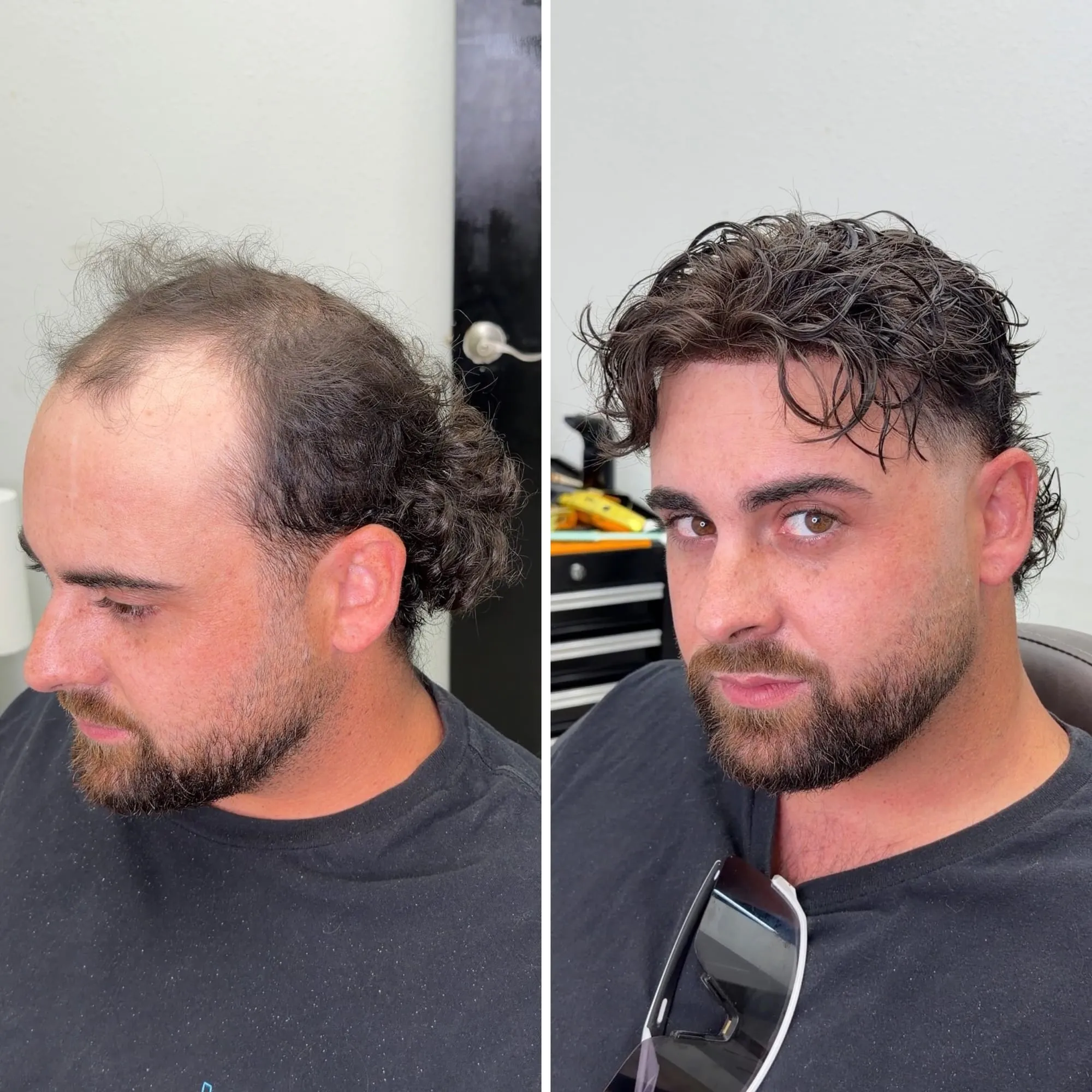
This is what it looks like.
A real client from our chair, photographed before and after his hair system was installed and cut in.
Questions, answered.
Is it cheaper to buy a hair system online than at a studio?
The unit alone can be, because you skip the fitting and the cut-in. But those are the steps that make it look like your hair, and a wrong spec online is usually not returnable, so a first unit bought blind often costs more to fix than it saved. Figures are set at consultation.
Can I match my hair color and density from a photo online?
Rarely with confidence. Screen and lighting shift color codes by a shade or two, and it is easy to over-order density online. We match color and density against your own hair under neutral light, which is the only comparison that holds up in daylight.
Do online hair systems come cut in and ready to wear?
No. They arrive with a blunt hairline, uniform density, and an untrimmed base. The cut-in, trimming the base to your scalp, cutting a soft hairline, and tapering the front, is a skill that is not included in the product, and it is what a studio does in the chair.
When does buying a hair system online actually make sense?
When you are an experienced wearer who already knows your exact spec, your base size in inches, color code with grey percentage, density, and curl, and can attach and cut in your own unit. For a first unit, get it specified and cut in with a practitioner first, then decide.
What if the online unit comes back wrong?
Custom units are built to order and usually not returnable, so a wrong color, size, or density is a unit you have paid for and have to live with or reorder. A studio checks the spec before the build and the result after, and the person who specified it is who you come back to.
Keep reading
Related guides.
Options Compared
Hair systems, transplants, SMP, medication, shaving, or nothing. An honest side by side of coverage, reversibility, commitment, and upkeep.
Reading the Order Form
Every field on a custom hair system order form explained in one place: base size, material, density, color, grey, curl, length, origin, and more.
Color Matching
How color matching works for a hair system, and how salt-and-pepper and grey are blended so it stays believable as you age.
Stock vs Custom
Stock hair systems are ready made and fast. Custom units are built to your head, color, and hairline. Here is how the two differ and when each makes sense.