

Last updated October 27, 2026
The short version
Non-surgical hair replacement adds hair rather than moving it, so there is no donor supply to run out and no minimum or maximum amount of loss that rules you in or out. If you have hair loss you want to cover, a system can almost certainly cover it.
Which means the honest screening is not really about your scalp. It is about fit: the result you are picturing, the routine you are willing to keep, and the occasional thing worth settling first. The sections below walk through each so you can place yourself before you ever sit in the chair.
Any stage of loss, from the first thinning to none left
A transplant has to borrow from the hair you still have, so where you sit on the scale of loss decides everything for surgery. A hair system has no such dependency. We build coverage onto the base from a full hairline back, so the same approach works whether you are noticing the first diffuse thinning, watching a hairline recede, losing the crown, or carrying no hair on top at all. It also covers loss a surgeon called untreatable, because a system never leans on a donor area.
The case men underestimate most is the early one, when they assume there is still too much of their own hair for a system to make sense. There is no too early. We decide together how a system works with the hair you have, and starting sooner often keeps the result more natural, because we are matching into existing coverage rather than building it from scratch.
Age is not a barrier, at either end
Men in their twenties and men in their seventies both wear hair systems well, and the considerations simply differ at each end. Younger clients are usually managing a hairline that will keep changing for decades, so we design something that can move with that rather than lock in a shape you will outgrow. A system is not committed to your scalp staying still, which is part of why it suits loss that is still advancing.
Older clients are usually after the opposite: a believable version of the hair they had, not the hair they had at twenty-five. That means age-appropriate density and the right amount of grey, because the fastest way to make a system obvious is to make it younger than the face under it. There is no age at which this stops being an option.
What actually decides fit
If your scalp is not the deciding factor, what is? In practice a handful of real-world things, and most of them turn out to be reassurances rather than obstacles.
- Skin comfort, since a system bonds to the skin. Most skin takes an adhesive without issue, and where it is sensitive we adjust the attachment rather than rule you out
- An active life, which is a non-issue. Training, sweating, swimming, hats, helmets, and glasses are all compatible with a well-fitted system
- Your expectations, which matter more than any of the above. A system gives a natural, believable head of hair, not a different face, and going in clear-eyed about that is the biggest predictor of being happy
- Your willingness to keep a simple maintenance rhythm, since a system is worn and looked after rather than installed once and forgotten
The few things worth settling first
There are a few situations where we would slow down rather than fit you the same week, and naming them honestly is part of the job.
- An irritated, broken, or actively flaring scalp is worth settling before anything bonds to it. We are hair replacement artists, not physicians, so for anything that looks like a skin condition we would rather you see a doctor first
- A known adhesive allergy, which does not rule a system out but does change the attachment we plan, so it is worth flagging early
- Expecting a system to regrow or treat your own hair, because it does neither. It is a cosmetic covering that changes how loss looks, not what is causing it
How a consultation confirms it
The only way to move from almost certainly a candidate to definitely is to be seen in person. We look at your scalp as it is today, talk through what your loss is doing and where you want to get to, and tell you plainly whether a system is the right call. If it is not, we say so.
That visit is also where fit stops being abstract. You can see a hair unit on a real client and get close enough to judge the hairline yourself, which is the one thing no photo or online thread can settle. Our studio is in Peoria for Arizona and the greater Phoenix metro, with a second studio in Eighty Four for the Pittsburgh area, and either way the consultation is a conversation, not a commitment.
Real work
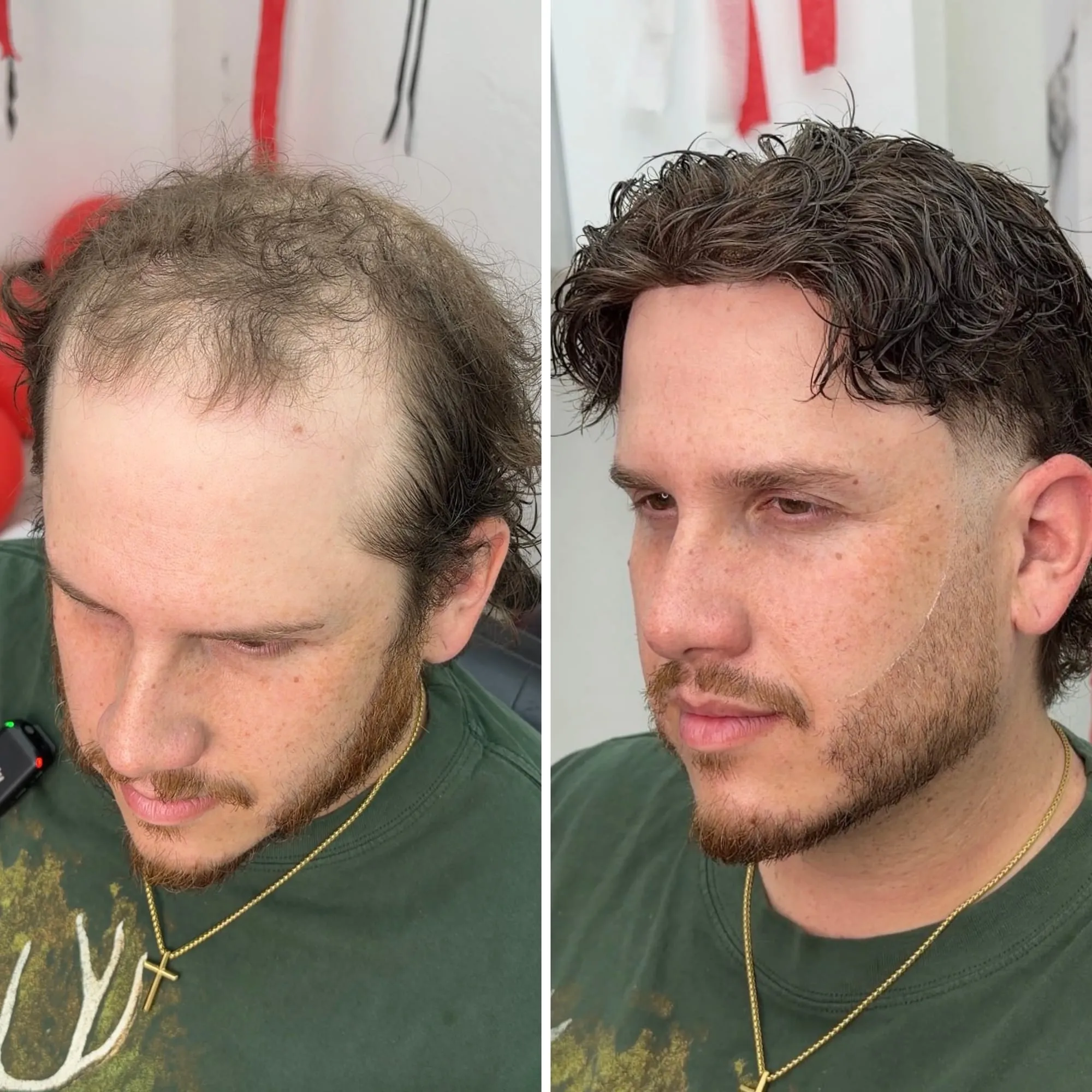
This is what it looks like.
A real client from our chair, photographed before and after his hair system was installed and cut in.
Questions, answered.
Who is a candidate for non-surgical hair replacement?
Almost every man with hair loss he wants to cover. Because a hair system adds hair to a base on your scalp instead of relying on the hair you have, no stage of loss and no age rules you in or out. The honest screening is about the look you want and the upkeep you will keep, not your scalp.
Can I get a hair system if I still have a lot of hair?
Yes, and there is no such thing as too early. We decide together whether the unit blends into the hair you have or carries the look on its own. Starting while you still have real coverage often keeps the result more natural, because we are matching into hair that is already there.
Am I too old or too young for a hair system?
Neither age rules you out. Younger clients get a hairline designed to keep moving with loss that is still changing. Older clients get age-appropriate density and grey so the hair matches the face under it. There is no age at which a system stops being an option.
Do I have to be turned down for a hair transplant first?
No. A hair system is a first-choice option, not a consolation prize. It is often the clear answer for men a surgeon declined, since diffuse loss, a thin donor area, and advancing loss do not limit what it covers. But you do not need a no from anyone to be a candidate.
Is there anyone who should not get a hair system?
No one is ruled out by their degree of hair loss. We would ask you to settle an irritated or broken scalp with a doctor first, since a system bonds to the skin, and we are honest that it covers loss cosmetically rather than treating or regrowing hair. Beyond that, it comes down to whether the routine fits your life.
Keep reading
Related guides.
What Is Non-Surgical Hair Replacement
What non-surgical hair replacement is, the methods that count, and how it differs from a transplant and from medication. Adds hair, no surgery.
Hair System vs Hair Transplant
A side by side look at hair systems and hair transplants: results, timeline, upkeep, and who each one suits. Non surgical vs surgical, honestly.