

Last updated September 28, 2026
Let him open the door first
The single biggest mistake is announcing the problem. A man in your chair already knows what his hairline is doing. He looks at it every morning. If you point it out unprompted, you are not informing him, you are confirming his worst read of himself, and you are doing it in a room with a mirror and other people in it.
So you wait. Most men give you an opening within a few visits: a comment about how the top is getting hard to style, a request to keep the sides longer to cover something, a joke that lands a little flat. That comment is the door. Answer the comment he actually made, calmly and without making it a big moment, and you have started the conversation on his terms instead of yours.
If the opening never comes, that is his answer too. Respect it. A barber who pushes hair replacement on a man who did not ask trades a long relationship for one uncomfortable appointment.
Lead with observation, never diagnosis
You are a barber, not a physician, and the line matters more here than anywhere. Describe what you see on the hair itself, and stop there. You can say a section looks finer than it used to, or that the coverage up top is changing. You cannot name a cause, predict how far it will go, or suggest anything is a medical condition. That is a doctor's job.
Anything that sounds medical belongs with his physician or dermatologist, and the honest move is to say so out loud. It builds trust rather than costing you the client. It also keeps you inside your scope of practice, which protects the business you are building.
Frame what you offer for exactly what it is. A hair system covers the appearance of thinning and restores the look of a full head of hair. It does not treat, cure, regrow, or diagnose anything. Being precise about that is not a disclaimer you mumble. It is the most credible thing you can say, because it tells him you are not going to oversell.
- Say what you see on the hair, not what you think is causing it
- Point anything medical to his doctor or dermatologist
- Describe a hair system as cosmetic coverage, never a treatment
- Never promise a result you have not delivered on a real head
Watch your words and your setting
Language does a lot of quiet work in this conversation. Some words shrink a man and some let him keep his footing. Talk about coverage, density, and options, and talk about what he wants his hair to look like, not about what he is losing. The goal is a normal grooming conversation, the same register you use when a client asks about a fade or a beard line.
Setting matters as much as wording. A comment about a thinning crown does not belong on a packed Saturday floor where the next three chairs can hear it. If a real conversation is starting, lower your voice, or move it to a quieter moment near the end of the appointment. Privacy signals respect, and respect is what earns you the next question.
Keep it short. You are not delivering a lecture on hair systems. You are leaving a door open and letting him walk through it when he is ready, which might be today or might be three months from now.
Handle the emotional moment with a steady hand
Sometimes the conversation gets heavier than a haircut. A man might get quiet, or admit how much this has been bothering him, or say something self-deprecating to test how you react. How you handle that moment is the whole relationship.
Do not rush to fix it and do not pile on reassurance. Acknowledge it plainly, stay matter of fact, and let him know this is common ground you cover with a lot of men. Normalizing it without making it dramatic is what lowers the temperature. Then hand the decision back to him: he is in control of if and when anything happens next, and nothing gets decided in that chair today.
- Acknowledge what he said instead of talking over it
- Keep your tone even, the way you would about any grooming choice
- Make it clear the next step is his to take, on his timeline
- Never use fear or urgency to move him faster
Move toward the next step without a pitch
When a client does want to know more, the pushy move is to start closing. The durable move is to show, not sell. Real before and after footage of work on real heads answers more questions than any script, because it lets him picture himself instead of trusting your words. Let the results carry the weight.
Then point him to a low-pressure next step rather than a decision. A consultation is where the specifics get worked out: what a system would look like on him, what the options are, and what actually drives the investment. You are not the place he commits. You are the place he gets permission to explore it, which is a far easier yes.
The men who become long-term maintenance clients almost never come from a hard sell. They come from a barber who raised it once, honestly, kept the door open, and let them arrive at it themselves.
Real work
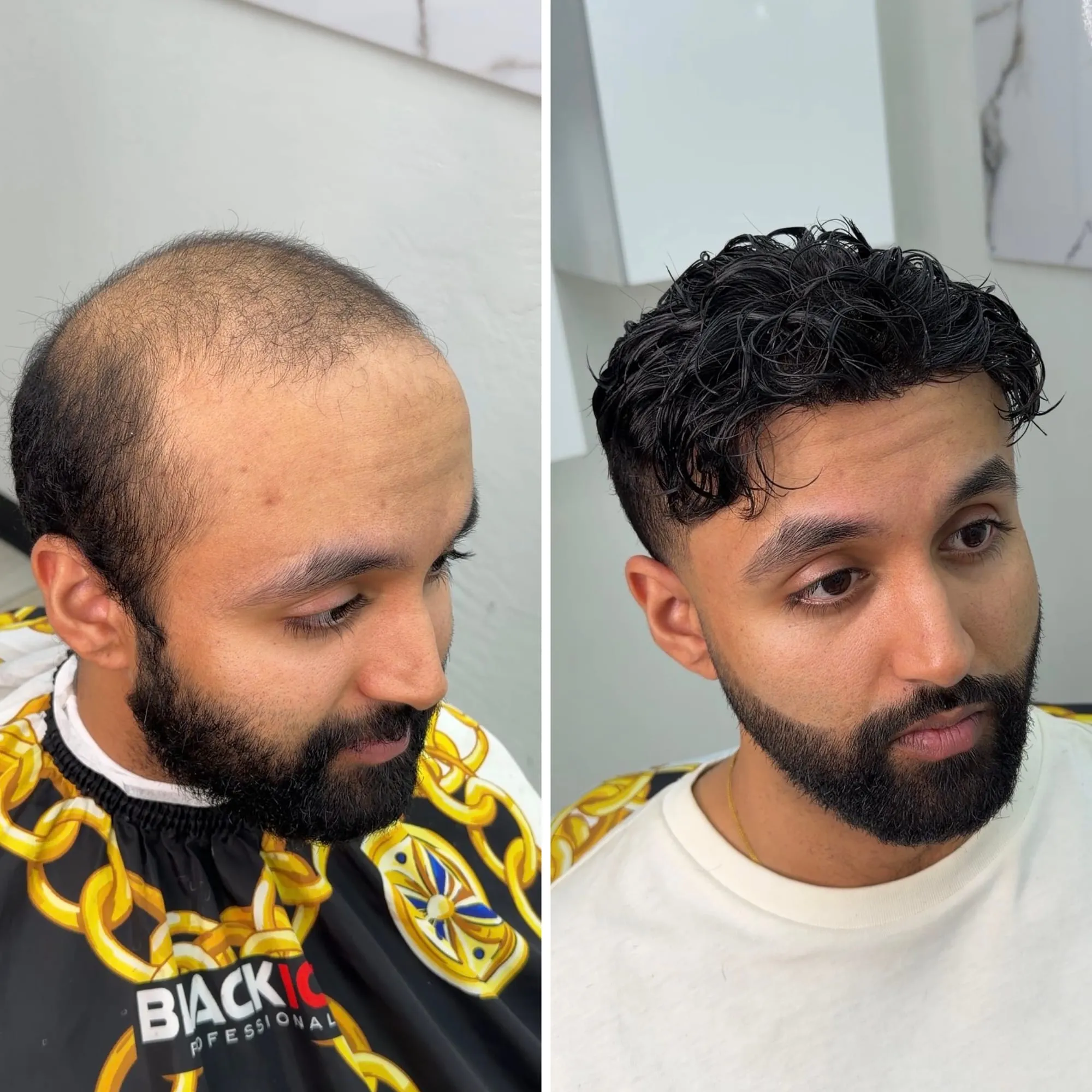
This is what it looks like.
A real client from our chair, photographed before and after his hair system was installed and cut in.
Questions, answered.
How do I bring up thinning hair without offending a client?
In most cases you do not bring it up first at all. You wait for him to give you an opening, a comment about styling, coverage, or how his hair is changing, and you respond to that. Answering the remark he actually made keeps the conversation on his terms and takes the sting out of it.
What if I notice thinning but the client never mentions it?
Then you leave it alone. A man who has not raised it is telling you he is not ready to, and pushing past that costs you his trust. Keep giving him great haircuts. If and when he opens the door, you will be the barber he already feels safe with.
Can I tell a client why his hair is thinning?
No. Naming a cause is a medical judgment, and that belongs to his physician or dermatologist, not to you. Describe only what you see on the hair itself, and send anything medical to his doctor. A hair system is cosmetic coverage for the appearance of thinning, not a treatment for it.
How do I move the conversation toward booking without pressure?
Show real results on real heads and point him to a consultation rather than asking for a decision in the chair. A consultation is a low-stakes next step where the specifics get worked out, so he explores it on his own timeline instead of being closed on the spot.
Keep reading
Related guides.
Start a Business
The real steps to add hair replacement to a barber business: training, first clients, pricing, and building recurring maintenance revenue.
Hair System Barber
A hair system barber installs, cuts in, and maintains hair systems for men. Here is what the role involves and why barbers are adding it.
Certification
What non-surgical hair replacement certification covers for barbers, what it proves, and how it de-risks adding hair systems to your chair.
How to Become a Hair Replacement Artist
The path from barber to hair replacement artist: the skills, the training, and how to add hair systems as a high margin service line.