

Last updated September 28, 2026
Why hair system hair needs different products
The hair on a system does not grow from a scalp, so it never gets the natural oils that keep your own hair supple. That means it dries out faster and shows damage sooner than growing hair does. It also means harsh cleansers have nothing to strip and everything to ruin. The goal shifts from deep cleaning a living scalp to gently cleaning a fiber and keeping it soft.
The other half of the job is protecting the bond. Tape and glue live at the base, and most of what wrecks a hold early is not sweat or water, it is the wrong product in the wrong place. Heavy oils, rich butters, and cleansing agents that are built to cut grease will also cut your adhesive. So the product rules are really two rules at once: keep the hair conditioned, and keep the base clean and oil free.
Ingredient rules by class, not by brand
You do not need a specific bottle. You need the right classes of ingredients and the right ones avoided. These rules hold whether the label says salon, drugstore, or specialty.
- Sulfate free cleanser: sulfates strip color and dry the fiber fast, and they attack adhesive. A mild, sulfate free shampoo is the baseline.
- Alcohol free formula: drying alcohols make the hair brittle and can lift a tape edge. Skip them in both shampoo and conditioner.
- No heavy oils or butters near the base: argan, coconut, shea, and thick silicones migrate to the bond and break it down. If you use a lightweight oil at all, keep it on the ends.
- Lightweight, water based conditioner: a thin, rinse-clean conditioner softens the fiber without leaving a greasy film that creeps toward the knots.
- Neutral pH, dye free where possible: gentler on the fiber and less likely to shift a color match over time.
- A clarifying shampoo for occasional use: a stronger, residue-cutting wash used before a fresh attachment, not for daily washing.
How to wash without touching the bond
Technique matters as much as the bottle. The base and the knots are the fragile part, so you clean the hair and leave the foundation alone.
- Detangle dry first with a wide tooth comb or your fingers, working from the ends up, so washing does not turn shed hair into a mat.
- Wet the hair with cool to lukewarm water. Hot water loosens adhesive and roughens the fiber.
- Dilute a small amount of sulfate free shampoo and stroke it through the hair in one direction, from base toward ends. Do not scrub in circles and do not dig into the knots.
- Rinse fully. Leftover shampoo dulls the hair and can irritate your scalp under the base.
- Apply conditioner mid-shaft to ends only. Keep it off the roots, the knots, and the adhesive edge entirely.
- Let conditioner sit a minute, then rinse until the water runs clear. Blot, never wring, and let the hair air dry when you can.
Buildup, and why it sneaks up on you
Even the right products leave a little behind, and over weeks that residue collects. Conditioner film, styling product, hard-water minerals, and skin oil all build up on the fiber and, worse, around the base. Buildup is what makes a unit look dull and heavy, and it is a quiet reason bonds start to fail before their time.
The fix is a clarifying wash on a schedule, not a stronger daily shampoo. A clarifying shampoo cuts through the film and resets the hair, which is exactly why we do a clarifying cleanse right before a new attachment. On a clean base, fresh adhesive grips the way it is supposed to. Between attachments, use clarifying sparingly, because using it too often will dry the fiber out.
How often to wash
There is no single number, because it depends on your climate, how much you sweat, and how much product you use. As a starting point, most men do well washing the hair two to three times a week, with a gentle rinse on the days between if they train or run hot. In a Phoenix summer or a humid stretch, you will wash more often than you would in winter.
Let the hair guide you. If it feels coated or looks flat, it wants a wash. If it feels dry and straw-like, you are washing too hard or too often, or the water is too warm. The adhesive method you wear also sets the outer limit, since some tapes and glues are built for a longer wear window than others, and we set that schedule with you when you leave the studio.
Do and do-not, at a glance
If you remember nothing else, remember this short list. It covers the mistakes we see most often.
- Do use a sulfate free, alcohol free shampoo diluted in water.
- Do keep conditioner mid-shaft to ends, off the base and knots.
- Do wash in one direction, from base to ends, with no scrubbing.
- Do clarify before a fresh attachment for a clean, strong bond.
- Do not use two-in-one, anti-dandruff, or clarifying formulas for daily washing.
- Do not put oils, heavy masks, or thick silicones anywhere near the base.
- Do not use hot water or a high, direct blow-dryer heat setting.
- Do not rub the base to clean it. Base and adhesive care is a separate step from washing the hair.
Real work
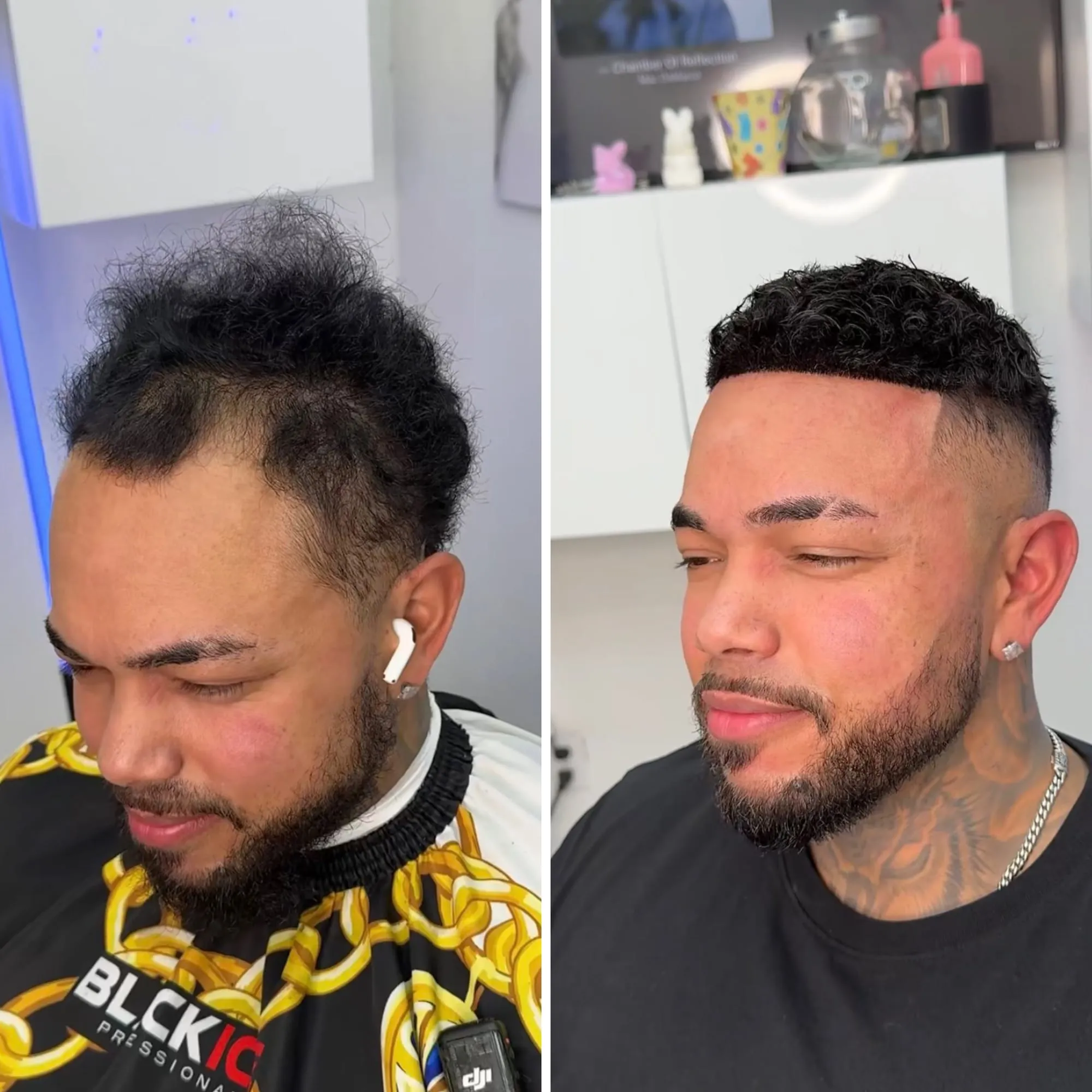
This is what it looks like.
A real client from our chair, photographed before and after his hair system was installed and cut in.
Questions, answered.
What shampoo can you use on a hair system?
A gentle, sulfate free, alcohol free shampoo, diluted in water and worked through the hair from base to ends. Sulfates strip the fiber and attack adhesive, so they are the main thing to avoid. Save any stronger clarifying shampoo for occasional resets, not daily washing.
Can I use my regular drugstore shampoo?
Only if it happens to be sulfate free and alcohol free with no heavy oils, which most mass shampoos are not. Standard formulas are built to strip oil from a living scalp, and on a system that just dries the fiber and undermines the bond. Read the class of ingredients rather than trusting the brand.
Where do I apply conditioner on a hair system?
Mid-shaft to ends only. Keep conditioner off the roots, the knots, and the adhesive edge, because a greasy film there loosens your hold. A lightweight, rinse-clean conditioner is enough to keep the hair soft without weighing it down.
How often should I wash my hair system?
For most men, two to three times a week, more in heat or heavy sweat and less in cool weather. Let the hair tell you: coated or flat means wash, dry and brittle means you are overdoing it. Your adhesive method sets the outer limit, which we map out with you.
Why does my hair system look dull or feel heavy?
That is almost always product and mineral buildup on the fiber and around the base. A clarifying shampoo used occasionally cuts through the film and resets the hair, and we clarify before every fresh attachment so new adhesive grips a clean base. Do not clarify daily, or you will dry the hair out.
Keep reading
Related guides.
Hair System Maintenance
How to keep a hair system clean, secure, and natural: your at home routine, the maintenance schedule, and what a studio visit covers.
Showering With a System
Yes, you shower normally with a hair system. Here is how to wash, which products to use, and how to dry it so the bond and hair stay right.
Tools & Supplies
The categories of tools and supplies a hair system barber needs, and how to choose each one, with no brand endorsements and no prices.
Scalp Health
How to keep the scalp under a hair system clean and healthy. Cleaning, breathability, and the early signs worth acting on. No scare tactics.