What certification actually is
Certification is a documented, assessed course of instruction. It is not a badge you buy or a weekend you sit through. Real programs put a system on a real head, walk you through the full sequence, and then watch you do it until the result holds up. The point is competence you can stand behind, not a certificate for the wall.
At The Hair Experience the training is delivered by Nico Rigano and team out of the Peoria, Arizona and Eighty Four, Pennsylvania studios, because a service this tactile has to be taught in the room, on the head, with someone correcting your hands in real time.
What it covers
A credible curriculum moves through the whole service the way you will actually perform it in your shop, not a highlight reel of the easy parts.
- Consultation and expectation setting, so you sell the right result and screen out clients you cannot serve well
- Reading a client's scalp, hair loss pattern, and existing hairline to spec the correct unit
- Base and material selection across lace, poly, and skin, and when each one is the right call
- Template making and ordering, so the unit that arrives fits the first time
- Attachment methods, adhesives, and tape, plus removal without damaging skin or the system
- Cutting in and blending the unit into the client's own hair for a natural, undetectable finish
- Color matching, density, and hairline design that reads as real up close
- Maintenance, reapplication cadence, and the at-home routine you send the client away with
Why certification de-risks adding the service
The risk in hair replacement is not the tools, it is the learning curve happening on paying clients. Every barber who teaches themselves from clips has a stretch of results they would rather forget, and in a service built on discretion those results walk around your town. Certification collapses that stretch by moving your worst work into a controlled training environment instead of your chair.
It also protects the business side. When you can execute the full service predictably, you can book it, price it, and stand behind it. Guesswork is what forces refunds, redos, and the awkward conversation where a client no longer trusts you. Trained hands turn a high-margin add-on into a repeatable revenue line rather than a gamble.
Certification versus licensing
These are two different things and conflating them gets barbers in trouble. Certification proves you were trained to perform the service to a standard. Licensing is the state-level credential that governs whether you are legally allowed to offer barbering or cosmetology services at all. One is about skill, the other is about legal standing.
Most states already permit a licensed barber or cosmetologist to perform non-surgical hair replacement, since nothing about it breaks the skin. Certification sits on top of that license as proof of specialty competence. Confirm your own state's rules before you advertise the service, and keep your base license current regardless of how many certifications you stack on it.
How to tell a real program from a cash grab
The market is full of paid weekends that hand out certificates and leave you no more capable than before. A few signals separate the real thing from the merch.
- Hands-on time on a real head, not a mannequin loop or a screen share
- A named, working instructor whose own client results you can actually see
- Assessment, where someone judges your work rather than rubber-stamping attendance
- Ongoing mentorship after the class, because the questions that matter show up on client three, not day one
- Honest scope, meaning they teach the full service including the parts that are hard
Certification is a starting line, not a finish
The best barbers treat certification as the entry point to a longer relationship with the craft. A weekend gets your fundamentals right. Mentorship is what carries you through the odd scalp, the tricky hairline, the client who sweats through every adhesive you try. That is why our path pairs the certification class with one-on-one mentorship rather than sending you off with a certificate and a wave.
If you are weighing whether to add the service at all, start with the broader path into the career, then come back to certification as the concrete first step that makes the rest safe to attempt.
Real work
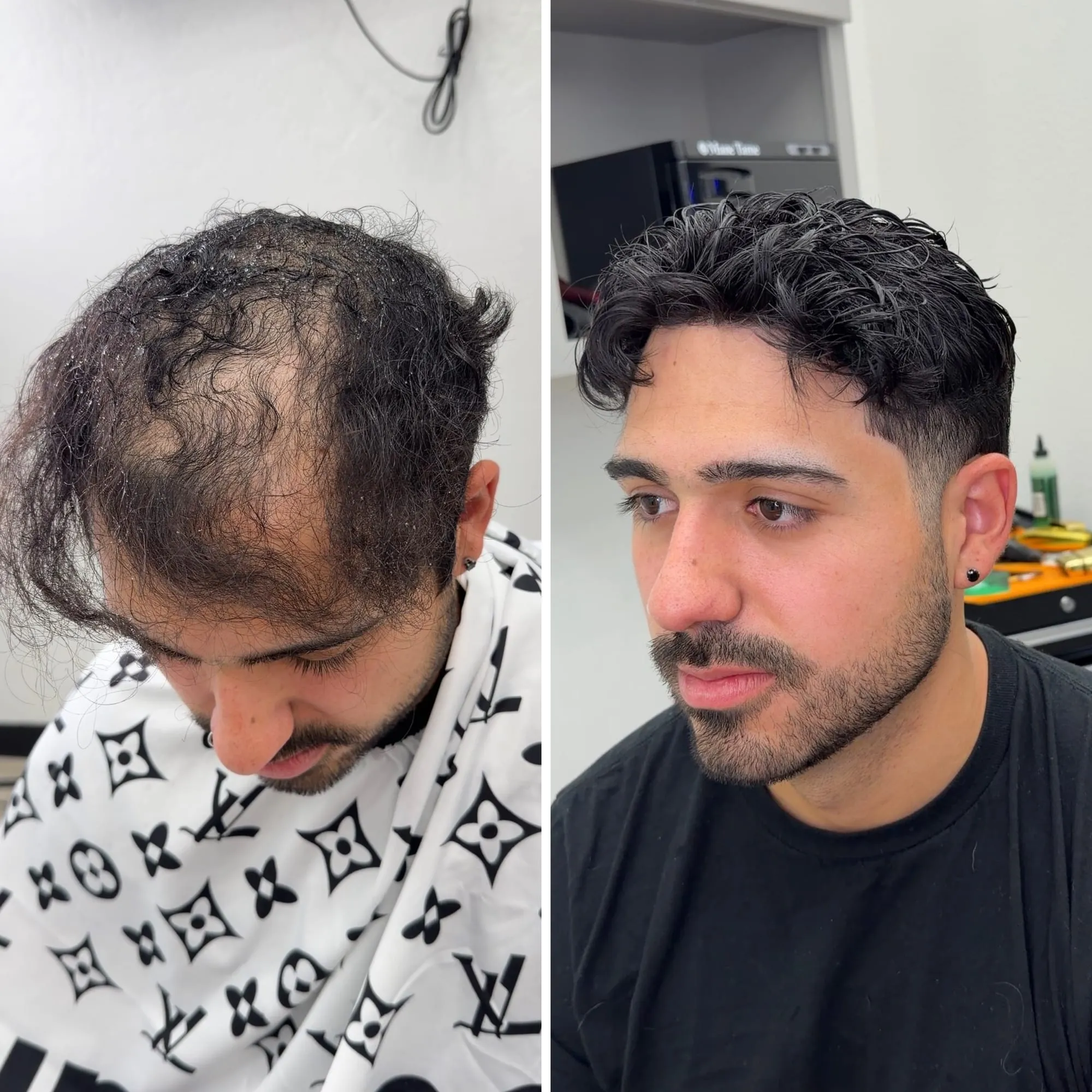
This is what it looks like.
A real client from our chair, photographed before and after his hair system was installed and cut in.
Questions, answered.
Do I need certification to offer hair replacement as a barber?
Legally you generally need a current barbering or cosmetology license, since the service does not break the skin. Certification is not usually a legal requirement, but it is what makes the service safe to charge for, since it proves you can deliver a professional result rather than learning on paying clients.
How long does certification take?
The core class is intensive and hands-on, and competence keeps building through the clients you take afterward. Treat the certification itself as the foundation and mentorship as the layer that turns it into consistent, repeatable work.
What is the difference between certification and a license?
A license is the state credential that lets you legally offer barbering or cosmetology services at all. Certification is proof of specialty skill in hair replacement that sits on top of that license. You keep the license current and add certification to show competence in the service.
Will certification alone make me good at hair replacement?
Certification gets your fundamentals right and moves your steepest mistakes into a training setting instead of your chair. Mastery comes from reps on real clients with someone to call when a case is unusual, which is why mentorship matters as much as the class.
Keep reading
Related guides.
How to Become a Hair Replacement Artist
The path from barber to hair replacement artist: the skills, the training, and how to add hair systems as a high margin service line.
Licensing
Do you need a license to do hair replacement? What barbers and stylists should know about requirements in Arizona, Pennsylvania, and beyond.
Training
What hair replacement training for barbers covers, how classroom and mentorship fit together, and how to choose a program that builds a paying service.
Hair System Barber
A hair system barber installs, cuts in, and maintains hair systems for men. Here is what the role involves and why barbers are adding it.