

Last updated September 28, 2026
Two kinds of washing, and why the deep clean matters most
There is a difference between rinsing a unit you are wearing and actually cleaning one. Day to day water exposure is its own topic, and we cover getting wet in the shower on a separate page. Here we are talking about the real wash, the routine that keeps hair soft, lifts oil and product, and clears residue before it builds into a problem.
The best version of that wash happens off the head. Taking the unit down on your reattachment schedule lets you clean both the hair and the underside of the base, deal with any old adhesive at the same time, and dry everything fully before it goes back on. A unit that is deep cleaned on a regular cadence stays looking natural far longer than one that is only ever rinsed in place.
What you need before you start
Keep it simple. You do not need a shelf of products, you need a few gentle ones and a steady surface to work on.
- A sulfate free, low pH shampoo made for processed or fine hair
- A light conditioner, applied to the hair only and never to the base
- A wide tooth comb for wet detangling
- A clean towel plus a second one to protect your counter
- A styling stand, a mannequin head, or a clean flat surface for drying
The off-head deep clean, step by step
This is the routine we teach every client at handoff. Work slowly the first few times, and it becomes a ten minute habit.
- Remove the unit on your normal reattachment schedule, then clean any adhesive off the base first so residue does not smear into the hair.
- Hold the unit under lukewarm running water and let it flow from the base side out through the hair, in the direction the hair falls.
- Work a small amount of diluted shampoo through the hair with flat palms, stroking downward from root to tip. Do not scrub, pile, or circle the hair.
- Rinse fully in the same downward direction until the water runs clear and you feel no slickness.
- Apply a thin layer of conditioner to the mid lengths and ends only, keep it well away from the knots and the base, wait a minute, then rinse.
- Press the unit gently in a towel to blot out water. Do not wring or twist it.
- Detangle with a wide tooth comb from the ends upward, then lay it flat or set it on a stand to air dry.
Wash direction and handling the hair
Hair on a unit is not anchored by a living root, so it cannot recover from rough handling the way growing hair does. Every stroke should follow the hair down, from base to tip, the way you would smooth a delicate fabric. Scrubbing at the roots, bunching the hair up on top of the head, or working shampoo in circles is what breaks knots loose and starts shedding and tangling.
The same rule applies to combing. Start at the very ends, clear those, then move up a little at a time until the comb passes cleanly from top to bottom. Forcing a comb straight down through a tangle pulls hair out at the knot, and on a unit that hair does not grow back.
Keep water and product off the base perimeter
The perimeter is the bonded edge that holds the unit to your scalp, and it is the one zone you protect most carefully. When you deep clean off the head this is easy, because there is no bond to defend. The care matters when a unit is on your head and you are tempted to shampoo the scalp underneath.
Shampoo, conditioner, and heavy water flow all attack adhesive. Conditioner is the worst offender because it is designed to be slick, and any that reaches the perimeter or the knots will loosen the bond and can cause premature lifting at the front. Keep conditioner on the hair only, keep direct water off the edge while the unit is worn, and save any real cleaning of the bond area for when the unit is down.
Drying without wrecking the base or the style
How you dry is as important as how you wash. Air drying is the default because it is the gentlest thing you can do for both the hair and the base.
- Blot, never wring. Twisting stresses the knots and can distort the base.
- Air dry flat or on a stand out of direct sun. Strong sun fades color and can dry the base out over time.
- If you must speed it up, use a cool or low setting held well back, never high heat aimed at the base or the knots.
- Let the unit dry fully before you store it or reattach, since trapped moisture invites odor and shortens base life.
- Style only once the hair is dry or nearly dry, and keep hot tools off the base itself.
Common wash mistakes and how to fix them
Most wash problems trace back to one of a few habits. If something is going wrong, it is usually here.
- Hair feels stiff or looks dull: hard water or product buildup. Do a proper off-head deep clean and rinse longer than feels necessary.
- Front edge lifting after washing: conditioner or water reached the perimeter. Keep conditioner to the ends and clean the bond only when the unit is off.
- Increasing shedding or thin spots: scrubbing or combing root to tip. Switch to downward strokes and comb from the ends up.
- Persistent tangling at the nape: friction plus skipped detangling. Comb gently after every wash and condition the mid lengths lightly.
- A faint smell that returns fast: the unit went back on damp. Always let it dry fully before reattaching or storing.
How often to wash
Cadence depends on your unit, your climate, and how much you sweat. A good anchor is to deep clean at each reattachment, so washing lines up naturally with your maintenance rhythm rather than becoming a separate chore. Men who sweat heavily, train hard, or live through a hot Phoenix or humid Pittsburgh stretch will want to clean more often to stay ahead of oil and salt.
The honest test is your hair, not a calendar. When it starts to feel coated, look flat, or hold odor, it is time. We set a realistic schedule with you at your fitting and adjust it as we see how your unit actually behaves on your head.
Real work
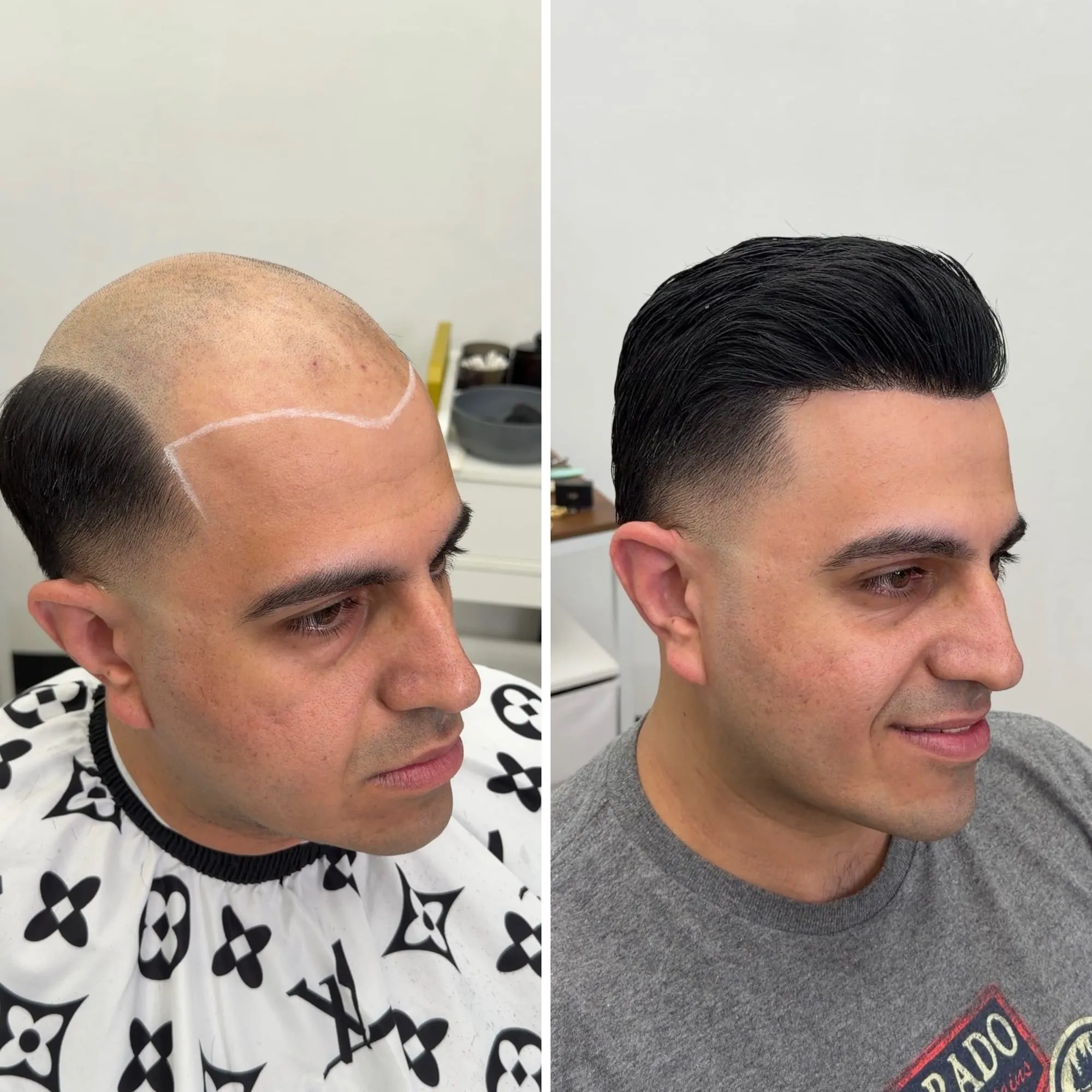
This is what it looks like.
A real client from our chair, photographed before and after his hair system was installed and cut in.
Questions, answered.
Can I wash my hair system in the shower while wearing it?
You can rinse and lightly clean the hair in place, but a true wash is better done with the unit off so you can clean the base and protect the bonded perimeter. For daily water exposure and showering technique, see our page on showering with a hair system.
What shampoo should I use on a hair system?
A gentle, sulfate free, low pH shampoo made for processed or fine hair. Harsh clarifying shampoos strip the hair and can dry the base. Dilute a small amount and stroke it through the hair from root to tip rather than scrubbing.
Why does conditioner have to stay off the base?
Conditioner is engineered to be slick, so any that reaches the perimeter or the knots loosens the adhesive bond and can cause the edge to lift early. Apply it to the mid lengths and ends only, and keep it away from the base entirely.
Should I air dry or blow dry a hair system?
Air drying flat or on a stand is best and safest for the base and the knots. If you need to speed it up, use a cool or low setting held well back from the base, never high heat pointed at the knots.
How often should I deep clean my hair system?
A practical rule is to deep clean at each reattachment so it lines up with your maintenance schedule. Heavy sweating, training, or hot humid weather call for more frequent washing. Let the feel and look of the hair be your guide.
Keep reading
Related guides.
Showering With a System
Yes, you shower normally with a hair system. Here is how to wash, which products to use, and how to dry it so the bond and hair stay right.
Hair System Maintenance
How to keep a hair system clean, secure, and natural: your at home routine, the maintenance schedule, and what a studio visit covers.
Removing a System
How to remove a hair system without damaging your hair: the right solvent, the technique, and why studio removal protects your scalp and the unit.
Tools & Supplies
The categories of tools and supplies a hair system barber needs, and how to choose each one, with no brand endorsements and no prices.