
Think in categories, not brands
New barbers ask which adhesive to buy. That is the wrong first question. The right question is what job each item does in your workflow, because once you understand the categories you can evaluate any product that lands in front of you at a trade show. Brands rotate, reformulate, and go out of stock. A barber who understands why a soft-bond adhesive behaves differently from a hard-bond one will never be stranded by a supplier change.
Everything you keep at the chair falls into a handful of buckets. Stock the buckets, keep a backup of anything you cannot finish a service without, and resist the urge to hoard variety you will not use.
- Adhesives and removers
- Cutting, thinning, and styling tools
- Prep and skin protection
- Cleaning and maintenance products
- Templating and fitting materials
- Sanitation and disposables
Adhesives and removers: the category that decides your day
This is where most of the skill and most of the callbacks live. You want a small range that covers different hold needs rather than one product you force onto every head. Broadly you are choosing along a few axes: hold strength, wear time, water and sweat resistance, and how kind the formula is to a given client's skin. A humid climate, an active client, and a sensitive scalp each pull you toward a different answer.
Removers matter as much as the bond. Match the remover to the adhesive chemistry, keep a citrus-based and an oil-based option so you are not fighting residue, and never let a client leave with product you could not fully clear. The removal being clean is what protects the client's own hair and skin, and it is what earns the rebook.
- A soft-bond option for shorter wear and easier removal
- A hard-bond option for longer wear, heat, and sweat
- Removers matched to each adhesive type
- Skin-test supplies for new or sensitive clients
Cutting, thinning, and styling tools
You already own most of this if you cut hair, but hair system work asks more of your blending tools than a standard cut does. The make-or-break of a natural result is where the unit meets the client's growing hair, so invest in the tools that let you feather that transition: quality thinning shears, a razor you trust for soft edges, and fine detailing scissors for the hairline.
Keep a dedicated set for system work if you can. Ventilating needles and holders come in once you start doing knot repairs and small customizations in-house rather than sending every unit out, which is a natural step as your skill grows through mentorship and reps.
- Thinning and texturizing shears for blending the perimeter
- A razor for soft, undetectable hairline edges
- Fine detail scissors for hairline and density work
- Ventilating needles and a holder for in-chair repairs
Prep, cleaning, and maintenance supplies
Prep supplies protect the scalp and give the adhesive a clean, oil-free surface to grab. Think scalp cleansers and prep solutions, alcohol or a suitable degreaser, and skin-protection products for clients who need a barrier between adhesive and sensitive skin. Prep is quiet work that never shows up in a photo, but skipping it is the fastest way to a bond that fails in a week.
Maintenance products are what you sell the client on for at-home care and what you use during service resets. Sulfate-free cleansers, conditioners formulated for the base material, and leave-in products keep the hair looking real between visits. Knowing this category well turns a one-time install into a maintenance relationship, which is the real economic engine of the service.
- Scalp cleansers and pre-bond prep solutions
- Degreasers and residue removers for the scalp and base
- Skin-protection or barrier products for sensitive clients
- Gentle cleansers and conditioners safe for the base
Templating, fitting, and sanitation
Templating materials let you capture the client's exact head shape and hairline before a custom unit is ordered. Molding material, tape, and a marker for mapping the hairline are cheap relative to the cost of a poorly fitted unit, so never improvise here. Accurate templating is the difference between a unit that sits like it grew there and one that fights the client every morning.
Sanitation is not optional and is often what a state board actually inspects. Disposable gloves, barbicide or an equivalent disinfectant, single-use applicators where it makes sense, and clean towels keep you compliant and keep clients safe. Build sanitation into your per-client cost from day one so it is never something you cut to save a few minutes.
- Molding and templating material for custom orders
- Hairline mapping markers and measuring tools
- Gloves, disinfectant, and single-use applicators
- Clean towels and a sanitary station setup
How to actually buy: a sourcing framework
Do not build your kit from a single shopping list you found online. Build it from the services you offer this quarter. If you are installing stock units, you need less templating gear and more adhesive variety. If you are moving into custom work, templating and repair tools climb the priority list.
Buy consumables in quantities you can cycle through before they degrade, because adhesives and prep solutions have a working shelf life. Keep a backup only of items that would cancel a service if you ran out, chiefly your primary adhesive and remover. Test any new product on yourself or a model before a paying client, and keep notes on how each performs in your climate. That notebook becomes your real supplier guide, worth more than any brand's marketing.
Real work
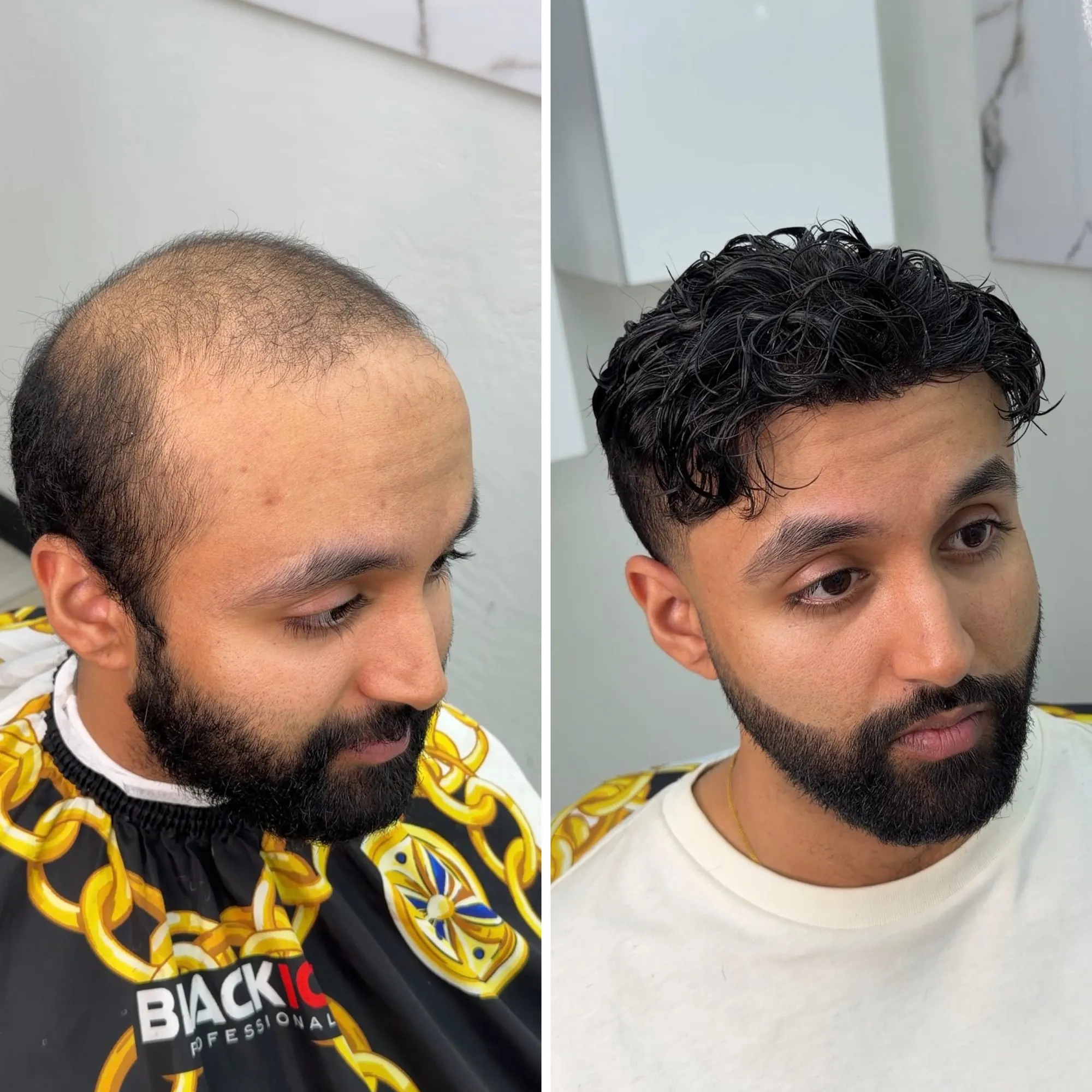
This is what it looks like.
A real client from our chair, photographed before and after his hair system was installed and cut in.
Questions, answered.
What is the single most important category to get right?
Adhesives and removers. Hold and clean removal drive both client comfort and your callback rate, so it is worth spending real learning time here before you widen the rest of your kit.
Do I need special tools if I already cut hair?
You have most of the basics, but system work leans harder on blending. Prioritize good thinning shears, a razor you trust for soft edges, and fine detail scissors for the hairline. Ventilating needles come in once you start doing in-chair repairs.
Should I stock one adhesive or several?
Carry a small range rather than one. A soft-bond and a hard-bond option, each with a matched remover, cover most clients across different skin types, activity levels, and climates without forcing one product onto every head.
How do I choose products without brand recommendations?
Judge by behavior, not label. Understand what each category does, test on yourself or a model first, and keep notes on how a product holds and removes in your climate. That record outlasts any brand that reformulates or disappears.
Where do I learn to use all of this correctly?
Hands-on. Certification and one-on-one mentorship compress the trial and error, because someone experienced can tell you why a bond failed instead of leaving you to guess through wasted units and unhappy clients.
Keep reading
Related guides.
Hair System Barber
A hair system barber installs, cuts in, and maintains hair systems for men. Here is what the role involves and why barbers are adding it.
Training
What hair replacement training for barbers covers, how classroom and mentorship fit together, and how to choose a program that builds a paying service.
How to Become a Hair Replacement Artist
The path from barber to hair replacement artist: the skills, the training, and how to add hair systems as a high margin service line.
Attachment Methods
Tape, bonding, and clip attachment for hair systems compared by hold, comfort, and how they suit your routine. How to attach a hair system.