

What good training actually covers
A program worth your time is built around the full client journey, not a single trick. You are learning a repeatable process you can run on strangers, in your own shop, without someone standing over your shoulder. That means every stage of the service gets its own reps until the movement is yours.
If a course only shows you attachment and skips the consultation and the maintenance cycle, it is teaching you the easy middle and leaving out the parts that keep a client coming back. The recurring visit is where this service becomes a business, so the training has to cover it.
- Consultation and expectation setting: reading hair loss patterns, matching density, color, and hairline to the face
- Templating and base selection: capturing the scalp shape and choosing lace, poly, or skin for the client's life
- Cutting in and blending the unit into the client's existing hair so it disappears
- Attachment methods: tape, liquid adhesive, and combinations, plus safe removal
- The maintenance cycle: reset visits, cleaning, re-bonding, and how to keep a scalp healthy
Why classroom plus mentorship beats a weekend course
A single weekend can teach you the vocabulary and let you watch a system go on. It cannot give you the reps it takes to handle a nervous first-time client, a tricky hairline, or an attachment that lifts in the heat. Skill on this service comes from volume under guidance, and that is what a mentorship layer provides.
The model that works is a certification class to build the foundation, followed by one on one mentorship as you take your first paying clients. You do the work, you hit a wall, and someone who has done thousands of these walks you through it before it becomes a refund. That feedback loop is the difference between a barber who dabbles and one who books the service out.
Who this training is for
This is education for working barbers and stylists who already have hands, a chair, and a client base. You do not need prior hair replacement experience. You do need to be comfortable with clippers and shears and willing to slow down and learn a new discipline that rewards precision over speed.
It is also for shop owners who want to add a premium, appointment-based service that fills the quiet parts of the calendar. Hair replacement clients rebook on a schedule, which is a different and steadier rhythm than walk-in cutting.
What separates a real program from a sales pitch
Plenty of training exists mostly to sell you inventory. The tell is whether the curriculum is built around your skill or around their product line. Real training teaches you to evaluate systems and tools on their merits so you can source the right unit for each client, not the one with the best margin for the instructor.
Look for a program taught by people who still do the work on real clients, that gives you a defined path from first class to independent service, and that is honest about the learning curve. If a course promises overnight mastery or leans on income claims, treat that as a warning rather than a feature.
- Taught by active practitioners, not career salespeople
- A clear path from certification into ongoing mentorship
- Time on real heads, not just mannequins
- Vendor-neutral guidance on units, bases, and tools
- Straight talk about how long competence really takes
How the path fits together at The Hair Experience
The training is run by Nico Rigano and team out of working studios in Peoria, Arizona and Eighty Four, Pennsylvania, so what you learn is what actually holds up on paying clients in a live chair. The structure is a certification class to build the core skill, then mentorship to carry you through your first real clients.
From there you decide how deep to go: some barbers add hair replacement as one more premium service, others build a dedicated part of their business around it. Either way the goal of the training is the same, which is to hand you a process you can run and charge for on your own.
What drives your results after training
Training gets you competent. What you do next decides the return. The factors that matter are your reps, the quality of your consultations, how reliably clients come back for maintenance, and how well you match each system to the person in the chair. None of that is about a magic technique, and all of it is teachable.
Treat the class as the start of the skill, not the finish line. The barbers who get the most out of it keep a line open to their mentor, book their early clients deliberately, and build the maintenance rhythm into how they run the chair.
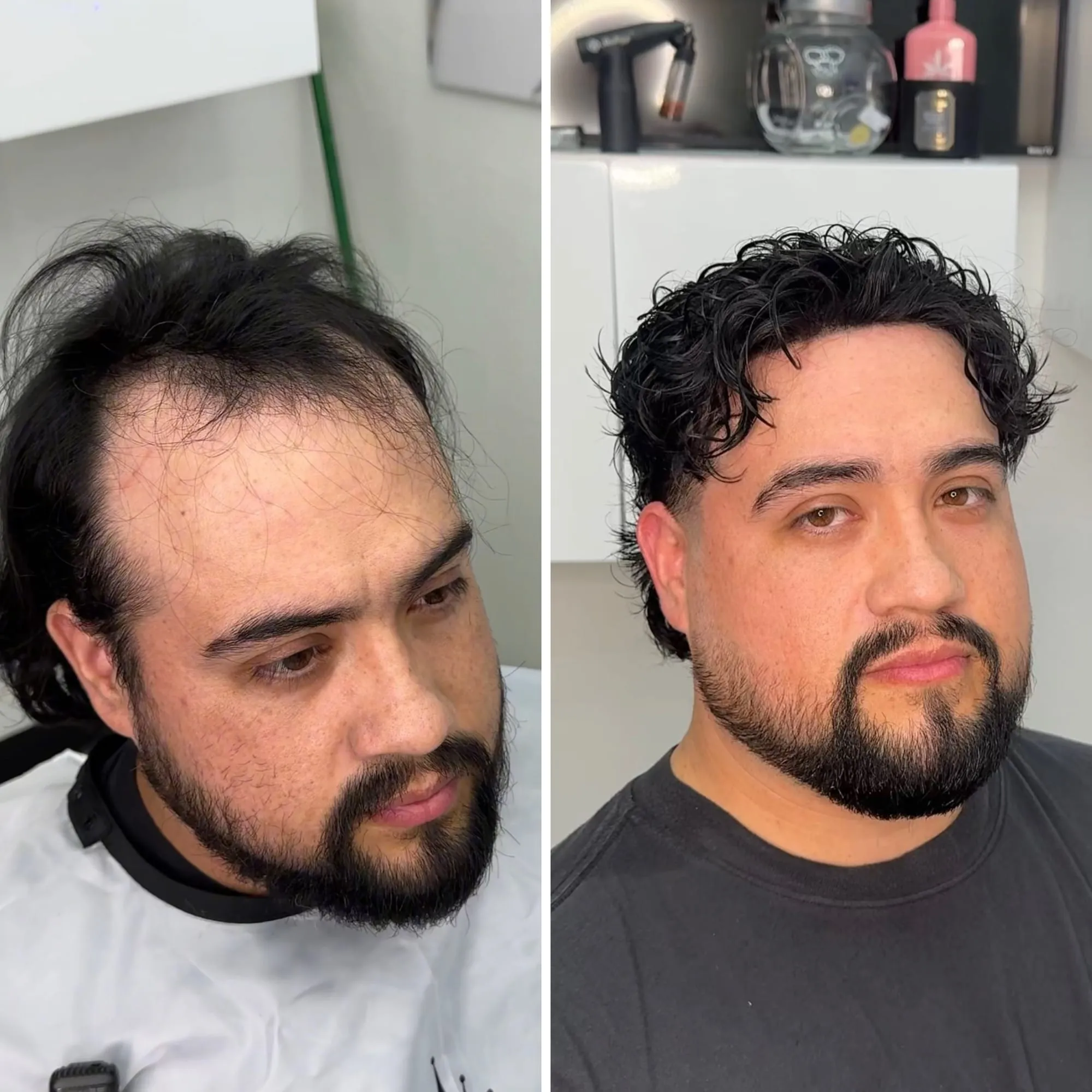
Real work
This is what it looks like.
A real client from our chair, photographed before and after his hair system was installed and cut in.
Questions, answered.
Do I need to be a licensed barber or stylist first?
Licensing rules vary by state, so check your own board before you plan to offer the service. The training itself is built for people who already cut hair, and pairing it with your existing license is the cleanest path. See our licensing overview for how the pieces fit together.
How long does it take to get competent?
The classroom foundation is short by design, but real competence comes from reps on real clients during the mentorship phase. Plan for a learning curve measured in your first several clients rather than a single day, and lean on your mentor through it.
Do I need my own clients to start?
It helps. If you already have a chair and a base of clients, you have people to consult and practice on as you build the service. If you are earlier in your career, the mentorship layer is where you work out how to bring the first hair replacement clients in.
Is this the same as the consumer hair replacement service?
No. The consumer side is about getting a hair system for yourself. This is professional training that teaches you to deliver that service to clients as a barber or studio owner.
What tools and supplies will I need?
You will need units, bases, adhesives, and a maintenance kit alongside your existing barbering tools. The training covers how to evaluate and source them so you buy for the client rather than for a vendor. Our tools and supplies guide breaks down the categories.
Keep reading
Related guides.
How to Become a Hair Replacement Artist
The path from barber to hair replacement artist: the skills, the training, and how to add hair systems as a high margin service line.
Licensing
Do you need a license to do hair replacement? What barbers and stylists should know about requirements in Arizona, Pennsylvania, and beyond.
Certification
What non-surgical hair replacement certification covers for barbers, what it proves, and how it de-risks adding hair systems to your chair.
Tools & Supplies
The categories of tools and supplies a hair system barber needs, and how to choose each one, with no brand endorsements and no prices.