

Last updated September 28, 2026
Open with discovery, not a diagnosis
The consultation is different work from the install, and it is different work from the client-side visit where a prospect just wants to know what to expect. As the practitioner, you are running the room. Your first job is to listen. Most men who sit down have carried this quietly for a long time, and they arrive with a mix of hope and guardedness. If you lead with product talk, you lose them.
Start by asking what brought them in and what they picture. Are they returning to a look they had, or building something new. Is there an event driving the timing, or is this a slow decision they have finally acted on. What have they already tried, and how did it feel. You are mapping motivation, not selling. A hair system covers the appearance of thinning; it is a cosmetic choice, and the strongest installs start from a clear picture of the outcome the person wants to see in the mirror.
Keep this medical-adjacent line clean. If anything they describe sounds like a scalp condition, sudden change, or something a doctor should look at, we say so plainly and point them to their physician or dermatologist first. We do not treat, cure, or diagnose. We restore an appearance, and we are careful to frame it exactly that way.
Assess the scalp and hair cosmetically
Once you understand the goal, assess what you are actually working with. This is a cosmetic and technical read of the head, done in good light, ideally with the client facing a mirror so they see what you see. You are gauging how much existing hair there is and where, the pattern of the visible thinning, skin condition and oiliness, and how any of it will influence base choice, attachment method, and blend.
Narrate the assessment out loud in plain language. When a client understands why you are looking at their crown, their existing density, or their hairline shape, they stop feeling examined and start feeling guided. This is also where you quietly gather the inputs that a good unit order depends on later, so the assessment and the eventual spec sheet line up.
- Existing hair: how much, where, and how it will blend with a unit
- Thinning pattern and the shape of the area to be covered
- Scalp condition: oiliness, sensitivity, any sign to defer to a doctor
- Lifestyle load: work, sweat, sport, water, and how active the day is
- Hairline history: what looked natural on them before
Present options in their terms, not the catalog
The mistake beginners make is presenting everything. They walk a nervous first-timer through every base material, every attachment method, and every density option until the person is overwhelmed and defers the decision. Your job is the opposite. Take everything you learned in discovery and assessment and narrow the field to the two or three combinations that genuinely fit this head and this life.
Frame each option around the tradeoff that matters to them. A more durable base for someone hard on their hair. A finer front for someone who wears it back. A method that survives heavy sweat for an active client. Say what each choice gives up as well as what it gains, because honesty about tradeoffs is what separates a consultant from a salesperson. When we present at our Peoria, AZ and Eighty Four, PA studios, we show, not just tell: real photos and, where we have them, a sample base in hand beats any description.
We hold the money conversation for its own moment and keep it about what drives value, not a headline figure. Base construction, hair type, density, and how often the unit is serviced all move the number, and the honest answer is that the right spec is priced to the person. If a client presses for a number before we understand the build, we explain what the figure depends on rather than guess.
Set expectations before anyone commits
The single biggest driver of a happy long-term client is expectations set correctly at the consultation. A hair system is not a fit-and-forget purchase. It is a relationship with a cadence. The person needs to leave your chair understanding that the unit is maintained, re-bonded, cut back in, and eventually replaced, and that the result on day one is maintained by the rhythm that follows.
Be specific about what the first install day looks like, how it will feel for the first week, and what home care they own between visits. Under-promise on timelines and over-deliver on care. A client who was told the honest version of upkeep and cost drivers becomes an advocate. A client who was sold a fantasy becomes a refund and a bad review. In a local market, the expectations you set today are the reputation you carry tomorrow.
- The result is ongoing: it is maintained on a schedule, not bought once
- First week: what is normal, what to expect, and what to call about
- Home care they own between studio visits
- The replacement cycle, so the eventual unit swap is never a surprise
- Cost drivers, not a fixed figure, so value is understood before booking
Close on the next step, always
End every consultation with a clear next action, even when the person is not ready to book. If they are ready, template and schedule the install while the energy is high and reserve the first maintenance visit at the same time. If they need to think, agree on what happens next and when, and send them home with something concrete rather than a vague promise to be in touch.
Treat the consultation as the true start of the service, not a gate in front of it. The practitioners on our team, Nico Rigano, Ivette Rigano, and Denisse Diaz, run this same protocol every time precisely because it is repeatable. A consistent consultation is what lets a new practitioner deliver the same experience on client one as on client fifty, and it is the difference between a service that grows by referral and one that stalls.
Real work
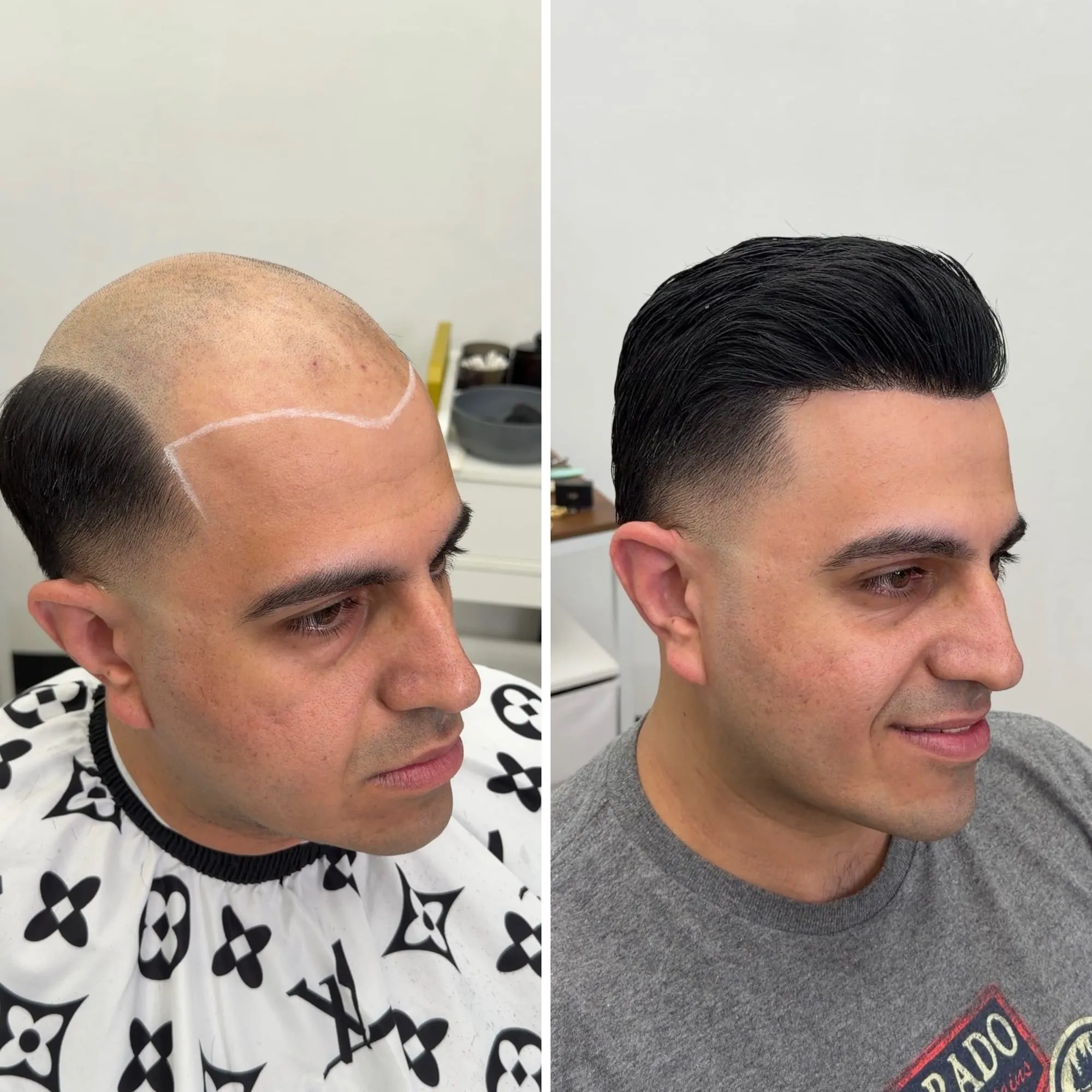
This is what it looks like.
A real client from our chair, photographed before and after his hair system was installed and cut in.
Questions, answered.
How is a practitioner consultation different from the client-side visit?
The client-side visit answers what to expect and what to ask. The practitioner side is the protocol you run to deliver that visit: leading discovery, reading the head, narrowing options to what fits, and setting expectations. Same appointment, different seat, different skill.
How long should a first consultation take?
Long enough to do all four moves properly and not feel rushed. Discovery and assessment cannot be compressed without losing the trust the rest depends on. Book enough time that a nervous first-timer never feels hurried, and protect that time on the calendar.
What if the client wants a price before I have assessed them?
Explain what the figure depends on rather than guess. Base construction, hair type, density, and service cadence all move value, so a real number needs a real spec. Walking through the drivers builds more trust than a number pulled from the air.
How do I handle something that looks medical?
Defer it. We cover the appearance of thinning cosmetically; we do not treat, cure, or diagnose. If a scalp condition, sudden change, or anything a doctor should see comes up, point the person to their physician or dermatologist first, then continue only with what is cosmetic.
Keep reading
Related guides.
How Long It Takes
A realistic timeline from your first hair replacement class to a confident, booked artist, plus the specific things that speed it up.
Pricing Framework
A pricing framework for barbers adding hair replacement: the factors that set install and maintenance fees, and how to build a menu that holds.
Reading the Order Form
Every field on a custom hair system order form explained in one place: base size, material, density, color, grey, curl, length, origin, and more.
Training
What hair replacement training for barbers covers, how classroom and mentorship fit together, and how to choose a program that builds a paying service.