

Last updated September 28, 2026
What a hair replacement certification actually covers
Certification is about the skills that sit next to barbering but are not the same craft. You already know how to cut hair. What a program adds is everything specific to fitting and finishing a hair unit so it reads as a man's own hairline in daylight, at the gym, and up close.
A serious curriculum works through the full client journey, not a single trick. If a course only shows you how to stick a unit down and stops there, it is teaching you the easiest ten percent of the job and skipping the part that keeps clients.
- Consultation and honest expectation-setting with a new client
- Templating and measuring a scalp for a stock or custom order
- Reading a spec sheet and ordering the right base, density, and color
- Cutting a lace or skin front into a believable, undetectable hairline
- Attachment methods, tape and adhesive selection, and safe removal
- Cut-in, blend, and styling so the unit matches the surrounding hair
- Maintenance, re-bonding, and when to replace a worn unit
Prerequisites: what you need before you enroll
Most reputable programs expect you to arrive with a cutting license already in hand, because the hands-on portion involves cutting hair and working on the scalp. The certification builds on that foundation rather than replacing it.
You do not need prior hair replacement experience to start. You do need to be honest about where your license lets you work, and you need a plan for a private space to deliver the service once you are trained.
- An active barbering or cosmetology license in your state
- Comfort with clippers, shears, and detail cutting
- A private, well-lit station you can use for installs and maintenance
- The willingness to practice on models before charging a client
Certification versus your state license
This is the point that confuses most barbers, so it is worth being precise. A certification is proof that a specific instructor watched you perform the skill and signed off. It is not a government license, and it does not by itself grant you the legal right to work on someone's head.
Your state board decides what your cosmetology or barbering license permits, and those rules vary by state. Confirm what your license already covers for cutting, scalp work, and adhesives before you take a paying client. Anything that crosses into a medical question, such as scalp conditions or a client asking about a diagnosis, belongs with a physician or dermatologist, not with you. Hair replacement covers the appearance of loss cosmetically. It does not treat, cure, regrow, or diagnose anything, and a good program will draw that line clearly.
What is included in a real program
Programs differ, and the differences are where your money goes to work or goes to waste. Look past the marketing and ask exactly what lands in your hands and how much supervised time you get on a real head. The elements below separate a course that makes you client-ready from a weekend that only makes you confident, which is a dangerous combination on a real hairline.
- Hands-on installs on live models, not only demonstrations or slides
- One-to-one feedback from an experienced instructor during your reps
- A starter kit of adhesive, tape, remover, and cutting tools you are trained on
- Practice hair units and bases to cut and template during class
- Written reference material for ordering, care, and troubleshooting
- A defined class size small enough that you get real chair time
- Post-course mentorship or a person you can send a photo to when a job goes sideways
Hands-on hours, models, and class size
The single best predictor of whether a certification made you ready is how much time you spent with your own hands on a real head while someone qualified corrected you. Passive hours watching a demo do not count the same way. When you ask about a program, ask how many models each student personally installs and cuts, not how many the instructor demonstrates on.
Small class sizes matter for the same reason. A tight group means more reps, more feedback, and a hairline you actually cut yourself before you cut a client's. At our studios in Peoria, AZ and Eighty Four, PA, Nico Rigano, Ivette Rigano, and Denisse Diaz keep the hands-on work close and supervised for exactly this reason. There is no universal number of hours that makes someone competent, and any program selling a fixed count as a guarantee is selling the wrong thing.
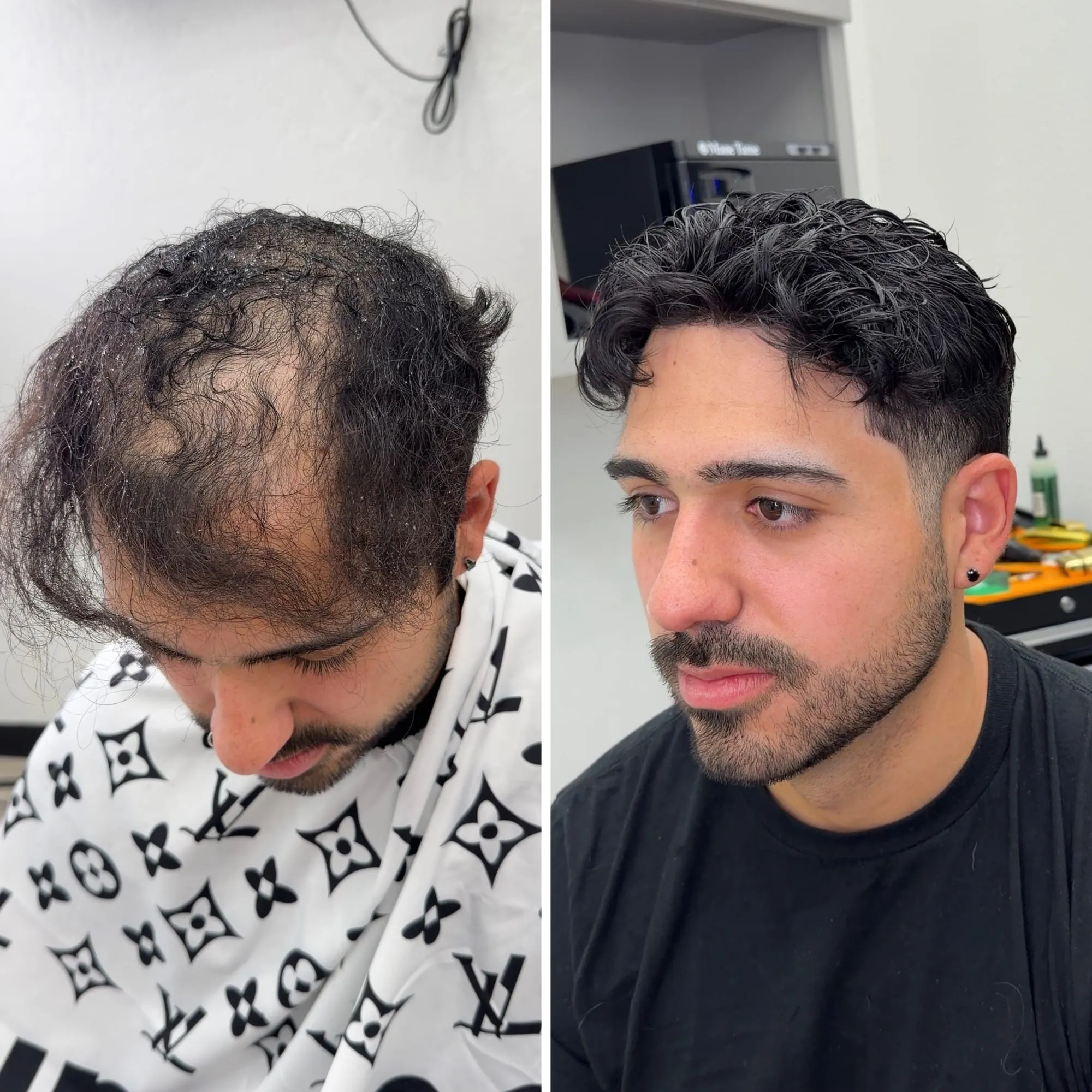
Real work
This is what it looks like.
A real client from our chair, photographed before and after his hair system was installed and cut in.
Questions, answered.
Do I need a cosmetology or barbering license to get certified?
In most cases yes, because the hands-on training involves cutting hair and working on the scalp. Requirements vary by state, so confirm what your license already covers before you enroll. Treat the license as the foundation and the certification as the skill layer built on top of it.
Is a hair replacement certification a legal license?
No. A certification proves an instructor watched you perform the skill and signed off. It is not issued by a state board and does not by itself grant the right to work on a client. Your state license governs what you are legally allowed to do, so check both.
How long does certification take?
It depends on the program format and how much supervised hands-on time is built in, not on a fixed calendar. Some courses run over a focused stretch of days, others space training out with mentorship in between. The goal is competence you can prove on a real head, not a number of hours on a certificate.
Do I practice on real models or only mannequins?
A strong program puts you on live models, because a mannequin cannot show you how a lace front sits against real skin, how a client's growth pattern blends, or how tension feels during attachment. Mannequins are useful for early drills. Live models are what make you client-ready.
Is a kit included, or do I buy tools separately?
It varies by program. The better ones include a starter kit of adhesive, tape, remover, and cutting tools you are trained to use, plus practice units and bases. Always ask exactly what is included so you know what you still need to source before your first paying client.
Can certification teach me to treat hair loss?
No, and any program claiming otherwise should be a red flag. Hair replacement covers the appearance of loss cosmetically. It does not treat, cure, regrow, or diagnose. Anything medical, including scalp conditions or a client's questions about a diagnosis, belongs with a physician or dermatologist.
What should I ask before paying for a program?
Ask how many models each student personally installs and cuts, how small the class is, what lands in your kit, and whether there is mentorship after the course. Ask to see real before-and-after work from graduates. The answers to those questions tell you more than the price ever will.
Will certification alone make me ready for clients?
It is a strong start, but readiness comes from reps and honest feedback, not the certificate itself. Plan to install your first clients slowly, document everything with permission, and lean on mentorship for your early cut-ins. Competence you can demonstrate is what earns trust in a local market.
Keep reading
Related guides.
Certification
What non-surgical hair replacement certification covers for barbers, what it proves, and how it de-risks adding hair systems to your chair.
How to Become a Hair Replacement Artist
The path from barber to hair replacement artist: the skills, the training, and how to add hair systems as a high margin service line.
Training
What hair replacement training for barbers covers, how classroom and mentorship fit together, and how to choose a program that builds a paying service.
Licensing
Do you need a license to do hair replacement? What barbers and stylists should know about requirements in Arizona, Pennsylvania, and beyond.